

On this page
In senior secondary mathematics, the most common mistakes in linear programming problems (LPP) rarely happen while drawing lines. According to the NCERT Class 12 mathematics curriculum, an LPP requires translating verbal business conditions into decision variables, linear constraints, and non-negative restrictions (x ≥ 0, y ≥ 0). Graphing lines and evaluating corner points is mechanical arithmetic. The true hurdle is mathematical formulation: turning descriptive English sentences into a complete system of linear inequalities.
Why do students and AI models struggle to formulate LPP constraints?
When reading a word problem, you must simultaneously identify unknown targets, group resources, and pick the correct inequality signs. Reversing a single sign flips the feasible region into the wrong half-plane, invalidating the solution before graphing begins.
AI models face the exact same translation hurdle. In the NeurIPS NL4Opt benchmark, Ramamonjison and colleagues (2023) tested how language models extract optimization formulations from text. Evaluated zero-shot, ChatGPT achieved a declaration-level mapping accuracy of 0.927 (92.7%), outperforming competition baselines by 2.8 percentage points. Yet the researchers noted that models frequently fail by omitting constraints mentioned in the prompt, inventing phantom constraints, or flipping "at most" (≤) and "at least" (≥). Asking an AI for an immediate solution often conceals these errors behind neat algebra.
What prompt forces an AI to match each constraint to a sentence?
Pasting a word problem and asking "Solve this" bypasses active learning. To use AI effectively, prompt it to map the text before calculating anything. This mirrors the technique of using AI to turn maths word problems into equations through sentence-by-sentence parsing.
Use this prompt:
"Read this linear programming word problem. Do not calculate the numerical answer yet. Instead:
Name the decision variables (x and y) with their units.
State the objective function (Maximize or Minimize Z) and quote the sentence defining it.
List every constraint inequality, quoting the verbatim sentence that defines it directly underneath. Include non-negativity restrictions."
How do you verify that every constraint has a matching sentence?
Once the AI generates its breakdown, audit the output with a four-point check:
Coverage: Read each sentence of the problem. Does every stated limit, quota, or budget appear as an inequality? If a number is missing, the AI dropped a constraint.
Hallucination: Check that every generated inequality traces back to an actual sentence. Strike out any condition the AI invented without text support.
Direction: Verify inequality keywords. Words like "at most", "maximum", and "capacity" demand ≤. Phrases like "at least" and "minimum" demand ≥.
Units: Ensure coefficients and limits share identical units, converting minutes to hours or kilograms to grams where necessary.
How does the sentence-matching method work on a real exam problem?
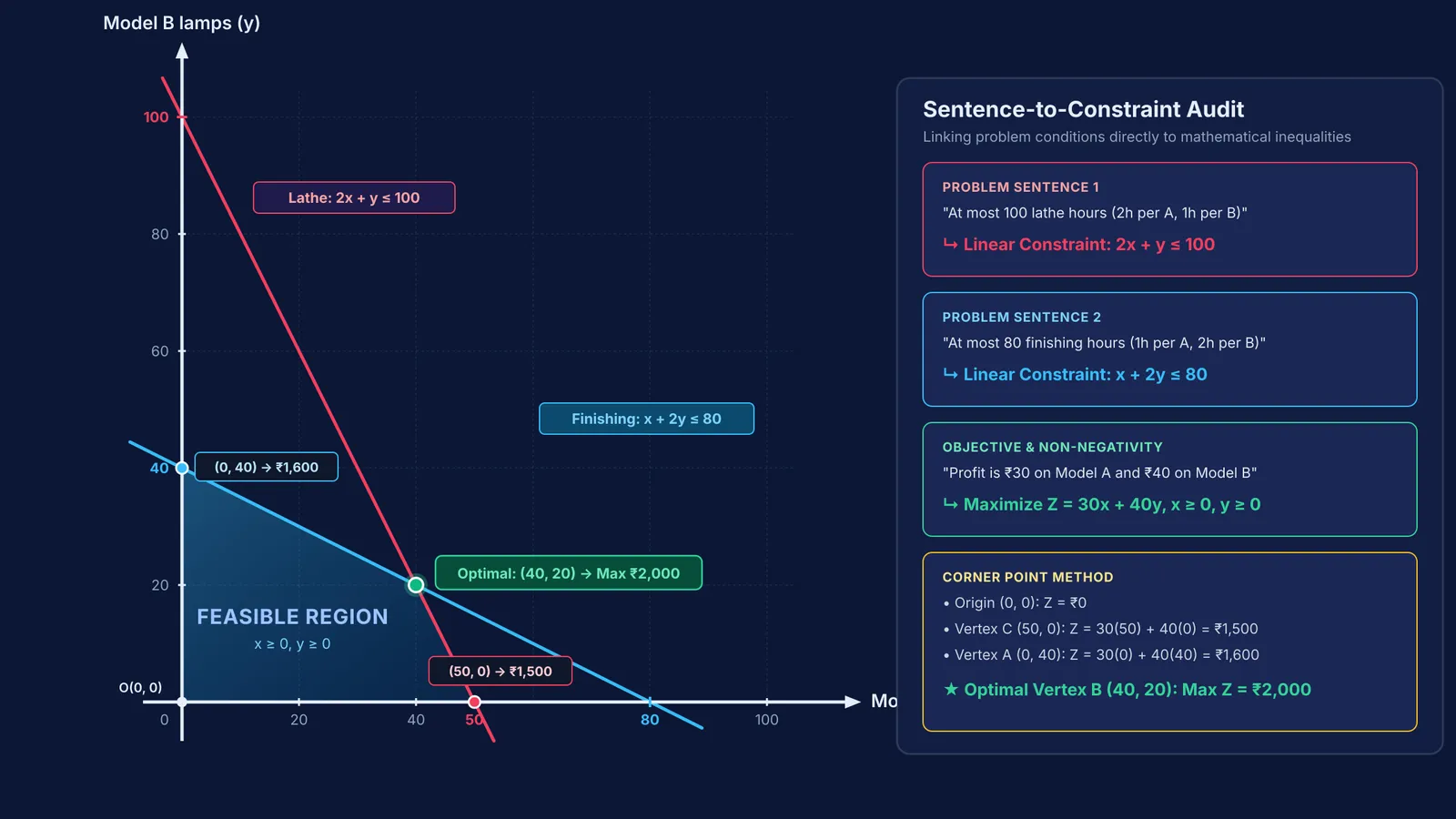
Take a classic manufacturing problem: A workshop makes Model A and Model B lamps. Each Model A requires 2 hours of lathe work and 1 hour of finishing. Each Model B requires 1 hour of lathe work and 2 hours of finishing. The workshop has at most 100 lathe hours and at most 80 finishing hours available monthly. Profit is ₹30 on Model A and ₹40 on Model B.
The prompt produces this verified structure:
Variables: Let x be monthly Model A lamps and y be Model B lamps.
Objective: Maximize Z = 30x + 40y (Sentence: Profit is ₹30 on Model A and ₹40 on Model B).
Lathe constraint: 2x + y ≤ 100 (Sentence: 2 hours for Model A, 1 hour for Model B, at most 100 lathe hours).
Finishing constraint: x + 2y ≤ 80 (Sentence: 1 hour for Model A, 2 hours for Model B, at most 80 finishing hours).
Non-negativity: x ≥ 0, y ≥ 0 (Quantities cannot be negative).
With constraints verified against the text, identifying the feasible region and corner points is straightforward. Boundary lines intersect at (40, 20), yielding a maximum profit of ₹2,000. Checking slopes also confirms when an LPP has infinitely many solutions, since the objective slope (-0.75) lies strictly between the boundary slopes (-2 and -0.5).
When should you bring an AI tutor into your maths revision?
Using an AI to bypass the translation stage weakens your exam performance. Instead, use AI to audit your reasoning. Fermi's AI tutor teaches rather than answers: it holds a line of reasoning across a session, notices where a student is stuck, and decides whether to explain, ask or show. If you flip an inequality sign, the tutor prompts you to re-read the sentence rather than printing the correction. For broader practice, the Fermi Problem Library offers worked problems with a step-by-step solver that explains the reasoning rather than printing an answer. Linking every inequality to a sentence turns LPP formulation into a reliable, verifiable habit.


