

On this page
Many linear programming mistakes happen before any arithmetic: a half-plane shaded the wrong way, or a corner missed. The fix is to predict as you go: guess the shape as you shade, and guess which corner wins before you calculate.
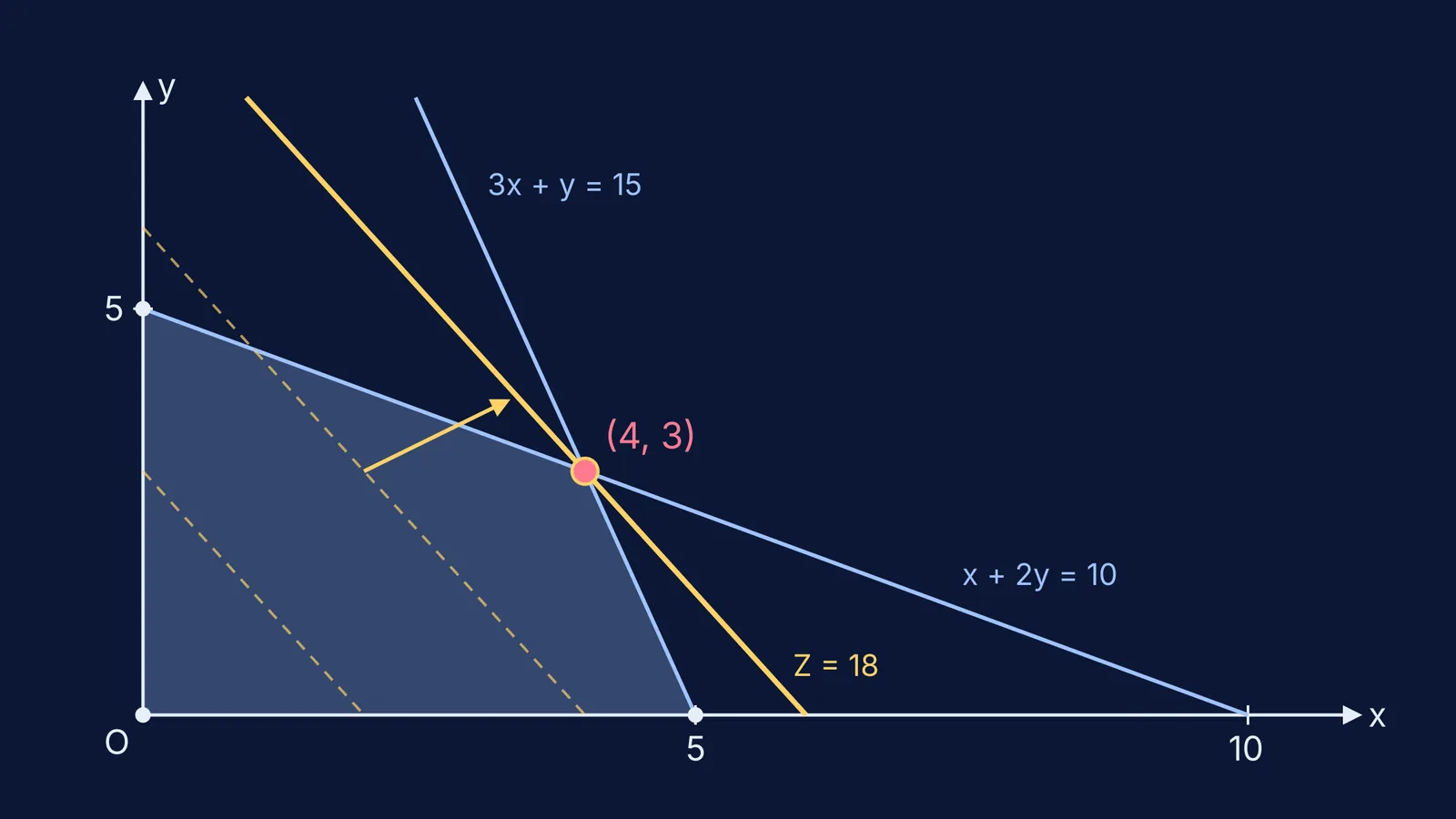
We will use one problem: maximise Z = 3x + 2y subject to x + 2y ≤ 10, 3x + y ≤ 15, x ≥ 0 and y ≥ 0.
What is the feasible region in linear programming?
The feasible region is the part of the plane where all the inequalities hold together. Build it in this order:
Shade x ≥ 0 and y ≥ 0. You are now in the first quadrant, and the region stays there.
Draw x + 2y = 10 through (0, 5) and (10, 0). Test the origin: 0 ≤ 10 is true, so keep the side containing (0, 0). The region is now a triangle.
Draw 3x + y = 15 through (0, 15) and (5, 0). The origin passes again (0 ≤ 15), so keep its side. Predict before you shade: this steep line cuts off the right-hand tip of the triangle, leaving a four-sided shape.
It does. The feasible region is the quadrilateral O(0, 0), A(5, 0), B, C(0, 5). For a refresher on the half-plane test, see our guide to solving and graphing linear inequalities in Class 11.
How do you find the corner points of the feasible region?
Three corners sit on the axes. Corner B is where the two slanted lines cross, so solve them together. From 3x + y = 15, y = 15 − 3x. Substituting into x + 2y = 10 gives x + 30 − 6x = 10, so x = 4 and y = 3. B is (4, 3); check: 4 + 6 = 10 and 12 + 3 = 15.
Why is the maximum always at a corner point?
The rule you use in exams is the fundamental theorem of linear programming: if a linear programming problem has a solution, the solution always occurs at a corner point (LibreTexts, Linear Programming).
The sliding line shows why. Every point on 3x + 2y = 6 gives Z = 6; the lines for Z = 12 and Z = 18 are parallel to it, further from the origin. Slide a ruler at that slope outwards. Z grows as it moves, and the last point of the region it touches is a corner (or a whole edge, if the ruler lies along one). Here that is B. Evaluate Z at every corner to confirm:
O(0, 0): Z = 0
A(5, 0): Z = 15
B(4, 3): Z = 18
C(0, 5): Z = 10
The maximum is 18 at (4, 3), as predicted.
Can you predict the winning corner without calculating?
Yes, by comparing slopes. For Z = ax + by, the objective line has slope −a/b. The edges meeting at B have slopes −1/2 (x + 2y = 10) and −3 (3x + y = 15). B wins when the objective line is steeper than the first edge and flatter than the second, which means a/b lies between 1/2 and 3. For Z = 3x + 2y, a/b = 1.5, so B wins.
Try the rule before checking:
Z = x + 3y: a/b = 1/3, flatter than both edges, so the ruler leaves at C(0, 5). Check: Z = 15 at C, 13 at B.
Z = 4x + y: a/b = 4, steeper than both, so it leaves at A(5, 0). Check: Z = 20 at A, 19 at B.
Z = x + 2y: a/b = 1/2 exactly, parallel to the edge BC. Z = 10 at both B and C, so every point on that edge is a maximum.
More examples: our walkthrough of the corner point method for CBSE Class 12.
Why predict before you check?
In a study of classroom physics demonstrations, Crouch, Fagen, Callan and Mazur found that students who only watched understood the underlying concepts no better than students who did not see the demonstration at all, while students who predicted the outcome first showed significantly greater understanding (Crouch et al., American Journal of Physics, 2004). That study was about physics demonstrations, not graphs, but the habit carries over: a prediction gives you something to check, so a wrong shading or a missed corner shows up quickly.
A routine for every question:
Shade one constraint at a time, predicting the shape.
List every corner, solving pairs of lines that meet.
Predict the winning corner from the slope, then check with Z at every corner.
Graphing apps help with shading and sliding if you predict first; see our guide to using graphing tools to learn, not to skip. The Fermi Simulation Lab has interactive simulations for ideas that are easier to see than to read. If a method keeps going wrong, the Fermi Problem Library has worked problems with a step-by-step solver that explains the reasoning rather than printing an answer.


