

On this page
Limiting reagent questions look easy until the amounts are uneven. A free simulation such as PhET's Reactants, Products and Leftovers lets you choose how many molecules of each reactant to mix, then shows the products and leftovers.
What is a limiting reagent?
The limiting reagent is the reactant that is used up first, so it limits the amount of product formed (NCERT Class 11 Chemistry, Unit 1). Every other reactant is in excess, and whatever is not used is the leftover. For what an equation's coefficients do and do not tell you, see what a balanced chemical equation gives and its limitations.
The common trap is to pick the reactant you have least of. In a survey of 97 Thai Grade 10 and 11 students, Chanyah Dahsah and Richard Coll found students who took the limiting reagent to be the smallest amount of reactant, read mole ratios as mass ratios, or assumed every ratio was 1:1 (Research in Science & Technological Education, 2007).
Laure Gauchon and Martine Méheut found another strong idea among Grade 10 students: that both reactants are fully used up, whatever their proportions, especially when the reactants are in the same physical state (Chemistry Education Research and Practice, 2007).
What can you change in a limiting reagent simulation?
PhET's teacher guide describes three screens: Sandwiches, where you set a recipe and count the sandwiches; Molecules, with three reactions (make water, make ammonia, combust methane); and a Game that asks you for missing numbers of molecules (PhET Tips for Teachers). The guide notes that many students at first entered only the amounts that gave zero leftovers, so choose uneven amounts on purpose.
The rule you will test: divide each reactant's count by its coefficient in the balanced equation. The smallest result marks the limiting reagent. With whole molecules, round it down to get how many times the reaction runs.
What should you predict before pressing go?
For each round, write which reactant runs out, how much of each product forms, and what is left. Then run it.
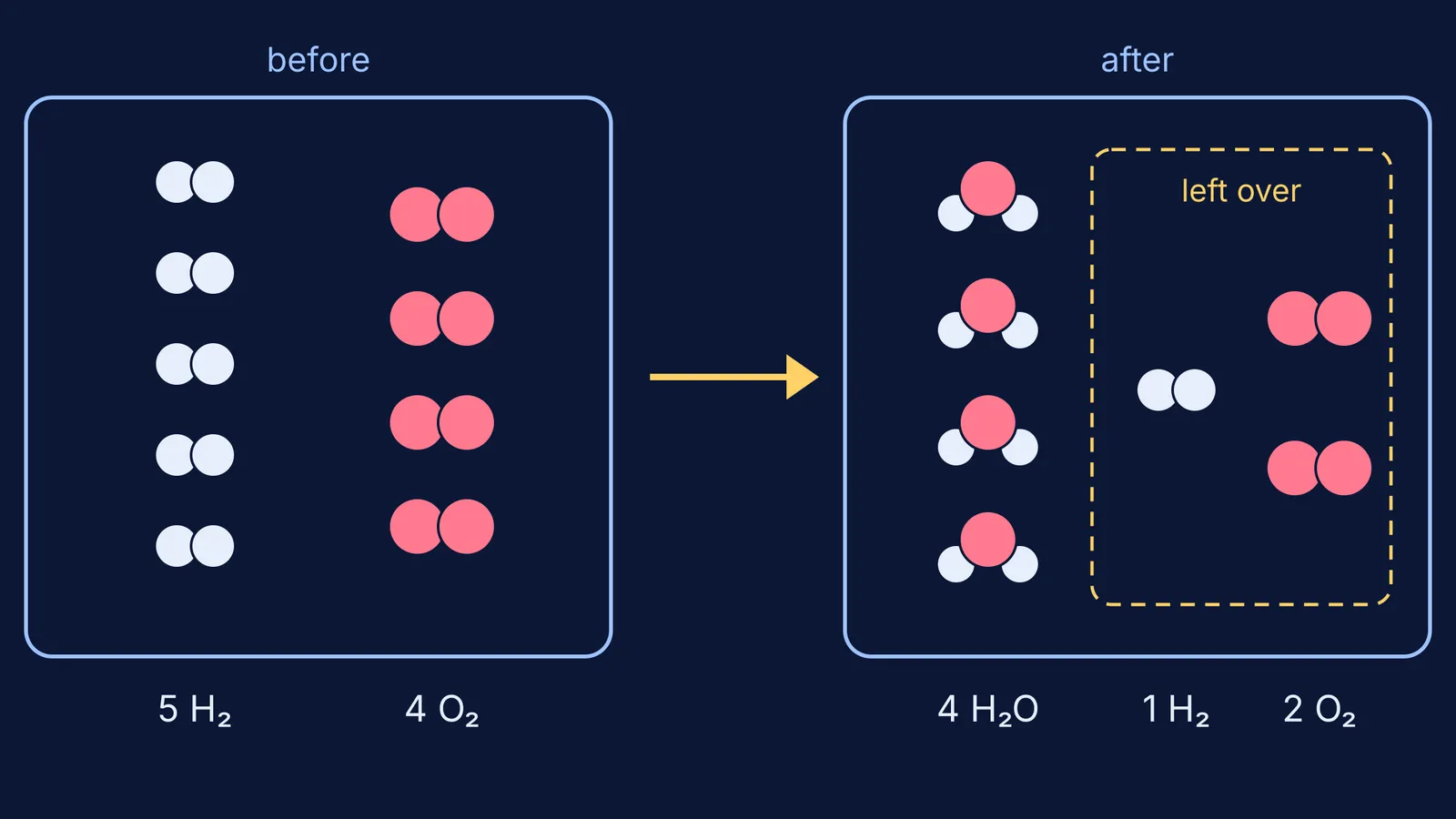
Make water, 2H₂ + O₂ → 2H₂O, with 5 H₂ and 4 O₂.
Make ammonia, N₂ + 3H₂ → 2NH₃, with 3 N₂ and 6 H₂.
Combust methane, CH₄ + 2O₂ → CO₂ + 2H₂O, with 4 CH₄ and 5 O₂.
Make ammonia with 2 N₂ and 2 H₂.
Answers. Round 1: H₂ gives 5 ÷ 2 = 2.5 and O₂ gives 4 ÷ 1 = 4, so H₂ limits and the reaction runs twice: 4 H₂O, with 1 H₂ and 2 O₂ left. Round 2: H₂ gives 6 ÷ 3 = 2, N₂ gives 3, so 4 NH₃ form and 1 N₂ is left. Round 3: O₂ gives 2.5, so the reaction runs twice: 2 CO₂ and 4 H₂O, with 2 CH₄ and 1 O₂ left. Round 4: H₂ gives 2 ÷ 3, less than one, so nothing forms; each Game level has one question like this.
Why is the smaller mass not always the limiting reagent?
Reactants have different molar masses, so grams do not compare the way molecules do. Take 2H₂ + O₂ → 2H₂O with 4 g of H₂ and 16 g of O₂. Use 2 g/mol for H₂ and 32 g/mol for O₂; NCERT's worked examples use 2.016 g/mol and 32 g/mol (NCERT Class 11 Chemistry, Unit 1).
Moles: H₂ = 4 ÷ 2 = 2 mol; O₂ = 16 ÷ 32 = 0.5 mol.
Divide by coefficients: H₂ gives 2 ÷ 2 = 1; O₂ gives 0.5 ÷ 1 = 0.5. O₂ is limiting, even though you have more of it by mass.
Product: 0.5 mol O₂ makes 2 × 0.5 = 1 mol H₂O, which is 18 g.
Leftover: 1 mol of H₂ is used, so 1 mol (2 g) of H₂ is left.
With moles, the limiting reagent is used up completely. The stray H₂ in Round 1 is there because the sim counts molecules, not moles, as the PhET guide notes; it suggests asking what would change if the numbers were moles. For unit slips, see the mistakes to check in mole concept numericals.
Why predict before you run the simulation?
In a study of physics lecture demonstrations, Catherine Crouch, Eric Mazur and colleagues found that students who only watched understood the concept no better than those who did not see the demonstration, while students who predicted the outcome first showed significantly greater understanding (American Journal of Physics, 2004). A simulation is a demonstration you control, so the same habit is worth trying. Simulations also simplify; see the limits of simulations and how to learn from them.
For more ideas to try this way, the Fermi Simulation Lab has interactive simulations for ideas that are easier to see than to read. When a written problem goes wrong, the Fermi Problem Library has worked problems with a step-by-step solver that explains the reasoning, so you can find the step where the mole ratio slipped.
Tonight, pick one reaction, set uneven amounts, and write your three predictions before you press go.


