On this page
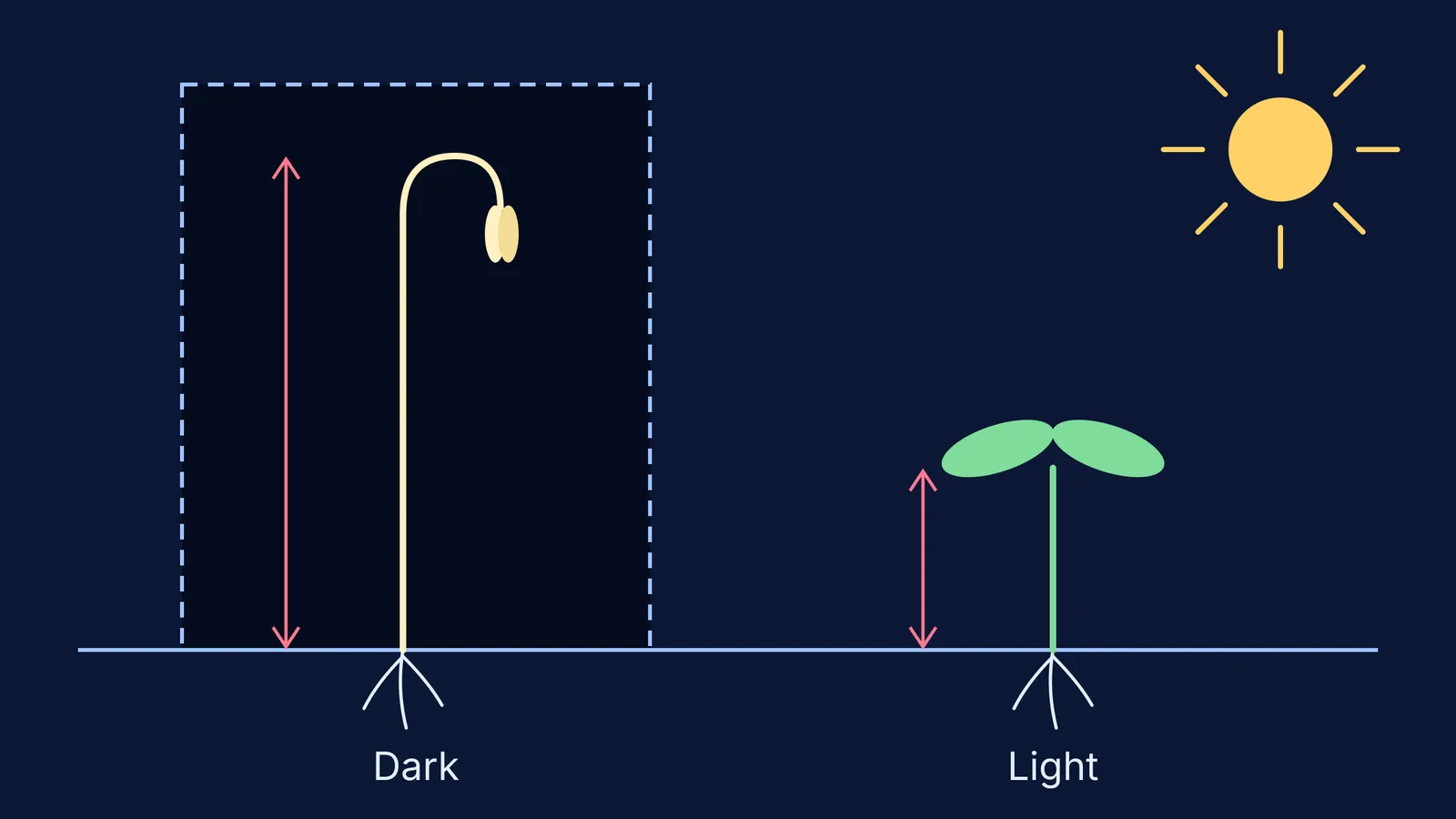
Put one sprouting seed in a dark box and another on a bright windowsill. Before reading on, write down which will be taller after a week. Many people pick the lit one, because light feeds plants. The dark one usually wins on height and loses on almost everything else.
Do plants grown in the dark grow taller?
Usually, yes, at first. A seedling that germinates in darkness follows a programme called skotomorphogenesis, or etiolation: a long stem below the seed leaves (the hypocotyl), a hook at the tip, closed seed leaves, and no chlorophyll or working chloroplasts, as described in a 2019 review of phytochrome research in the International Journal of Molecular Sciences. The purpose: a buried seedling stretches upward, tip folded into a hook, until it reaches the soil surface and light.
How fast is it? In a 2022 study in Frontiers in Plant Science, the average length of dark-grown Arabidopsis seedlings almost doubled between day 2 and day 4, quickly passing 10 mm, and reached about 30 mm by day 12. The same team concluded that etiolation of these seedlings should not extend beyond 6 days, because longer growth in the dark rapidly makes them more likely to die.
Why does a seedling in the dark grow tall and yellow?
To a seedling, light carries information as well as energy. Plants sense red and far-red light with proteins called phytochromes. In darkness, proteins called PIFs build up in the cell nucleus and keep the etiolated programme running; when light arrives, phytochromes move into the nucleus and the PIFs are broken down, which switches on light-grown development, according to the same phytochrome review. Once the seedling reaches light, stem elongation stops, the seed leaves open and functional chloroplasts develop.
The extra height comes from longer cells, not more of them. A 1997 Plant Physiology study of the Arabidopsis hypocotyl found that the stem lengthens without significant division of its epidermal or cortical cells; the cells themselves stretch.
The pale colour has its own cause. In flowering plants, one step in making chlorophyll is carried out by an enzyme called POR, and it is the only light-dependent reaction in the whole pathway, as a 2000 Plant Physiology paper on etioplasts explains. Without light, that step cannot run, so the seedling stays yellow instead of turning green. For a recap with all the terms, read our explainer on why seedlings grown in the dark are tall and yellow.
How do you test it at home in a week?
Long darkness weakened Arabidopsis seedlings in the 2022 Frontiers study, so plan a short run of about 6 days.
Soak 12 moong (green gram) seeds in water overnight.
Line two identical cups with wet tissue or cotton and place 6 seeds in each.
Put one cup inside a closed cardboard box or cupboard. Put the other in a bright spot out of harsh direct sun, so it does not dry out.
Keep both cups in the same room, so the temperature matches, and give both the same amount of water each day.
Before day 1, write your prediction: which cup will have taller stems, and what colour will each be?
Each evening, measure every stem in millimetres from the seed to its highest point, and note colour, whether the tip is hooked and whether the seed leaves have opened. Check the dark cup quickly.
For a younger sibling, our two-week seed germination plan for kids shows a gentler set-up.
How do you compare stem length and colour fairly?
Average, do not pick: add the stem lengths in one cup and divide by the number of seedlings, so one odd seedling does not decide the result.
Compare the ratio: divide the dark average by the light average. Above 1 means the dark seedlings are taller.
Use a colour scale of yellow, pale green and green, agreed before you start.
Record shape too: hook bent or straight, seed leaves closed or open.
End with one sentence linking result to cause: the dark seedlings were taller and yellow because, without light, they kept stretching and could not finish making chlorophyll.
Then try the twist: move the dark cup into the light for a day or two, and predict what changes before you look. Watch for the hook straightening and the colour shifting towards green.
What happens if light comes from one side?
The stem bends towards it instead of simply stretching. That is phototropism, which you can follow in our phototropism simulation of how auxin bends a growing shoot. For other ideas that are easier to see than to read, the Fermi Simulation Lab has interactive simulations. If phytochromes and PIFs still feel like a list of names, the Fermi Concept Library gives each biology concept its own lesson and its place in the map.
Set up your two cups tonight, and write your prediction down first.