

On this page
A sealed flask of nitrogen dioxide is a good place to test Le Chatelier's principle because you can see the two gases apart: NO₂ is brown and N₂O₄ is colourless, as the NCERT Class 11 chemistry chapter on equilibrium notes. Below, we disturb one equilibrium mixture three times. Before each step, write down your prediction: which way will it shift, and will K change?
What does Le Chatelier's principle say?
NCERT states that a change in any of the factors that determine the equilibrium conditions of a system "will cause the system to change in such a manner so as to reduce or to counteract the effect of the change" (NCERT Chemistry Part 1, section 6.8).
The principle tells you the direction, but not by how much. For numbers, compare the reaction quotient Q with K. If Q is less than K, the reaction runs forward. If Q is greater than K, it runs backward. The same chapter makes the point that matters most in exams: a change in concentration, pressure or volume makes Q differ from K, while a change in temperature changes the value of K itself.
Which reaction are we testing?
We use N₂O₄ ⇌ 2NO₂ in a closed 1 L flask. The forward reaction is endothermic. NCERT gives ΔH = −57.2 kJ/mol for the reverse reaction, in which 2NO₂ forms N₂O₄. The NIST-JANAF values for NO₂ and N₂O₄ give ΔH = +57.1 kJ/mol and ΔS = +176 J/(mol K) for the forward direction. From these, Kc = [NO₂]²/[N₂O₄] comes out at about 0.0060 mol/L at 25 °C.
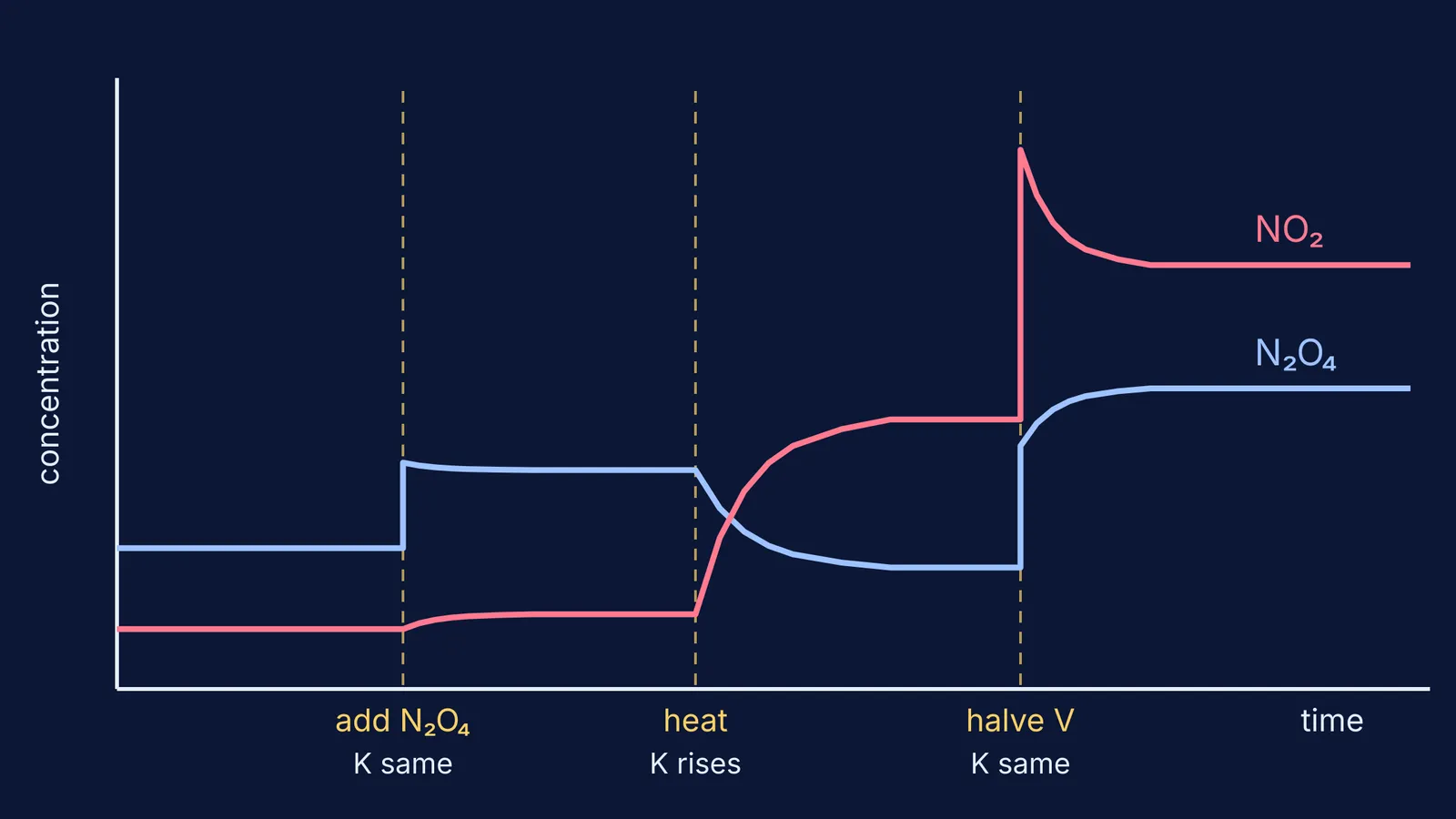
Start with 0.0400 mol/L of N₂O₄ at 25 °C. It settles at [N₂O₄] = 0.0330 and [NO₂] = 0.0140 mol/L. Now make three changes.
What happens when you add more reactant?
Predict: you inject extra N₂O₄, raising its concentration by 0.0200 mol/L. Which way does the reaction go, and does K change?
Check: just after the addition, [N₂O₄] = 0.0530, so Q = 0.0140² / 0.0530 = 0.0037. That is below Kc (0.0060, from the NIST-JANAF data), so the reaction runs forward. It settles at [N₂O₄] = 0.0513 and [NO₂] = 0.0175 mol/L, and Kc is still 0.0060.
Notice how small the shift is. Only 0.0017 mol/L of the extra 0.0200 reacts. The system reduces the change but does not undo it. If your simulation shows most of the added reactant disappearing, recheck your Q.
Does heating change the equilibrium constant?
Predict: you warm the sealed flask from 25 °C to 75 °C without changing its volume.
Check: this time K itself moves. NCERT's rule is that K rises with temperature for an endothermic reaction (positive ΔH) and falls for an exothermic one. With the NIST-JANAF values, assuming ΔH and ΔS stay constant, Kp goes from about 0.15 at 25 °C to about 4.1 at 75 °C, roughly 27 times larger. Kc goes from 0.0060 to 0.140 mol/L. Heating changes no concentration at the moment it happens, but Q is now far below the new K. The mixture shifts forward to [N₂O₄] = 0.0284 and [NO₂] = 0.0631 mol/L, and the flask turns a deeper brown.
A quick way to remember it: in an endothermic reaction, treat heat as a reactant. Adding heat pushes the reaction forward, and the larger K records that.
What does compressing a gas equilibrium do?
Predict: at 75 °C you push the piston in and halve the volume.
Check: every concentration doubles at once, to 0.0569 mol/L of N₂O₄ and 0.1262 mol/L of NO₂. Because [NO₂] is squared in the expression, Q doubles too: Q = 0.280, twice Kc. The reaction runs backward, towards fewer gas molecules (two become one), as NCERT's section on pressure predicts. It settles at [N₂O₄] = 0.0704 and [NO₂] = 0.0993 mol/L, with Kc unchanged at 0.140 (from the NIST-JANAF data).
[NO₂] is still higher than the 0.0631 mol/L it had before the squeeze. So the colour darkens sharply, then fades only part of the way back.
How do you practise this with a simulation?
The hard part of this topic is picturing a sudden jump followed by a slow settle, and a simulation shows that well. Use this routine for any equilibrium you meet:
Write the equation, the sign of ΔH and the number of gas moles on each side.
Before you change anything, write down which way it will shift and whether K changes.
Make one change at a time. Note the instant jump separately from where things settle.
Calculate Q right after the change and compare it with K.
If your prediction was wrong, name the step in your reasoning that failed.
You can run this predict-then-check loop in the Fermi Simulation Lab, a set of interactive simulations for ideas that are easier to see than to read. If a step still doesn't make sense, Fermi's AI tutor can run the simulation with you and check your understanding as it goes.
To go further with this reaction, read why NO₂ dimerises to N₂O₄, why a catalyst leaves the equilibrium constant unchanged and how the Haber process balances temperature, pressure and yield.


