

On this page
Picture a 5 m ladder leaning on a wall. You pull its foot away at a steady 1 m/s. Before reading on, predict: does the top slide down at 1 m/s too, slower, or faster? And does that speed stay the same as the ladder falls?
The hero diagram and implicit differentiation both say: not steady at all.
What does the sliding ladder animation show?
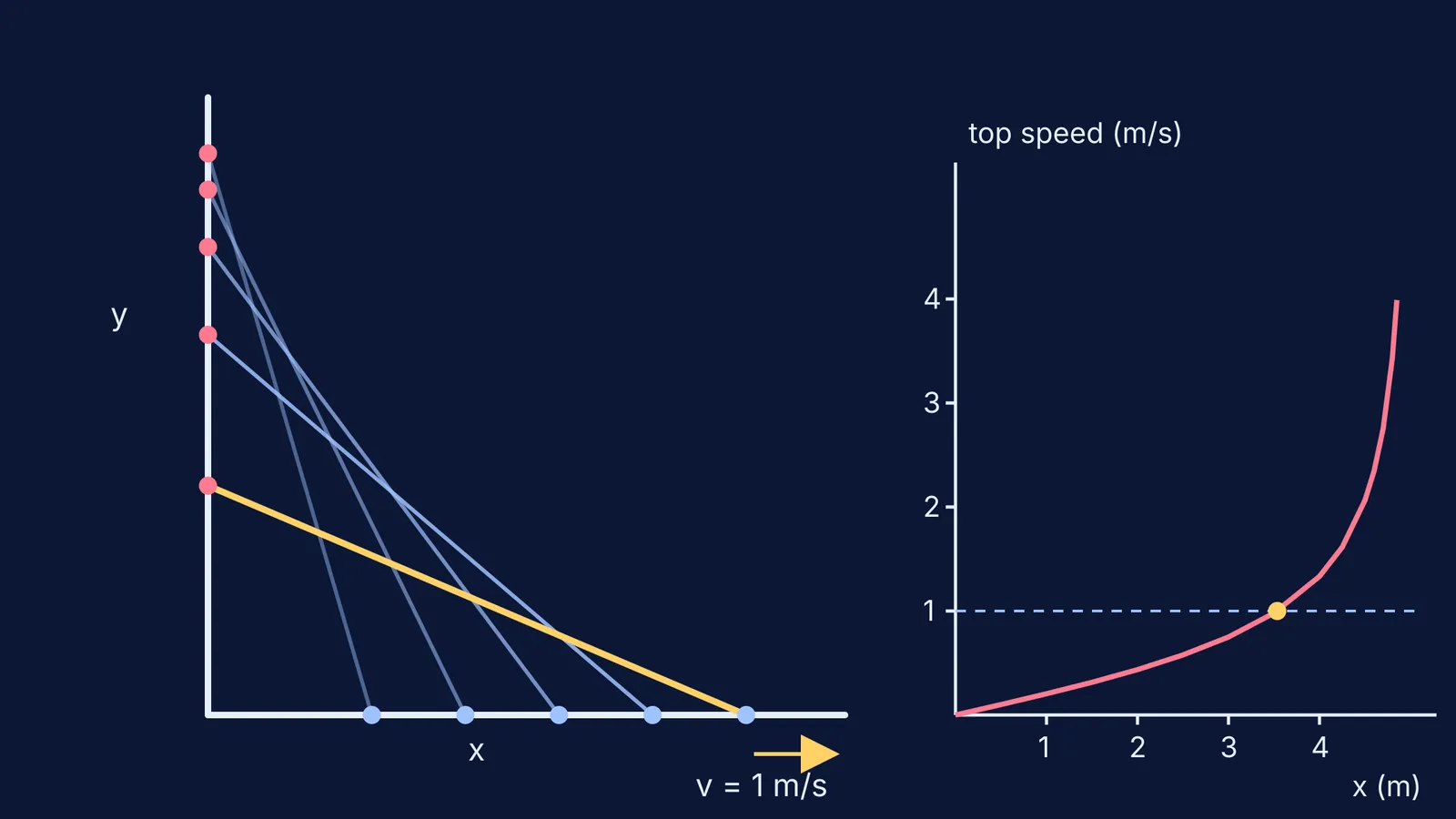
In the hero diagram, the five ladders are frames of a sliding-ladder animation taken at equal time intervals, so the foot moves the same 0.8 m between each one. Each height comes from x² + y² = 25, the Pythagoras setup of OpenStax's ladder exercise. Watch the red dots on the wall. The top drops by about 0.31 m, then 0.49 m, then 0.75 m, then 1.29 m. Same pull at the bottom, bigger and bigger drops at the top. Say that in words before you write a single derivative.
How fast does the top of a sliding ladder fall?
The five-step method in OpenStax Calculus Volume 1, section 4.1 on related rates fits this problem exactly: assign symbols and draw a figure, state what is given and what you want, find an equation linking the variables, differentiate with respect to time using the chain rule, then substitute.
Let x be the distance of the foot from the wall and y the height of the top. Both change with time t. The length L = 5 m does not.
Given: dx/dt = 1 m/s. Wanted: dy/dt.
Pythagoras: x² + y² = L².
Differentiate both sides with respect to t: 2x(dx/dt) + 2y(dy/dt) = 0, because L is constant.
Solve: dy/dt = -(x/y)(dx/dt).
The minus sign says y is shrinking. The factor x/y grows as the ladder falls.
Worked example: a 5 m ladder pulled at 1 m/s
When x = 1.4 m, y = 4.8 m, so the top falls at 1.4/4.8, about 0.29 m/s.
When x = 3 m, y = 4 m, so the top falls at 0.75 m/s.
When x = y, about 3.54 m each (a 45° ladder), the top falls at exactly 1 m/s.
When x = 4 m, y = 3 m, so the top falls at about 1.33 m/s.
When x = 4.8 m, y = 1.4 m, so the top falls at about 3.43 m/s.
The graph in the hero image plots this formula; the yellow dot marks the 45° crossing. Use it as a check: if your formula does not give equal speeds at 45°, recheck your signs.
Why does the maths say the top falls infinitely fast?
As y heads to zero, x/y blows up: the well-known falling ladder paradox. In The Falling Ladder Paradox Revisited, Burke, Jackson and Kifowit explain in The College Mathematics Journal that a real ladder whose foot moves at constant speed will come away from the wall at some point, after which it falls like a pendulum whose pivot moves along the ground. Their model, which treats the ladder as a uniform rod and ignores air resistance, gives the height where contact is lost as the cube root of 2L²v²/(3g).
Put in L = 5 m, v = 1 m/s and g = 9.8 m/s², and that height works out to about 1.2 m. So for our ladder, the related rates answer holds from the start down to roughly 1.2 m above the floor, where the top is moving at about 4 m/s. Below that, the wall no longer guides it and the formula no longer describes it.
A habit for JEE Main, JEE Advanced and board exams: after any answer, ask what the model assumed.
How should you use an animation to learn related rates?
Evidence from physics lectures suggests predicting first matters. Crouch, Fagen, Callan and Mazur (American Journal of Physics, 2004) found that students who passively watched classroom demonstrations understood the underlying ideas no better than students who did not see them, while students who predicted the outcome before watching showed significantly greater understanding.
A five-minute routine for this problem:
Write your guess for the top's speed at three moments: near the start, at 45° and near the floor.
Run the animation and check each guess.
Derive dy/dt = -(x/y)(dx/dt) on paper without looking.
Plug in the three positions and compare with what you saw.
Change one thing, such as a longer ladder, and predict again before you run it.
If ideas like this are easier to see than to read, the Fermi Simulation Lab has interactive simulations for them; predict before you run one. When the derivation is where you get stuck, the Fermi Problem Library has worked problems with a step-by-step solver that explains the reasoning rather than printing an answer.
For more practice, try our four-step method for related rates problems, see how the velocities of a sliding ladder's ends and midpoint connect, or revisit the derivative as the slope of a tangent if dy/dt still feels abstract.


