On this page
A ladder leaning against a wall is a classic statics problem. Set it up too steeply, and you might tip backwards. Set it too wide, and the base slides out from under you. Finding the exact angle where slipping begins relies on balancing forces, friction and torque.
When does a ladder leaning against a wall slip?
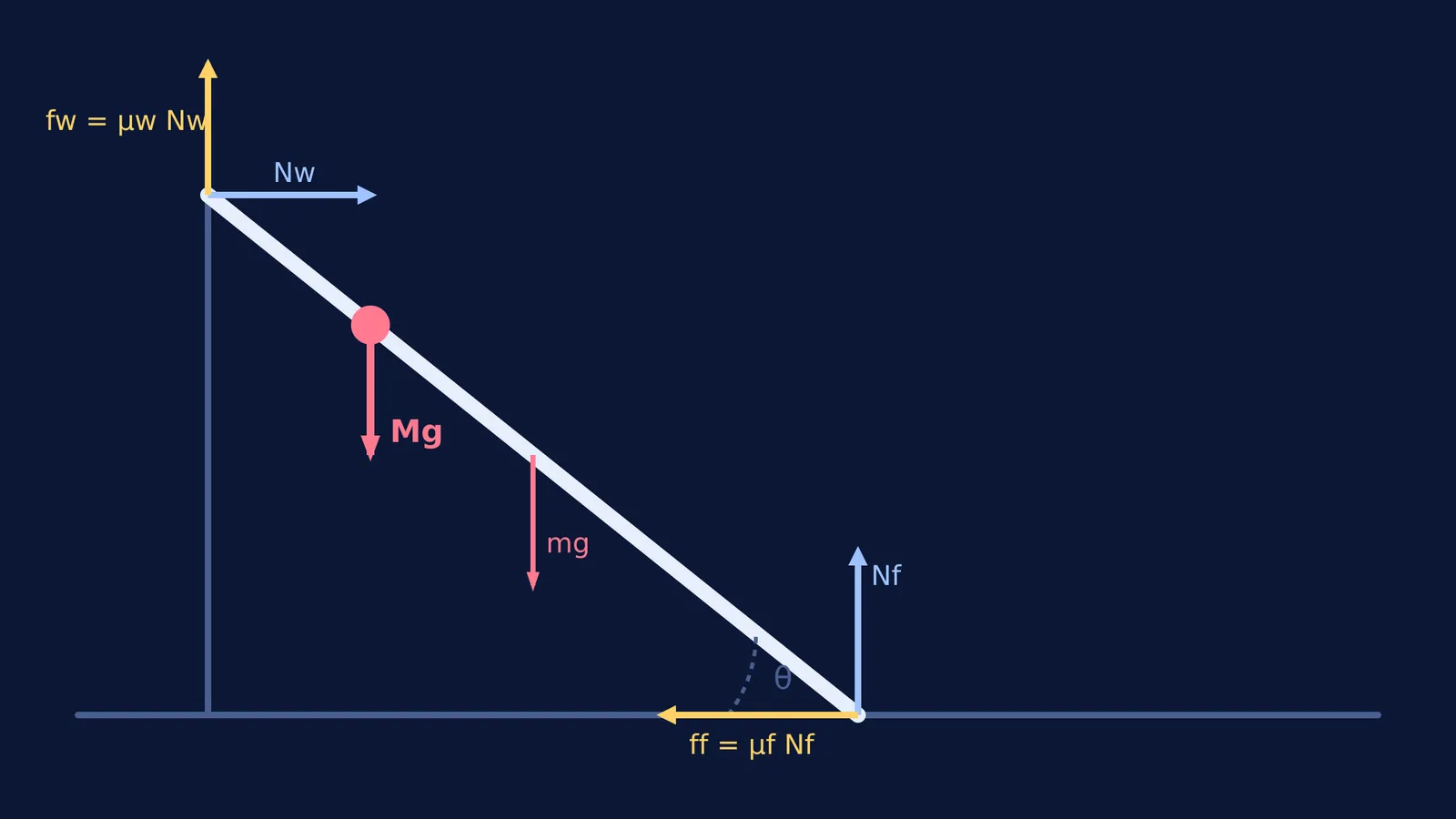
For a ladder to stay still, the forces and torques acting on it must cancel out to zero. Gravity pulls the ladder down. The floor pushes up (the normal force) and pushes in toward the wall (static friction) to stop the base from sliding. The wall pushes out, and if it is rough, it also pushes up with its own static friction. Finding the exact slip point is a balancing act, similar to calculating the minimum force to drag a block on a rough floor.
Because both the floor and the wall have friction, this is what engineers call a statically indeterminate system. There are only three equilibrium equations available in two dimensions (horizontal forces, vertical forces, and torques). However, there are four unknown forces acting on the ladder: the normal force at the wall, the normal force at the floor, and the two friction forces.
To find the slipping angle, physicists look at the system just as it breaks. In 1995, Kenneth S. Mendelson showed that on the verge of slipping, the friction at the top of the ladder reaches its absolute maximum (10.1119/1.17972). By assuming that both the top and the bottom grip as hard as they possibly can just before they fail, you can calculate the exact angle where the base kicks out.
What is the minimum angle before it slips?
The critical angle (θ) is the minimum angle the ladder can make with the horizontal ground. This relies on the relationship between normal forces and friction, much like finding the angle of repose for an object on a ramp. If you lean the ladder further down than this critical angle, it will slide.
If we assume the wall is perfectly smooth (zero friction) and the floor has a static friction coefficient of μ_f, the minimum angle is: tan θ = 1 / (2μ_f)
But real walls have friction (μ_w). Jonathan Bennett and Alex Mauney showed in 2011 how to find the critical angle for a rigid ladder when both surfaces grip (10.1119/1.3661104). When both the wall and floor are at their limits, the angle becomes: tan θ = (1 - μ_f × μ_w) / (2μ_f)
A rougher floor (higher μ_f) lowers the minimum angle, letting you lean the ladder further out. A rougher wall (higher μ_w) also lowers the angle, but the floor's friction matters more because it carries the full weight of the ladder.
What happens when a person climbs?
A ladder might be perfectly stable when you stand at the bottom, only to slide away when you are halfway up.
As you climb, you add your weight to the ladder. This does two things. First, it pushes harder against the floor, increasing the normal force and therefore the maximum possible friction the floor can provide. Second, your mass moves higher and creates more torque about the base. To stop the ladder from rotating outwards, the wall must push back harder.
Because the wall pushes back harder, the friction required at the floor to keep the ladder from sliding horizontally must also increase. The higher you go, the longer the lever arm of your weight becomes, forcing the horizontal forces to scale up. Eventually, the required friction exceeds what the floor can provide, and the ladder slips. You are always most likely to cause a slip when you are near the top.
If you want to test these limits without risking a fall, the Fermi Simulation Lab offers interactive simulations for ideas that are easier to see than to read. You can change the friction of the floor and the wall, adjust the ladder's weight, and drag a person up the rungs to see exactly where the forces snap.
A checklist for safe climbing
Before you step onto a ladder, you can use these physics principles to ensure it stays exactly where you put it:
Check the floor: The floor provides the most critical friction. Never rest a ladder on smooth concrete, wet grass, or polished tiles.
Follow the one-quarter rule: Place the ladder base away from the wall by a quarter of the height you need to reach. This creates a steep angle that is mathematically safe for almost any typical surface.
Secure the top: If you must climb high or work at a wider angle, tie off the top of the ladder. This guarantees the wall cannot push out, eliminating the torque problem entirely.
Keep your centre of mass low: Avoid carrying heavy loads near the top of the ladder, as this rapidly increases the outward force at the base.