On this page
When you start a science fair project, you often begin with a broad, vague idea. You might wonder, "Does fertilizer help plants grow?" or "Does salt change how water boils?" These are good starting points, but they are not specific enough. To run a real experiment that produces meaningful results, you need to turn that idea into a formal hypothesis. A hypothesis is a tentative, testable answer to a scientific question (Science Buddies). It acts as a map for your entire project, telling you exactly what data you need to collect and how you will go about collecting it.
What makes a hypothesis testable?
A testable hypothesis makes a specific prediction that can be proven or disproven through an experiment. It cannot just be an opinion, a guess, or a vague statement like "plants like music." Instead, it must clearly state what you are going to change and what you are going to measure to observe the effect. If a statement cannot be tested by observation or experiment, it is not a scientific hypothesis.
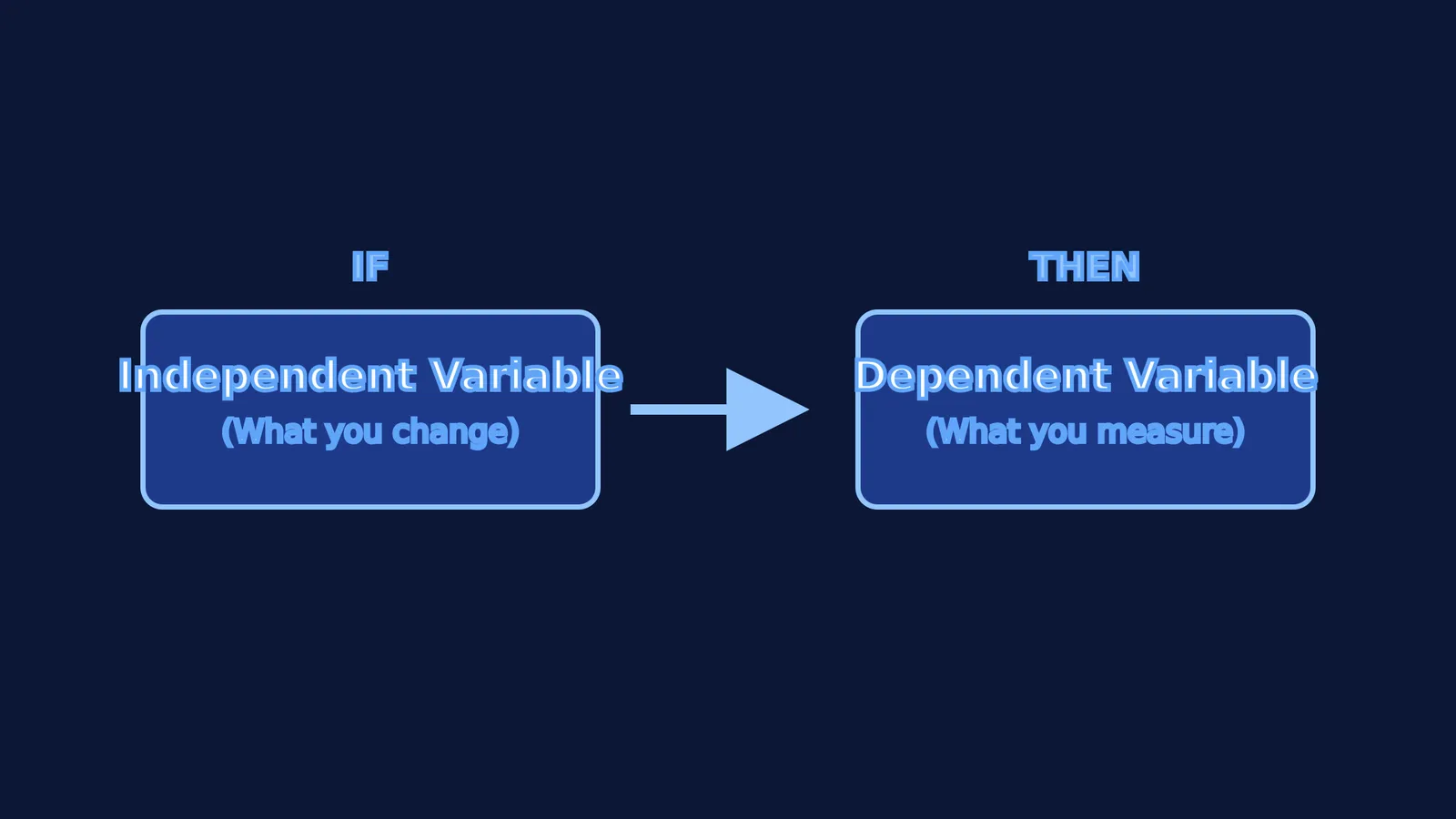
The most common way to format this prediction is an "if-then" statement. This structure forces you to clarify your thoughts and plan your procedure. A strong hypothesis should answer whether your prediction is based on research, whether it is practically testable, and whether it includes both an independent and a dependent variable (Science Buddies). By using this format, you make sure that anyone reading your report understands exactly what you set out to investigate.
How do you find the independent and dependent variables?
To write your "if-then" statement, you need to name two key factors. The independent variable is the factor you intentionally change during your experiment. The dependent variable is the factor you measure or observe to see how it responds (Science Buddies).
For example, if you want to know if electric current affects the speed of a motor, the current is the independent variable because you control it. The motor's RPM is the dependent variable because it depends on the current. Your resulting hypothesis would be: "If I increase the current to a motor, then its RPMs will increase."
By defining these variables clearly, you prevent your experiment from drifting off course. If your variables are vague—like "I will change the environment"—you will not know what to write down in your results table. You also need to keep other conditions constant, so that only your independent variable affects the outcome. These constant conditions are known as controlled variables.
How can AI help write a hypothesis for a science experiment?
If you are stuck with a broad topic, an AI tutor can help you narrow it down. Instead of asking a chatbot to simply "give me a hypothesis," you can tell Fermi's AI tutor your general idea and ask it to list possible independent variables you could change.
Once you pick an independent variable, the tutor can help you identify a dependent variable that you can actually measure at home or in your school laboratory. This ensures you do not accidentally design an experiment that requires professional equipment to measure the results. The tutor teaches—it holds a line of reasoning across a whole session, notices where a student is stuck, and checks your understanding as you go, rather than just printing an answer.
You can also run a draft of your hypothesis past the AI. Ask it, "Is this a testable hypothesis?" It will check if you have named specific variables and predicted a direction, helping you refine the wording before you start setting up your equipment. You can even ask the AI to suggest possible controlled variables, ensuring your test remains fair.
A checklist for your final hypothesis
Before you write your hypothesis down in your final lab report, run it through this quick checklist:
Does it name the independent variable? Ensure you have specified the one thing you are changing.
Does it name the dependent variable? Confirm you have stated exactly what you will measure (e.g., height in centimetres, time in seconds).
Does it predict a direction? Use words like "increase," "decrease," "speed up," or "slow down" rather than just saying it will "change."
Is it falsifiable? An experiment must have a possible result that could prove the statement wrong. Disproving a hypothesis is a normal part of science and provides valuable information.
Checking your setup virtually
Before you commit to a physical experiment, it can be helpful to see the relationship between variables in action. If you are designing a physical setup, you can try out different versions of your experiment virtually. The Fermi Simulation Lab provides interactive simulations for the ideas that are easier to see than to read. Changing a slider in a simulation allows you to instantly see how the dependent variable reacts to your independent variable.
If you are looking for simple ways to practice finding variables at home without complex equipment, you can explore kitchen science: five safe experiments and what each one teaches to get inspired.