

On this page
You stir fresh pineapple into jelly, leave it in the fridge overnight, and the next morning it is still soup. Here is how to turn that kitchen accident into a short experiment: predict which jelly sets with fresh, canned and boiled pineapple, test it, then explain the result with an enzyme that heat destroys.
Why does fresh pineapple stop jelly from setting?
Jelly made with gelatin is a protein gel. Gelatin is made by partly breaking down collagen, and it sets because its chains partly rewind into collagen-like triple helices as the warm solution cools, linking into a network that traps water, as a 2026 study of gelatin and hemp protein gels in Molecules describes. In that study, a pure gelatin gel turned back to liquid at about 30–35 °C when heated, so a set jelly is best kept cool.
Bromelain is a protein-cutting enzyme (a cysteine protease) found in pineapple, according to a 2026 review in Frontiers in Nutrition. Gelatin is protein, so active bromelain snips its chains into pieces too short to build the network. No network, no jelly. Raw papaya does something similar to meat with a different enzyme; see how raw papaya makes meat tender.
Predict first: which jelly will set?
Write down a prediction and one reason for each cup before you cook, so you cannot tell yourself later that you knew all along.
Cup A: gelatin, fresh pineapple.
Cup B: gelatin, canned pineapple.
Cup C: gelatin, fresh pineapple boiled for five minutes.
Cup D: gelatin, no fruit (your control).
Cup E: agar, fresh pineapple.
Cup E is the twist. Agar, sold in India as China grass, is a seaweed carbohydrate made of about 70% agarose and 30% agaropectin, according to a 2026 review in PeerJ. If bromelain cuts only proteins, what should happen to a gel with no protein in it?
How to run the pineapple jelly test at home
Keep an adult nearby for the hot steps.
Boil a third of the chopped fresh pineapple in a little water for five minutes, then cool it.
Make the gelatin mix as the packet says and split it between cups A to D.
Wait until the mix is just warm before adding fruit, so hot gelatin does not partly cook the fresh pineapple.
Add equal amounts of fruit to cups A, B and C.
Make the agar jelly as its packet says and add fresh pineapple to cup E.
Label the cups, chill them for at least four hours, then tilt each one.
What do your results mean?
Cup A runny or weak: active bromelain cut the gelatin.
Cup B set: canned pineapple is heated during canning, which denatures the bromelain, as Science Prof Online's bromelain demonstration explains.
Cup C set: your five-minute boil did the canning factory's job.
Cup D set: your method worked, so any runny cup was the fruit's doing.
Cup E set: agar has no protein for bromelain to cut.
If cup B is soft, check how much syrup went in; extra liquid alone weakens a gel.
Why does heat destroy the bromelain enzyme?
An enzyme is a folded protein, and its active site, the part that grips the target, depends on that shape. Heat shakes the fold apart. The enzyme is denatured, and cooling does not bring the activity back, which is what cup C tests.
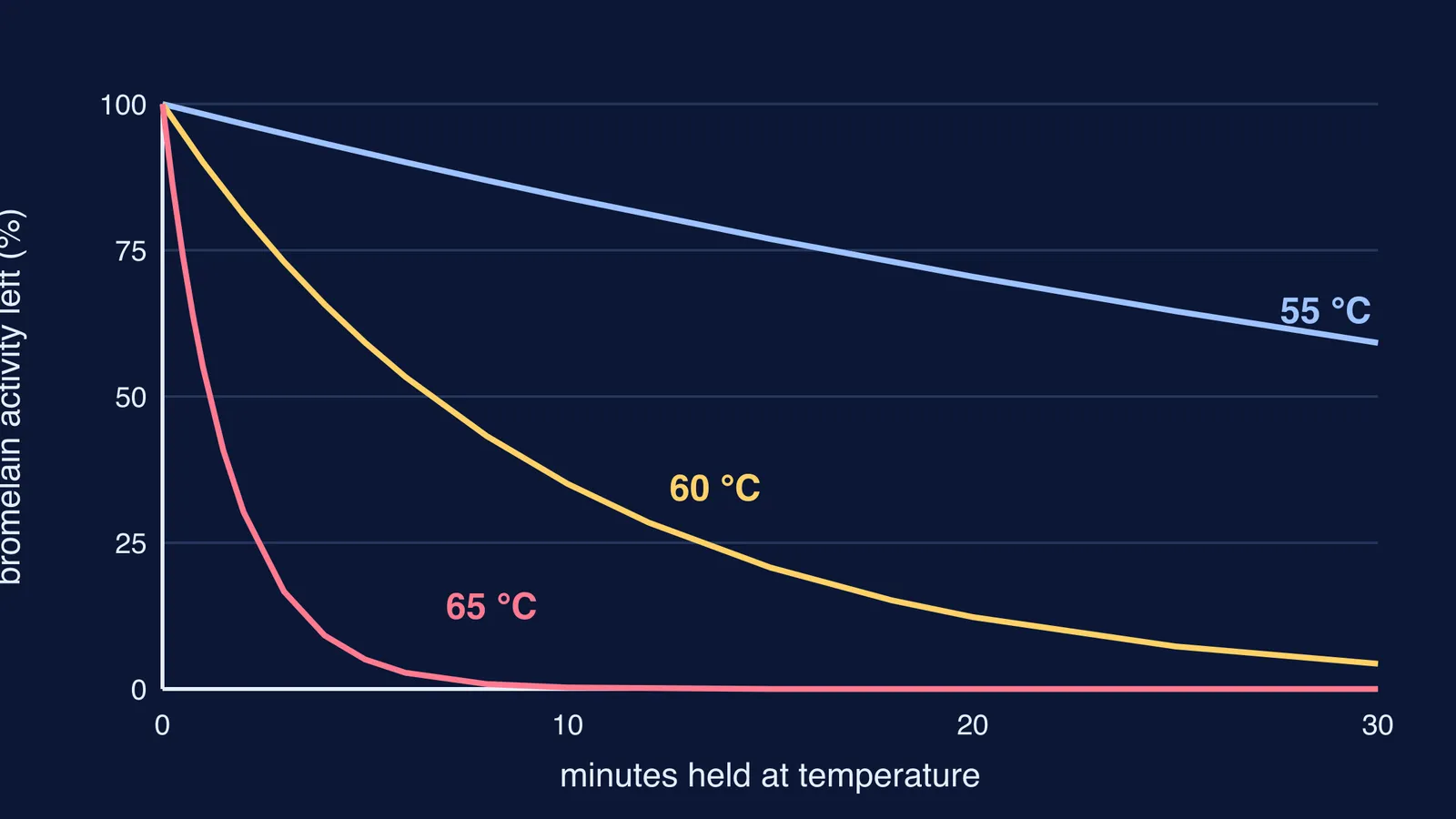
Bromelain's enzymatic activity is seriously inhibited above 65 °C, the Frontiers in Nutrition review reports. In a 2000 study in Transactions of the ASAE, Sriwatanapongse, Balaban and Teixeira heated pineapple juice at 55–67 °C and found first-order kinetics: at a fixed temperature, the same fraction of the remaining enzyme is lost every minute.
We put that study's published constants (activation energy 3.26 × 10⁵ J/mol, frequency factor 1.37 × 10⁵⁰ per minute) into the Arrhenius equation. By that model, 90% of the activity is gone after about 22 minutes at 60 °C, but after about 4 minutes at 65 °C. Five degrees makes it more than five times faster, which is why a five-minute boil, far hotter than anything in the study, should be more than enough.
To see the whole rise-then-crash shape of enzyme activity against temperature, try our enzyme activity simulation for temperature and pH. For why enzymes speed up reactions at all, read how enzymes lower activation energy on a graph.
If denaturation still feels like a word rather than a picture, the Fermi Concept Library gives every concept in biology and chemistry its own lesson and its place in the map. For physics ideas that are easier to see than to read, try the interactive simulations in the Fermi Simulation Lab.


