

On this page
Many traditional recipes for kebabs, stews, and tough cuts of meat call for a paste of raw, green papaya to be applied well before cooking. While it might look like a simple flavour marinade designed to add a tropical note, you are actually applying a highly effective biochemical treatment to your food.
The secret is not the fruit's natural acidity or its moisture content. Raw papaya contains a powerful enzyme called papain. When you rub the fresh paste onto meat, this enzyme goes straight to work on the strong structural proteins that make the cut dense and chewy, transforming a tough piece of muscle into something tender enough to melt in your mouth.
How does raw papaya make meat tender?
Meat is tough because of two main structures: the long myofibrillar proteins (such as actin and myosin) that make up the muscle fibres, and the thick web of connective tissue (collagen) that holds them together.
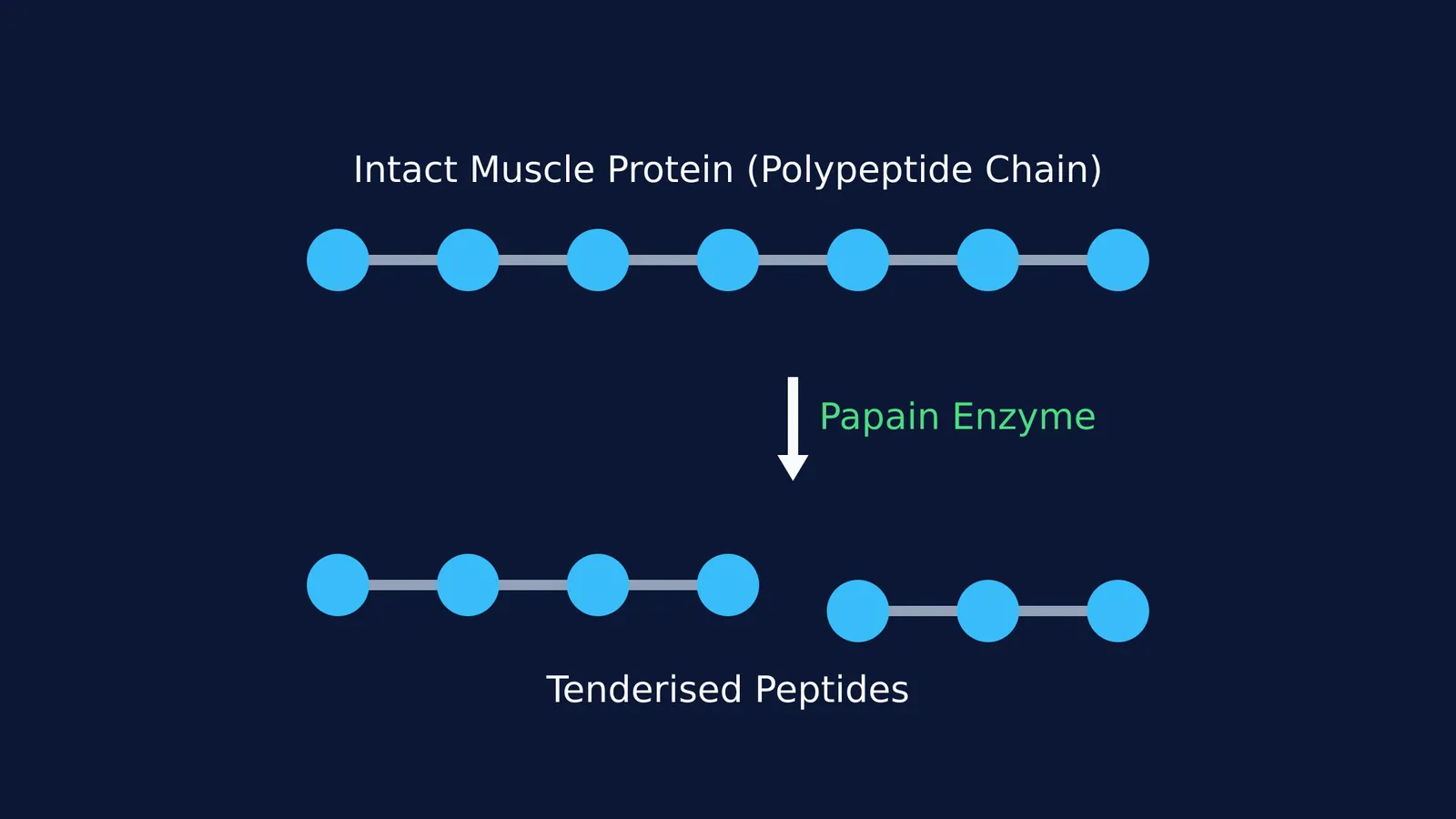
Papain belongs to a family of enzymes known as cysteine proteases. It tenderises meat through a chemical reaction called hydrolysis, a process that uses water to snap the strong peptide bonds linking individual amino acids. Think of papain as a pair of molecular scissors cutting long, stubborn protein chains into much smaller, softer fragments.
The highest concentration of this enzyme is found in the white latex that oozes from the skin of an unripe papaya. As the fruit ripens and turns yellow, the enzyme activity drops sharply. This is why a sweet, ripe papaya makes a poor tenderiser, while the green, raw version is a staple in professional kitchens.
How does papain compare to pepsin and trypsin?
If you have studied enzymes in biology, you know that the human body digests proteins using enzymes like pepsin and trypsin. Papain does the exact same chemical job—breaking peptide bonds—but it operates under very different environmental rules.
In human digestion, pepsin cuts up proteins in the highly acidic environment of the stomach, which typically sits between pH 1 and 3. Later in the digestive tract, trypsin takes over in the alkaline small intestine. Neither of these digestive enzymes would work well as a meat marinade because raw meat naturally reaches approximately pH 5.5. Papain, however, is perfectly adapted to work in this environment, allowing it to tenderise the meat without requiring you to soak your steak in strong vinegar first.
Students covering human digestion often struggle to picture how enzymes like pepsin and trypsin pull long protein chains apart. If you want to see these molecules in action, you can run interactive simulations in the Fermi Simulation Lab to watch how changes in pH and temperature speed up or completely stop an enzyme from working.
Why does raw papaya work better when heated?
Papain is such a popular tenderiser because of its unique heat stability. It is most active between 60 °C and 70 °C (140 °F to 158 °F).
This means the enzyme does not just work while the meat sits resting on the kitchen counter. It actually speeds up during the early stages of cooking. As the meat heats up in the pan or on the grill, papain rapidly cuts through the remaining tough fibres. It is only at higher cooking temperatures that the enzyme finally denatures, permanently losing its active shape and stopping its work.
How long should you marinate meat with raw papaya?
Because papain is so aggressive, it must be used with a careful plan. If you are preparing a tough cut of meat, follow this simple checklist to get the tenderising right:
Source the greenest fruit: Use a completely raw, green papaya. The highest concentration of the enzyme is in the skin and the white sap just beneath it. Do not peel it; blend the skin and the flesh together into a paste.
Apply an even coat: Massage the paste thoroughly into the meat so the enzyme makes physical contact with the muscle fibres.
Watch the clock: Do not leave a papain marinade on overnight. The enzyme will completely destroy the protein structure, turning the meat into an unpleasant, mushy paste. For most cuts, a brief marinade is plenty of time.
Cook thoroughly: Ensure the meat reaches a high enough temperature. If you serve the meat rare, the internal temperature might not rise enough to denature the papain, meaning the enzyme could continue breaking down the meat on the plate.
By understanding the biology behind the ingredient, you can predict exactly how long a marinade needs to work—and why raw papaya does a structural job that simple lemon juice and vinegar simply cannot match. Whether you are preparing a traditional slow-cooked curry or grilling a tough steak, knowing how to control the enzyme's temperature and time gives you the perfect result.


