On this page
When you learn a new scientific fact, it often feels like an isolated piece of trivia. You are told that a steel ship floats because of the buoyant force, or that plants need magnesium to make chlorophyll. You might memorise the sentence for the exam, but if the question is twisted slightly, the knowledge crumbles.
A better way to study is to refuse to accept the surface fact. By asking "why" repeatedly, you can dig down through the layers of an idea until you reach a fundamental principle you already know and trust.
Why is elaborative interrogation effective?
Educational psychologists call this process *elaborative interrogation*. Elaborative interrogation is the act of generating an explanation for why an explicitly stated fact is true, according to a 2013 review of 10 common learning techniques published in *Psychological Science in the Public Interest*. In that review, cognitive psychologist John Dunlosky and colleagues rated this technique as having "moderate utility". The study found that asking "why" improves learning by forcing you to actively connect new information to your existing knowledge schemas, making the memory far more durable than passive rereading or highlighting. When you build these logical bridges yourself, your brain retains the pathway far better than if you simply read a summary.
The strategy shares its DNA with the Five Whys technique, developed by Sakichi Toyoda for the Toyota motor company to trace manufacturing defects to their root causes. Instead of treating a symptom—like a puddle of oil on the floor—the method asks why the oil is there, down to the worn gasket and the missing maintenance schedule. In education, it works similarly to trace a confusing concept back to its logical root.
How do you ask why again and again to understand?
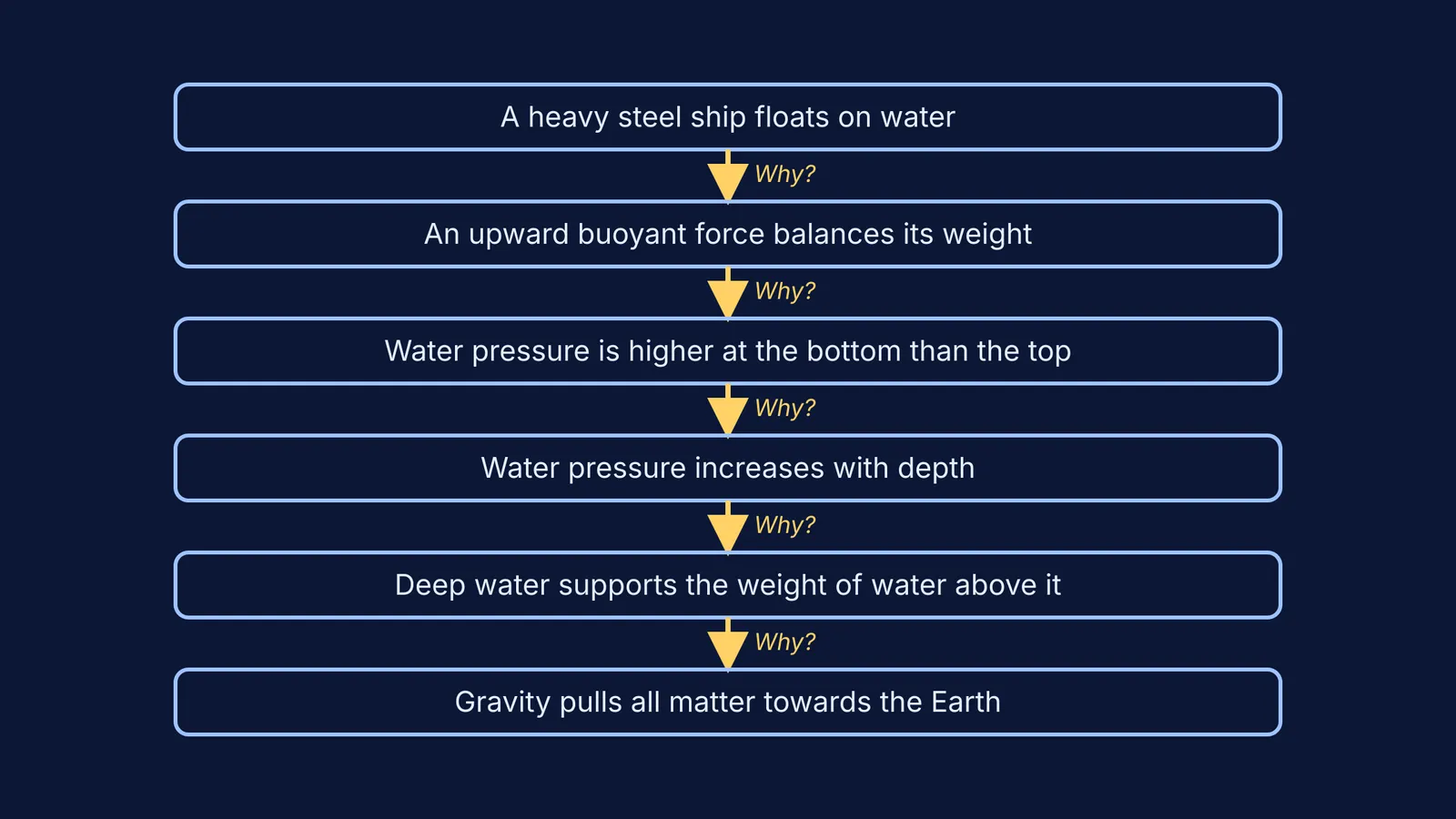
Imagine you are studying physics and you encounter the rule that a heavy steel ship floats on water. If you stop there, you have a fragile fact that will fail you if an exam question asks about a ship in freshwater versus saltwater. But watch what happens when you interrogate it:
Why does a heavy steel ship float?
Because an upward buoyant force pushes against its hull, balancing its weight.
Why is there an upward buoyant force?
Because the water pressure pushing up on the bottom of the hull is greater than the water pressure pushing down on the top.
Why is water pressure greater at the bottom?
Because water pressure increases with depth.
Why does pressure increase with depth?
Because the water deep down has to support the weight of all the water resting above it.
Why does the water above have weight?
Because gravity pulls all matter towards the Earth.
You already understand and trust gravity. By asking "why" five times, you have tethered a new, counter-intuitive idea (a massive steel ship floating) to a familiar, undeniable truth (gravity pulls things down).
How do you use an AI tutor for the Five Whys?
Historically, this technique was hard to use if you studied alone. If you asked a textbook "why?" a second or third time, it could not answer. You would hit a wall as soon as the book's specific explanation ended.
This is where a conversational tool like Fermi's AI tutor is useful. Because it is designed to teach rather than just answer, you can treat it as a limitless sounding board.
When you understand the theory but fail the numericals, it is usually because there is a broken link in your chain of reasoning. The next time you are stuck on a rule that feels arbitrary, open your tutor and ask why it is true. When it gives you the first reason, do not stop. Ask why *that* reason is true.
Keep going. Can AI tutors teach better than chatbots that give answers? Yes, because a tutor is designed to hold that line of reasoning across the whole session. Keep asking until the tutor hands you an explanation that makes you think, "Ah, of course." Once the new idea is anchored to something you already believe, you will not have to rely on rote memorisation again. You will have built a web of understanding that holds up under exam pressure.