On this page
An AI chatbot can turn NCERT lines into fill-in-the-blank questions in seconds. The catch is which word it hides: a blank over "nucleus" tests biology, while a blank over "discovered" or "the" tests grammar. Here is a prompt to copy, a check for every blank, and a worked example from a real chapter.
Why do fill-in-the-blank questions work for revision?
A blank makes you produce the word instead of reading it. Norman Slamecka and Peter Graf ran five experiments comparing words people generated themselves with the same words they simply read, and memory was better for the generated words in all of them (Journal of Experimental Psychology: Human Learning and Memory, 1978).
Answering a blank is also practice testing. In two experiments by Henry Roediger and Jeffrey Karpicke, students who took recall tests on prose passages remembered more 2 days and 1 week later than students who restudied, even though restudying made them more confident (Psychological Science, 2006). A 2013 review of 10 learning techniques rated practice testing as high utility, and rereading and highlighting as low utility (Dunlosky and colleagues, Psychological Science in the Public Interest). So the blank matters: if the hidden word can be guessed from grammar, you generate nothing useful.
How do you ask AI to make fill-in-the-blanks from NCERT lines?
Pick a handful of lines carrying the chapter's key ideas: definitions, names, dates, cause and effect.
Copy them exactly from your NCERT textbook. Do not let the AI quote them from memory; it may get them wrong.
Paste them with a prompt that sets the rules, and cover the answer list while you attempt.
Here is a prompt you can copy:
"Below are lines copied from my NCERT textbook. For each line, make one fill-in-the-blank question. Blank only a key term: a scientific term, a name, a number with its unit, or a word that changes the scientific meaning if it is wrong. Never blank articles, connecting words or ordinary verbs. Keep the rest of the line word for word. Each blank must have exactly one correct answer. Put the answers in a separate list at the end."
How do you check the AI's blanks hit key terms, not filler words?
Check every blank before you attempt it:
Could an examiner ask for the hidden word on its own? Terms, names, numbers and units pass. Words like "the", "is", "later" and "and" fail.
Could you fill it from grammar alone, knowing no science? If yes, it is filler.
Does exactly one answer fit? If two terms could both be right, ask for a clue or a different blank.
Is the rest of the line still NCERT's wording? If the AI rewrote it, you lose the phrasing you are trying to learn.
Fix a failing blank with one line: "Question 3 hides a filler word. Move the blank to the key term in that line."
Worked example: Class 11 Biology, Chapter 8
These lines are from Chapter 8, Cell: The Unit of Life, in the NCERT Class 11 Biology textbook:
"Hence, cell is the fundamental structural and functional unit of all living organisms."
"Antonie Von Leeuwenhoek first saw and described a live cell. Robert Brown later discovered the nucleus."
"In 1838, Matthias Schleiden, a German botanist, examined a large number of plants..."
Here is how six possible blanks from these lines score on the check:
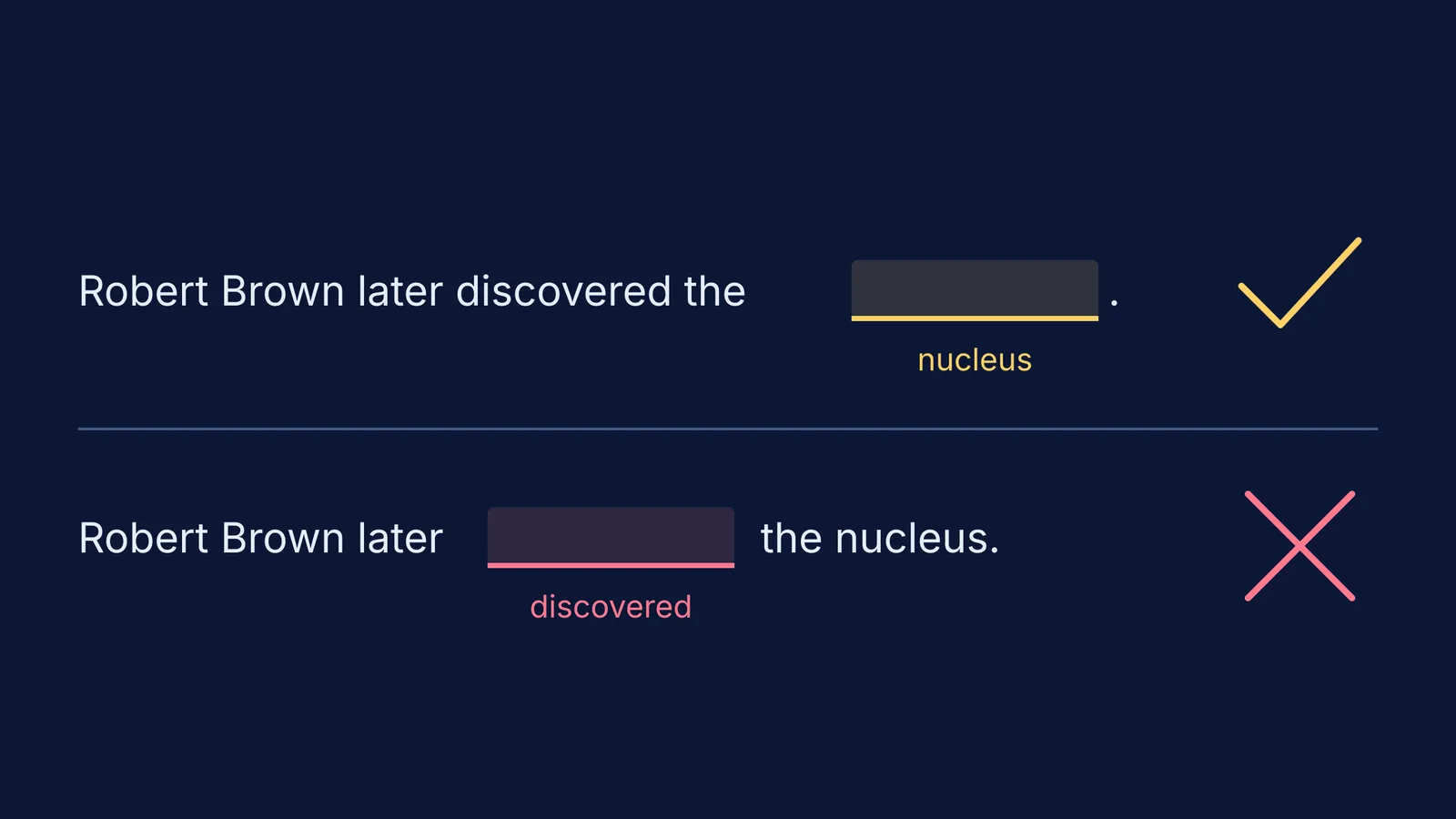
"Robert Brown later discovered the ____." Answer: nucleus. Keep: a key term with one answer.
"Robert Brown later ____ the nucleus." Answer: discovered. Fix: a verb you can guess from the sentence.
"Hence, ____ is the fundamental structural and functional unit of all living organisms." Answer: cell. Keep: the definition the chapter is built on.
"Hence, cell is ____ fundamental structural and functional unit..." Answer: the. Fix: pure filler.
"____ first saw and described a live cell." Answer: Antonie Von Leeuwenhoek. Keep: a name tied to a discovery.
"In ____, Matthias Schleiden, a German ____, examined..." Answers: 1838 and botanist. Split: two blanks in one line can give each other away, so make them two questions.
What should you do with the blanks you get wrong?
Answer each blank on paper with the book closed, then mark. For each miss, reread only the paragraph around that line. Retry missed blanks a few days later: in the Roediger and Karpicke study, testing beat restudying on the delayed tests, not the immediate one (Psychological Science, 2006).
If you keep missing a blank because the term itself makes no sense, more blanks will not help. Learn the idea first: the Fermi Concept Library has every concept in physics, chemistry, biology, mathematics and computing, each with its own lesson. Fermi's AI tutor notices where you are stuck and checks understanding as it goes, so a missed blank can become a short explanation rather than a guess.
To build blanks into a routine, see how to turn your notes into active recall cards with AI, how to set rules so an AI chatbot quizzes you properly, and how to use AI to revise an NCERT chapter you never understood.