On this page
You have stared at the diagram of the human heart in your biology textbook for ten minutes. You feel like you know it perfectly. But when you sit down in the exam hall, the page goes blank. You know the mitral valve is somewhere in the middle, but which side?
This happens because looking at a diagram is passive. To make the information stick, you need to practise retrieving it from your memory. A highly effective way to do this is to draw the diagram yourself, leave it unlabelled, and then have an AI tutor test you on the parts.
What makes drawing diagrams better than reading?
Many students rely on highlighting or re-reading their notes. However, a 2016 study on the 'drawing effect' showed that drawing out information creates a stronger, more reliable memory trace than simply writing it down (Wammes et al., 2016).
The researchers found that drawing forces your brain to integrate semantic meaning (what the object is), visual imagery (what it looks like), and motor memory (the physical act of moving your pen). When you merge these three streams, the information becomes much easier to recall later. This is related to the principle of Dual coding: combine words and diagrams in your science notes, where combining text and visuals locks the concept into long-term memory.
How do you practice labelling diagrams with an AI tutor?
It is one thing to draw a diagram; it is another to check if you got it right. Grading your own rough sketches can be difficult, and looking at the textbook's answer key spoils the entire diagram at once. Instead, you can use an AI tutor to quiz you interactively.
Here is a step-by-step method to practice labelling diagrams with an AI tutor:
Draw from memory: Put away your textbook. Take a blank sheet of paper and draw the structure or process from memory. Draw the lines and shapes, but do not write any names or functions yet.
Upload your sketch: Take a photo of your drawing and upload it to your AI tutor.
Ask for a quiz: Give the AI a prompt like: "I drew this diagram of a nephron. Please quiz me on its labels, asking me to identify one part at a time."
Retrieve and check: Fermi's AI tutor can take your scanned drawing, work out what you already know, and check your understanding as it goes. Instead of just printing an answer, it will hold a line of reasoning across the session, noticing where you get stuck and deciding whether to ask a guiding question or explain the concept.
Test the functions: Once you have correctly labelled all the parts, ask the tutor to quiz you on what each part actually does.
Why practice labelling diagrams with an AI tutor?
The main advantage of an AI tutor over a textbook answer key is immediate, targeted feedback.
When you study alone, you might mislabel the anode and cathode in a chemistry cell and not realise your mistake until you review your work much later. An AI tutor spots the error the moment you type it. It forces you to correct your line of reasoning right then and there. This immediate correction prevents you from memorising the wrong information.
Furthermore, because the AI asks you about one label at a time, you are forced to retrieve each fact individually. If you just glance at a fully labelled textbook diagram to check your work, the "illusion of competence" tricks your brain into thinking you knew all the labels all along.
Which diagrams should you practice drawing?
This method works well for any subject that relies on spatial relationships and processes.
Biology: Practice drawing the human brain, the female reproductive system, or a cross-section of a leaf. Once you master the shape, test yourself. You can read more about this in our guide to NCERT biology diagrams for NEET: draw from memory, then label.
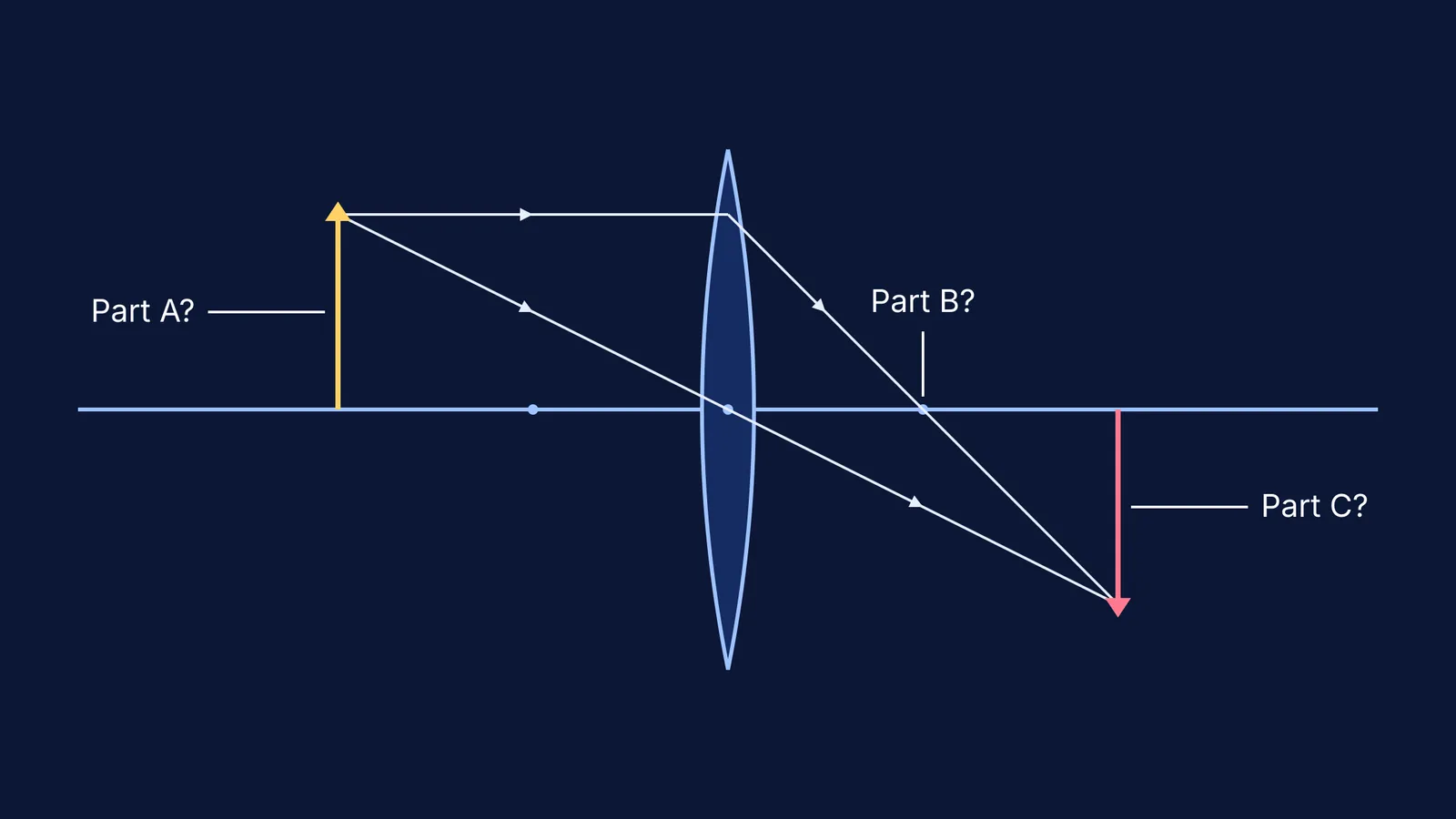
Physics: Optics and mechanics require precise drawings. Try sketching the path of light through a prism, or review Drawing ray diagrams in the CBSE Class 12 physics paper.
Chemistry: Use this technique for experimental setups, like the electrolytic refining of copper, or for complex organic reaction mechanisms.
By drawing the diagram yourself and using an AI to test your labels, you turn a passive reading session into a highly active recall exercise. The next time you sit in an exam hall, your visual and motor memory will take over, and the page will not stay blank for long.