On this page
Derivations are one of the most common hurdles in high school physics. You sit down for a mock exam, ready to derive the magnetic field of a loop or the drift velocity of an electron, but you get halfway down the page, forget a single substitution, and the whole proof comes to a halt.
Students often view derivations as a towering wall of mathematical steps. When you try to memorise them line by line, you miss the physical assumptions that hold the maths together. If one step falls out of your working memory, you cannot recreate the logic to find your way back. However, studies show that mapping out the structure changes how you process and remember the physics. A comprehensive 2024 meta-analysis of 55 studies published in *Educational Psychology Review* (10.1007/s10648-024-09877-y) found that concept mapping has a large positive effect on student achievement in science. The researchers measured a very large effect size of 1.040 for physics and earth science. This suggests that seeing how concepts link logically can be far more powerful for retention than reading equations in a sequence.
Why do students forget physics derivations?
When a student struggles with a derivation, the root cause is rarely the final formula. The breakdown usually happens because they rely on rote memorisation rather than structural understanding.
Without a map of the logic, it is easy to confuse internal variables with final constants, or to forget the starting conditions that make a derivation valid in the first place — such as assuming small angles for a pendulum or constant acceleration for a falling object. If you do not know why a step was taken, you are essentially trying to remember a random string of algebra.
By breaking the derivation down into a flowchart, you reduce the cognitive load. You no longer have to hold twenty lines of calculus in your head; you only need to remember three or four major logic milestones.
How do you turn a physics derivation into a flowchart with AI?
Instead of rereading your textbook and hoping the algebra sticks, you can ask Fermi's AI tutor to strip a derivation back to its skeleton. Fermi works out what you already know and builds a plan for the session, guiding you through the underlying reasoning rather than just printing the final algebraic answer.
The goal here is not to skip the maths, but to reveal the architecture behind it. A good flowchart ignores the complex algebra and highlights the key physical assumptions and decisions that move the proof forward.
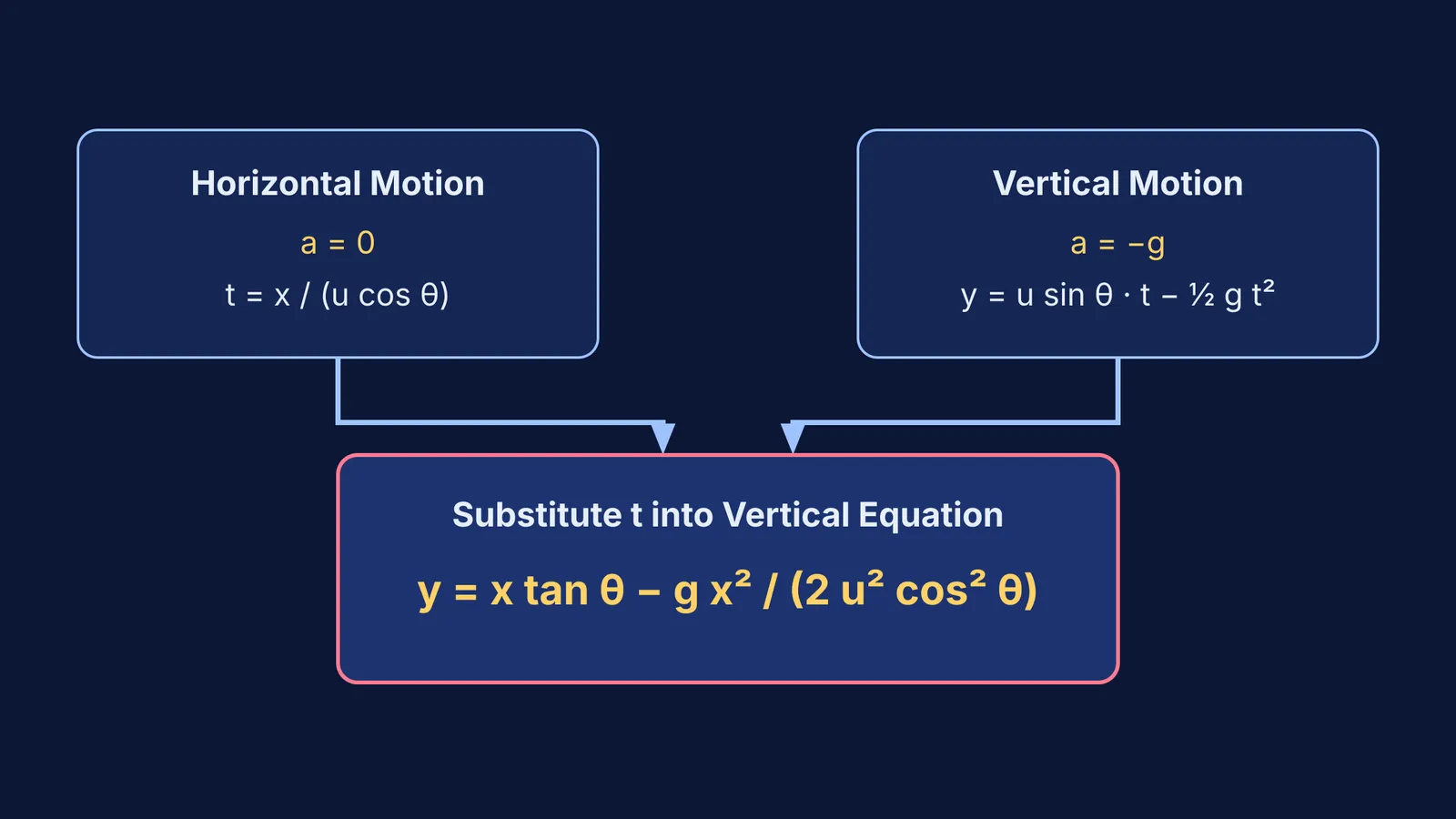
Whether you are mapping the equation of trajectory of a projectile or finding the period of SHM through a tunnel across the Earth, the resulting logic map is remarkably short:
State the physical setup: separate the motion, setting horizontal acceleration to zero and vertical acceleration to gravity.
Write the horizontal displacement equation to find an expression for time t.
Write the vertical displacement equation based on gravity.
Substitute your expression for time t into the vertical equation.
Notice that there is no x = u cos θ × t in the map. It simply tells you what to do, not how to do it.
How does a flowchart separate physics from maths?
Using a flowchart provides an immediate diagnostic benefit. It separates the physical concepts from the mathematical execution.
When you try to follow the flowchart, pay attention to where you get stuck. If you do not understand why the horizontal acceleration is zero, you have a conceptual gap in your physics knowledge. If you understand the physical setup but cannot successfully substitute the time variable and simplify the fractions, your problem is strictly algebraic. Pinpointing the exact nature of the hurdle saves hours of studying the wrong material.
How do you rebuild the full working from a logic map?
Once you have your flowchart, your study session must shift from passive reading to active doing. Put the textbook away, close your browser, and look only at the logic steps you generated.
Write down the physical starting points on a blank piece of paper. Then, execute the algebra yourself to connect the first milestone to the second. If you hit a wall, look back at the map to find your bearing.
This active recall process cements the structure of the derivation in your long-term memory. By treating the derivation as a connected path of physical truths rather than a memorised script, you build genuine intuition. On exam day, you will not need to panic about forgetting an intermediate line of working. You will only need to recall the core logic milestones, and you will be able to rebuild the maths naturally from scratch.