On this page
When you mix red and blue paint, you get purple. But light behaves differently. Instead of mixing physical pigments on a canvas, working with coloured lights, filters and objects involves tracing which wavelengths of light are allowed to reach your eye and which ones are absorbed.
For students revising optics, understanding the difference between additive colour mixing (adding lights together) and subtractive filtering (blocking light) is a common hurdle. Once you understand the rule of subtraction, you can predict the outcome of almost any combination.
Red filter on blue light: what colour do you see?
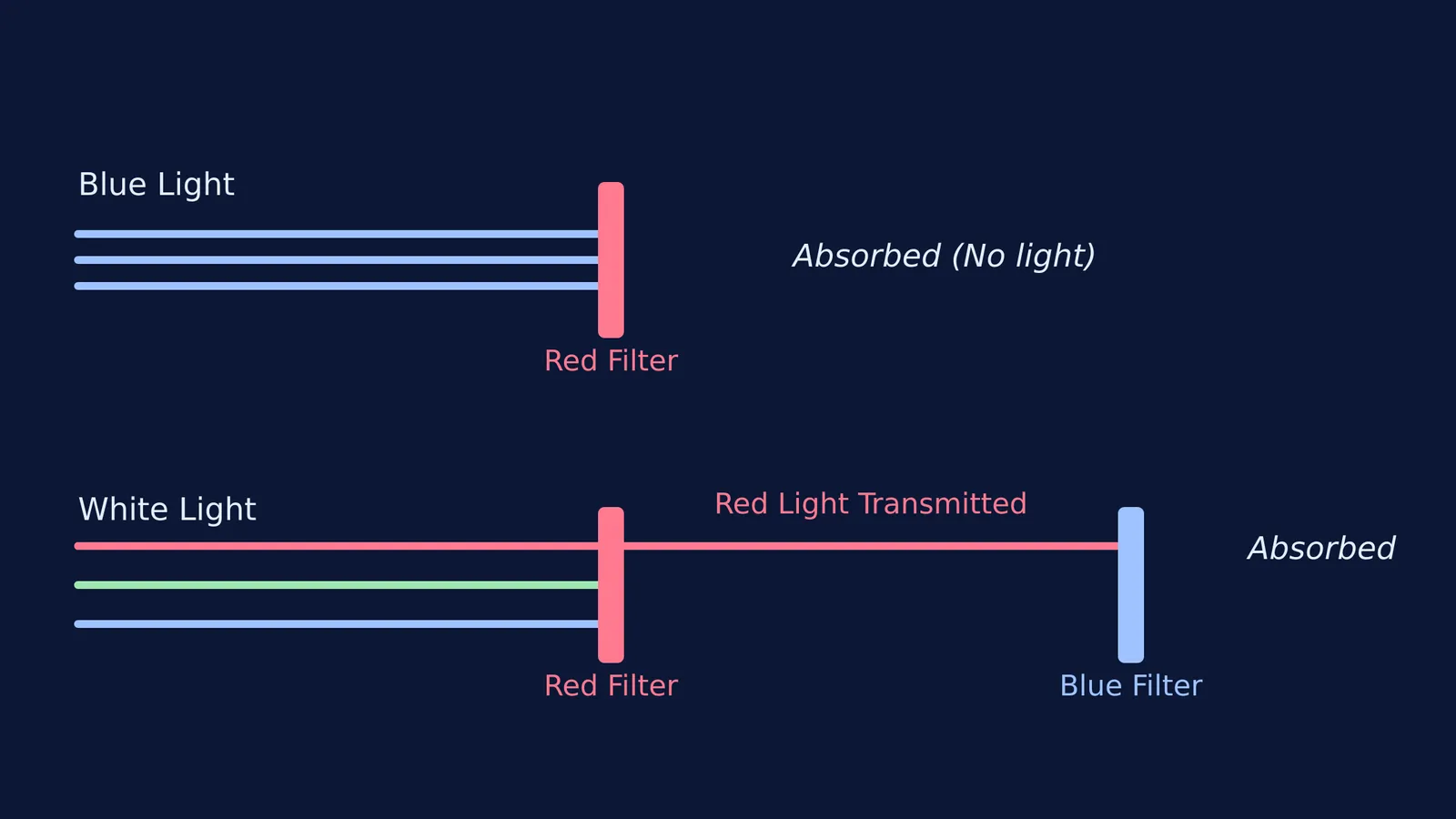
If you direct a beam of pure blue light at a pure red filter, the result is black.
To understand why, you have to look at what a filter actually does. A colour filter does not dye or stain the light passing through it. Instead, it acts as a selective barrier. A red filter is manufactured to transmit long wavelengths (red light) while absorbing shorter wavelengths (such as blue and green light).
Because your blue light source only emits short wavelengths, it contains no red light for the filter to transmit. The filter absorbs all the blue photons, converting their energy into a tiny amount of heat. Since no light passes through the barrier to reach your eye, you perceive black, which is simply the absence of light.
Why do stacked colour filters make things look black?
You can observe the exact same physics by stacking multiple filters in front of a white light source. White light contains all the colours of the visible spectrum.
If you place a red filter in front of a white lamp, it absorbs the blue and green light, allowing only the red light to emerge. If you then place a blue filter directly in front of the red one, the physical situation changes again. The blue filter is designed to absorb red and green light. Because the only light reaching it is the red light that survived the first filter, it absorbs that remaining red light.
By stacking a red and a blue filter, you have subtracted every wavelength from the original white beam. The result, once again, is black. For a broader look at how light interacts with different materials, you can read about the dispersion of white light by a glass prism or what happens to its speed and wavelength when light enters glass.
What happens when a red object is lit with blue light?
The rules of absorption do not just apply to transparent filters; they apply to solid objects as well. Just like a filter, physical objects get their colour through subtraction. A red apple appears red under normal white light because its surface absorbs blue and green wavelengths, reflecting only the red light back to your eyes.
If you take that same red apple into a completely dark room and shine a pure blue light on it, the physics of absorption take over. The apple's skin is chemically structured to absorb blue light. Because there is no red light in the room for it to reflect, it absorbs the blue beam entirely. As a result, the apple reflects no light and appears black. This is why buying clothes in a shop under artificial fluorescent lighting can sometimes lead to surprises when you step out into natural sunlight. The colour you see always depends heavily on the wavelengths present in the light source hitting the object.
The Predict-Observe-Explain framework
Reading about absorption is helpful, but treating it as a memory exercise—trying to rote-learn colour charts—is brittle. Active learning encourages you to test the physical rules yourself.
The Predict-Observe-Explain (POE) framework is a popular technique for mastering physics concepts without memorisation. In a 2011 study published in *Science*, researchers found that students taught using active engagement scored 74% on a conceptual test, compared to just 41% for students who sat through traditional lectures (Deslauriers et al., 2011).
You can apply this framework to optics by following three steps:
Predict: Before you combine lights, stack filters, or shine coloured light on an object, write down what you think will happen. Will the light be transmitted, reflected, or absorbed?
Observe: Run the experiment and look at the result.
Explain: If the outcome surprises you, work backwards. Ask yourself which wavelengths were present at the start, and which ones the material is designed to block.
By working through the logic step-by-step, you build an intuition that holds up under exam conditions, rather than a fragile list of facts.
If you do not have physical filters and coloured lamps on your desk, you can run these experiments digitally. In the Fermi Simulation Lab, you can mix light sources and place filters in their path to see exactly what happens, helping you bridge the gap between reading the theory and seeing the physics in action. If you find a gap in your theory while testing, the Fermi Concept Library can help you trace the exact wavelengths involved.