On this page
A 2025 benchmarking study by In Hak Moon evaluated how well five leading large language models handled calculus. The study found that the top-performing model, ChatGPT-4o, successfully solved 94.71% of differentiation problems, while others like Meta AI scored 56.75%.
However, this means AI is not infallible. The study noted that while models are highly fluent with standard procedural rules—such as the power rule, product rule, and quotient rule—they can still stumble on conceptual understanding or complex algebraic simplifications. As models generate text one token at a time, a long derivation can drift off course. For example, when applying the chain rule across nested trigonometric functions, a model might correctly state the calculus rule but drop a negative sign or forget the inner derivative at the very last step.
When an AI gives you a derivative, you need a way to know if it is exactly right before you build the rest of your working on it. The most robust way to check an AI's calculus is not to read through its algebraic steps line by line, but to plot the original function and the AI's proposed derivative on a graph.
Why check an AI's calculus?
Mathematical hallucinations happen when a model writes steps that look syntactically perfect but violate the rules of algebra. An AI might correctly state that the derivative of sin(x) is cos(x), but fail to properly distribute a negative sign across a fractional term in the next sentence.
If you are using AI to check your homework or prepare for an exam, trusting an incorrect algebraic step can set back your learning. Graphing the output forces the abstract algebra into a concrete visual form. You are no longer verifying the AI's logic step by step; you are verifying the final physical reality of the math.
How do you verify a derivative using a graph?
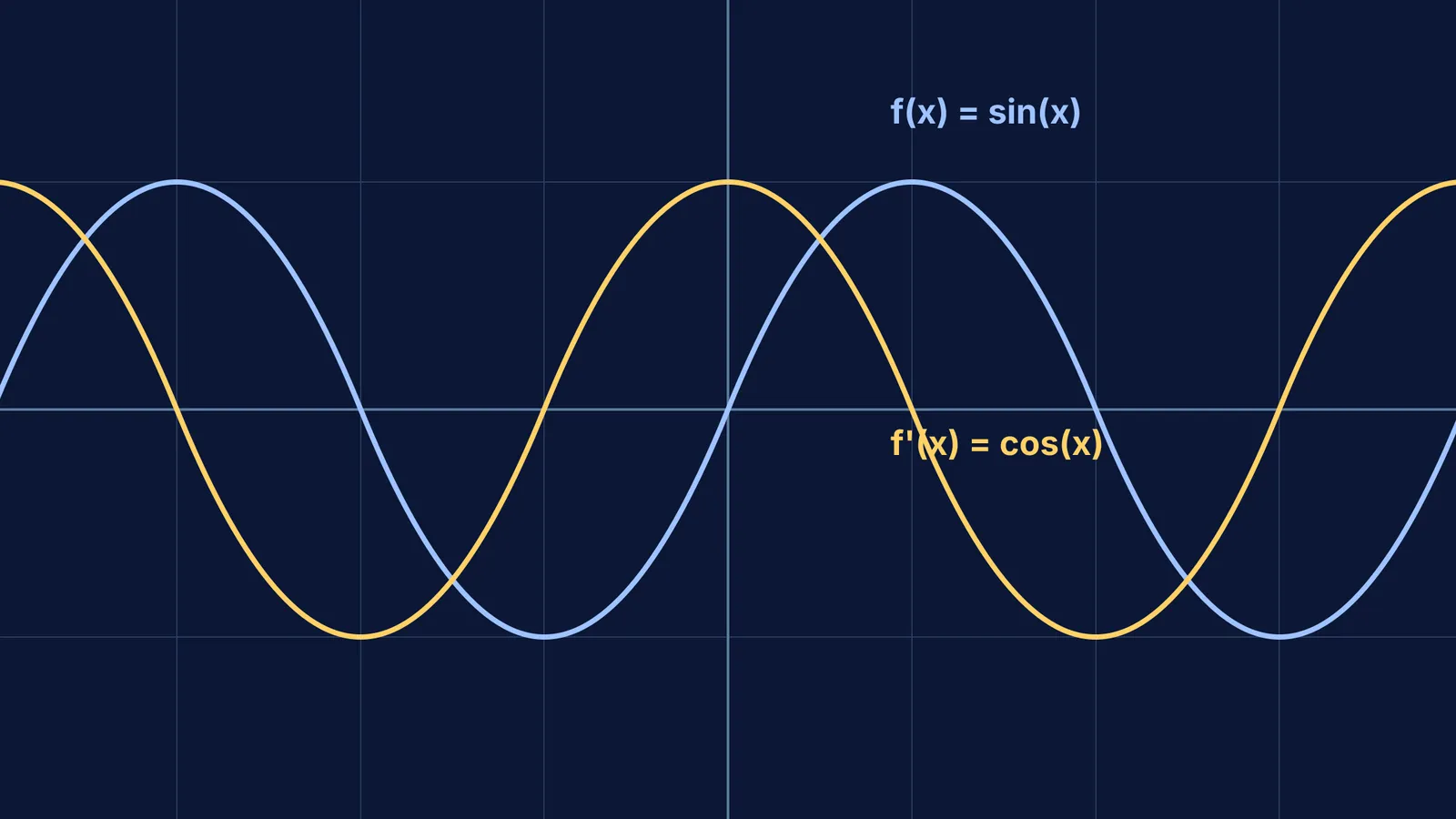
A derivative simply tells you the slope of the original function at any point. By plotting both the original function f(x) and the AI's provided derivative f'(x) on the same set of axes, you can instantly see if their relationship holds true.
You can use any free graphing tool, like Desmos or GeoGebra, and follow these three visual checks:
Look for the peaks and valleys. Find every point where the original curve of f(x) levels off at a local maximum or a local minimum. At these exact x-coordinates, the graph of the derivative f'(x) must perfectly cross the x-axis. The slope of a peak is zero, so the value of the derivative must be zero.
Check the uphill slopes. Pick a section where the original function is climbing upwards from left to right. In this entire interval, the derivative graph must sit above the x-axis. It does not matter if the derivative curve itself is going up or down; as long as f(x) is increasing, f'(x) must be a positive number.
Check the downhill slopes. Pick a section where the original function is dropping. The derivative graph must sit entirely below the x-axis for that stretch.
If the AI's algebraic derivative passes all three of these geometric tests, you can be highly confident that the answer is completely correct.
What does a wrong derivative look like on a graph?
When an AI drops a constant, applies a rule backwards, or messes up the algebra, the resulting graph will immediately fail the visual checks.
Imagine you ask an AI to differentiate f(x) = sin(2x). The correct application of the chain rule gives f'(x) = 2cos(2x). If the AI forgets the chain rule and incorrectly tells you the answer is just cos(2x), graphing it will expose the error. The roots (the zero-crossings) of the AI's derivative might still line up with the peaks of the original sine wave, but the derivative graph will not stretch high enough to match the true steepness of the curve.
Alternatively, if the AI incorrectly drops a negative sign while differentiating cos(x), the derivative graph will be completely upside down. It will sit above the x-axis in regions where the original function is clearly decreasing, making the hallucination obvious at a glance.
Checking work this way builds a deep, lasting intuition for how functions behave. Fermi's AI tutor teaches rather than answers; it holds a line of reasoning across a session, noticing where you are stuck, and checking understanding as it goes. If you bring a difficult derivative to the Fermi Problem Library, you get worked problems with a step-by-step solver that explains the reasoning rather than printing an answer. When an equation or a slope is hard to picture in your head, the Fermi Simulation Lab provides interactive simulations for the ideas that are easier to see than to read.
If you want to practice your calculus fundamentals so you rely less on AI, brush up on how to handle complex chains by differentiating parametric functions or working through differentiating one expression with respect to another.