

On this page
Imagine your class keeps one notebook for the canteen kitty: who paid whom, and how much. Now imagine every student keeps an identical copy, and a rule makes it very hard to quietly rewrite an old line. That, in plain terms, is a blockchain.
What is blockchain, in simple words?
A blockchain is a list of records grouped into blocks, where each block carries a fingerprint of the block before it. The idea became famous through the Bitcoin whitepaper by Satoshi Nakamoto, which describes a network that "timestamps transactions by hashing them into an ongoing chain of hash-based proof-of-work, forming a record that cannot be changed without redoing the proof-of-work."
There is no class monitor with a master copy. In the paper, new transactions are broadcast to every computer in the network, and each treats the longest chain as the correct one.
What is a hash, and why does it work like a fingerprint?
A hash function turns a message of almost any length into a short, fixed-length code called a message digest. The US Secure Hash Standard says SHA-256 produces a digest of 256 bits (NIST FIPS 180-4).
It also states the key property: "any change to a message will, with a very high probability, result in a different message digest." It calls these algorithms secure because it is computationally infeasible to find a message that matches a given digest, or two different messages with the same digest.
How do the blocks in a blockchain link together?
Real hashes are too long to work out by hand, so we will use a toy fingerprint rule:
New fingerprint = (previous fingerprint × 3 + amount) mod 97, where mod 97 means the remainder after dividing by 97.
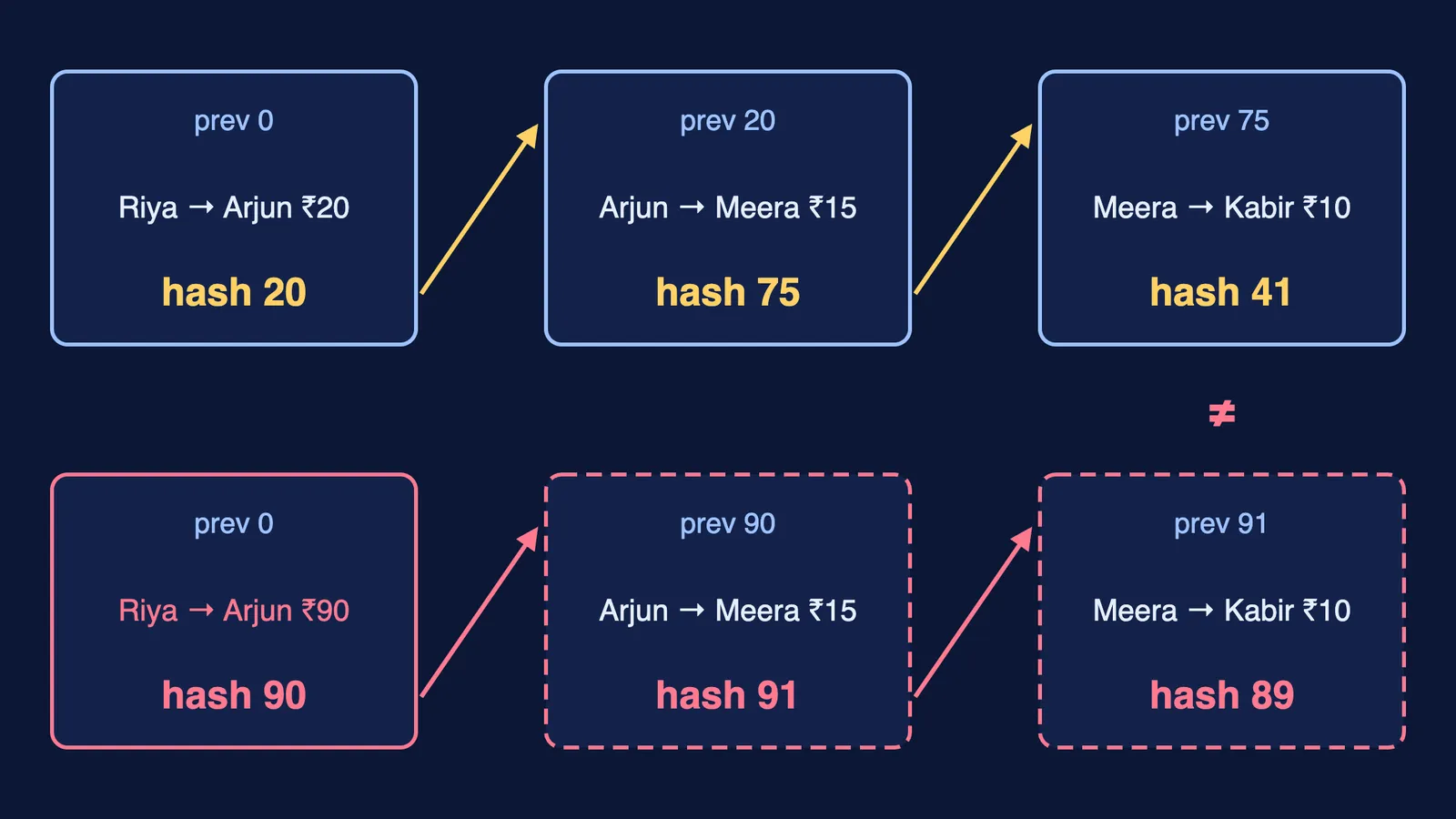
Block 1, Riya pays Arjun ₹20. There is no previous block, so start at 0: (0 × 3 + 20) mod 97 = 20.
Block 2, Arjun pays Meera ₹15: (20 × 3 + 15) = 75, so the fingerprint is 75.
Block 3, Meera pays Kabir ₹10: (75 × 3 + 10) = 235, and 235 − 194 = 41.
Everyone in class writes 41 at the bottom of their copy.
Now Arjun secretly changes block 1 to ₹90 in his copy. Block 1's fingerprint becomes 90. Block 2 becomes (270 + 15) mod 97 = 91. Block 3 becomes (273 + 10) mod 97 = 89. His copy ends in 89; everyone else's ends in 41. One edit to the oldest line changed every later fingerprint, and the class spots the forgery by comparing one number.
Why is changing an old entry in a blockchain so hard?
Three locks work together, all described in the Bitcoin whitepaper.
The chain. Each block includes the previous block's hash, so editing one block breaks every link after it.
The work. Each block holds a number (a nonce) chosen so that the block's hash begins with a required number of zero bits, which takes many guesses. In the paper's words, once that effort is spent "the block cannot be changed without redoing the work," and changing it means redoing all the blocks after it too.
The copies. A forger must also catch up with and overtake everyone else. The paper shows the chance of a slower attacker catching up shrinks exponentially as more blocks are added.
Hard is not impossible. The paper says the system is secure as long as honest computers together control more computing power than any group of attackers working together.
What can a blockchain not do?
It cannot check the truth. A blockchain proves a record has not changed since it was written, not that it was true. If Riya never actually paid, the ledger still says she did.
Proof-of-work costs energy. Ethereum switched to a different method called proof-of-stake on 15 September 2022 (ethereum.org, The Merge). ethereum.org cites a CCRI estimate that this cut Ethereum's annual electricity use by more than 99.988% (ethereum.org, energy consumption).
The technology is not the coin. Understanding blockchain does not make crypto trading safe; if a teen at home wants to try it, read our supervised plan for teens who want to trade crypto or stocks first.
Try it: a 15-minute ledger activity for your class
In groups of four, each student writes the same five canteen transactions.
Compute the five fingerprints together with the toy rule.
Compare final fingerprints. They should all match.
One student secretly changes line 2 and recomputes only that line. Compare again: the later fingerprints no longer agree.
Discuss: what would the forger have to redo, and how many friends would they need to convince?
If modular arithmetic or the idea of a one-way function is what trips you up, the Fermi Concept Library covers every concept in physics, chemistry, biology, mathematics and computing, each with its own lesson.
If the maths behind hashes hooks you, see cryptography careers for maths lovers, and for your own accounts, how students should manage passwords for exam portals.


