

On this page
It is 11 pm and you have one doubt: why does glucose, which clearly has a –CHO group, refuse to react with sodium hydrogensulphite? An AI tutor can help you reason it out. But AI tools can also put an –OH on the wrong side of a ring and sound sure about it, so the last step always belongs to your NCERT book.
Why does glucose need a ring structure at all?
NCERT Class 12 Chemistry, Unit 10 (Biomolecules), gives the open-chain structure of glucose first, then lists the facts it cannot explain (NCERT Chemistry Part II, Unit 10, reprint 2026-27):
Despite having an aldehyde group, glucose does not give Schiff's test and does not form the hydrogensulphite addition product with NaHSO3.
Glucose pentaacetate does not react with hydroxylamine, which points to no free –CHO group.
Glucose crystallises in two forms: the α-form melts at 419 K and the β-form at 423 K.
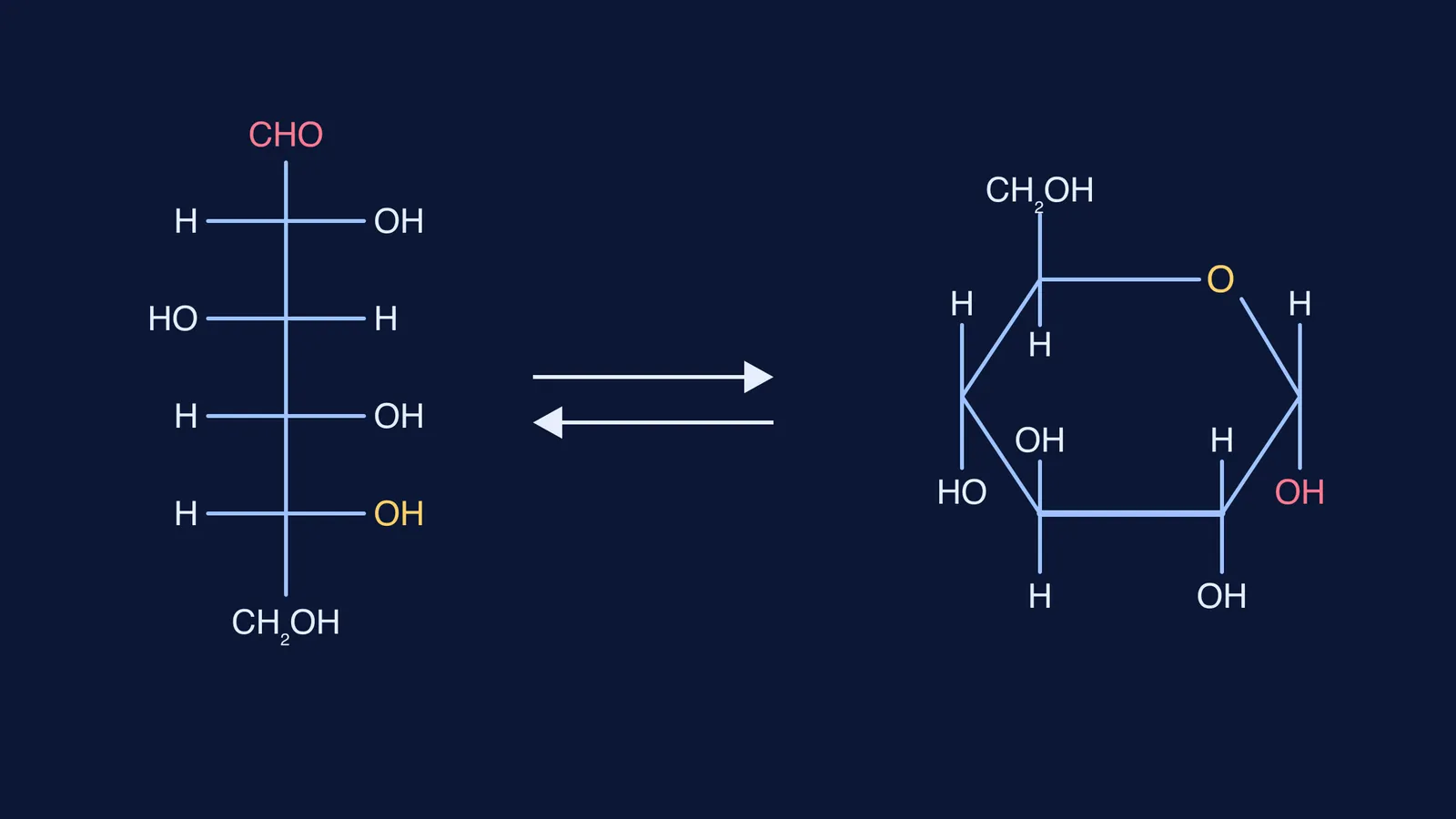
The fix: the –OH at C5 adds to the –CHO group to form a six-membered cyclic hemiacetal, and the two cyclic forms exist in equilibrium with the open chain. The α and β forms, called anomers, differ only in the configuration of the –OH at C1, the anomeric carbon. NCERT calls the six-membered ring a pyranose structure, after pyran, a ring of one oxygen and five carbon atoms.
How do I ask an AI tutor about glucose structure?
Don't ask for a summary. Ask the AI to make you argue, then test you:
"I know glucose is CHO(CHOH)4CH2OH. Give me the facts this open-chain structure can't explain. Don't tell me the ring yet."
"Let me guess which –OH group closes the ring and why the ring has six atoms. Only tell me if I'm wrong."
"Describe the α and β forms in words: which carbon changes, and which side of the ring its –OH points to in a Haworth structure."
"Quiz me with three questions on anomers and pyranose rings, one at a time."
Step 3 asks for words because a sentence is easy to check against a figure. Why check at all? In a 2025 study in Nature Chemistry, researchers built ChemBench, a set of more than 2,700 chemistry question-answer pairs. The best models, on average, outperformed the best human chemists in the study, yet still struggled with some basic tasks and gave overconfident predictions (Mirza et al., Nature Chemistry, 2025).
How do I check the AI's glucose ring against NCERT?
Open the Fischer and Haworth glucose structures in Unit 10 and run this five-point check:
Ring size: six atoms, five carbons and one oxygen. A five-membered ring is fructose's furanose form, not glucose.
Ring oxygen: it comes from the –OH on C5, not C4 or C6.
CH2OH (C6): sits above the ring in the Haworth structure, attached to C5.
Anomeric –OH on C1: below the ring for α, above the ring for β.
Open chain: –OH on the right at C2, left at C3, right at C4 and right at C5.
If one point disagrees, tell the AI: "You put the C1 –OH above the ring for α. NCERT shows it below. Recheck and explain which is right."
For the lab side, see how to distinguish glucose and fructose using chemical tests.
What are the four levels of protein structure?
NCERT describes protein structure at four levels, each more complex than the one before (NCERT Unit 10):
Primary: the specific sequence of amino acids in each polypeptide chain.
Secondary: the shape of the chain, either α-helix or β-pleated sheet, held by hydrogen bonds between the C=O and –NH– groups of peptide bonds.
Tertiary: the overall folding of the chains, giving fibrous or globular shapes.
Quaternary: the spatial arrangement of two or more polypeptide chains, called sub-units.
Hydrogen bonds, disulphide linkages, van der Waals and electrostatic forces stabilise both secondary and tertiary structure.
Denaturation is the classic trap. NCERT says secondary and tertiary structures are destroyed while the primary structure stays intact, and uses egg white coagulating on boiling as the example.
For proteins, ask the AI to sort rather than summarise: "Here are six statements about proteins. Tell me which structure level each one belongs to, and which ones survive boiling an egg." Then check its answers against Figs 10.1 to 10.4, which show the α-helix, the β-pleated sheet, all four levels and haemoglobin. NCERT's α-helix is a right-handed screw; a left-handed one is a red flag.
The same habit works when you ask AI to justify each arrow in nucleophilic addition or use AI to build phylum tables, then check every example.
Where does an AI tutor fit in?
Fermi's AI tutor teaches rather than answers: it notices where you are stuck, decides whether to explain, ask or show, and draws the figure as it goes, so you can hold its drawing beside the NCERT page. For a single idea such as anomers or peptide bonds, the Fermi Concept Library has a lesson for every concept in chemistry and biology.
Tonight, pick one structure, ask the AI to explain it in words, and spend five minutes checking it against Unit 10.


