

On this page
Ships have been lost in the Bermuda Triangle, as at every busy sea. The useful question is whether they are lost there more often than you would expect. That is a question about rates, and you can check it.
Is the Bermuda Triangle real?
The place is real in a loose sense: a region of the western North Atlantic. The extra danger is not. The US National Oceanic and Atmospheric Administration (NOAA) says there is no evidence that mysterious disappearances occur with any greater frequency in the Bermuda Triangle than in any other large, well-traveled area of the ocean.
NOAA adds that no official map marks the area's edges, the US Board of Geographic Names does not recognise the name, and the US Navy and Coast Guard say there are no supernatural explanations for disasters at sea. It points instead to ordinary hazards:
Weather: most Atlantic tropical storms and hurricanes pass through the area.
The Gulf Stream, which can cause rapid, sometimes violent changes in weather.
Shallow water among the Caribbean's many islands, treacherous for ships.
A compass quirk: NOAA notes some evidence that a magnetic compass there sometimes points to true north, not magnetic north.
Where did the Bermuda Triangle legend come from?
According to National Geographic, Vincent Gaddis coined the name in August 1964, in an Argosy magazine cover story about the loss of US Navy Flight 19. On 5 December 1945, five TBM Avenger torpedo bombers carrying 14 men took off on a training flight and never returned; one of the rescue planes also disappeared with its 13-man crew. The Navy's final report blamed pilot error. After a family protest and several reviews, the verdict was changed to "causes or reasons unknown".
The same article quotes Lieutenant A. L. Russell, writing in the Coast Guard's official response to Triangle inquiries, that "the combined forces of nature and the unpredictability of mankind" outdo science-fiction stories many times each year. It also notes that no one keeps statistics on Triangle losses.
What do insurers' shipping records show?
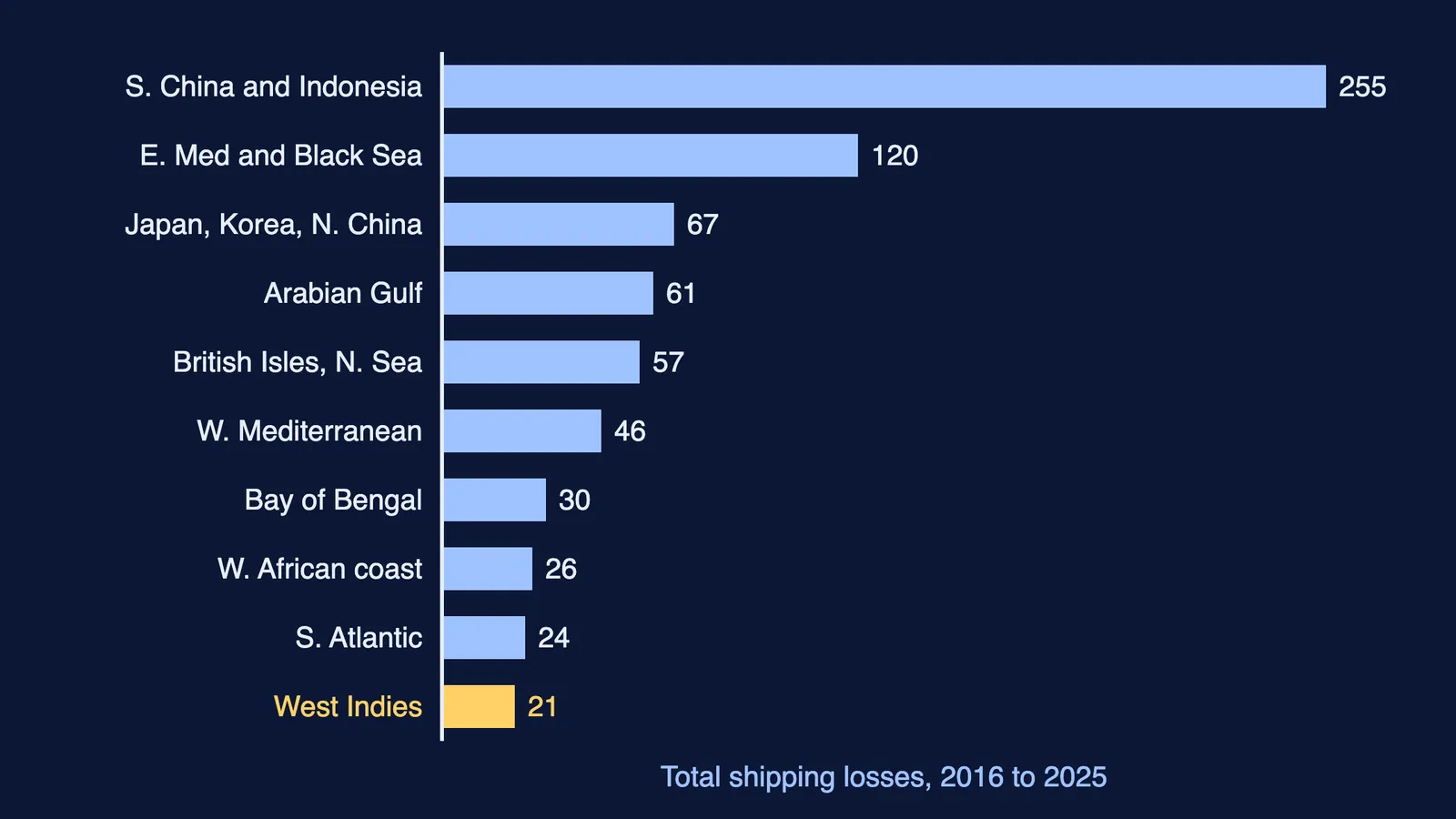
Insurers do keep score. The Allianz Commercial Safety and Shipping Review 2026, built on Lloyd's List Intelligence casualty statistics, counts 905 total losses of vessels over 100 gross tonnes worldwide from 2016 to 2025.
The worst region in the report's regional table is South China, Indochina, Indonesia and the Philippines, with 255 over the decade; the report links that to the huge volume of shipping traffic through the region. The East Mediterranean and Black Sea comes second with 120. The West Indies, the closest of its ten biggest loss regions to the Triangle, recorded 21, the lowest of the ten. "Bermuda Triangle" is not a category at all.
An older study points the same way. When WWF published a 2013 study of shipping-accident hotspots, the Christian Science Monitor reported that the South China Sea and East Indies were among them, with 293 shipping accidents since 1999. "Neither did the Bermuda Triangle, despite persistent urban legends," it added.
Some honest limits: these counts cover large ships, not yachts or private planes; the report's regions do not follow the Triangle's edges; and they are raw counts, not adjusted for traffic.
Why can a list of disappearances fool you?
A list of losses sounds frightening until you ask how many passed safely. National Geographic quotes John Reilly, a historian with the US Naval Historical Foundation, saying the region is highly traveled and has been a busy crossroads since the early days of European exploration. More traffic means more accidents, even if each trip is no riskier.
Here is the trap, with made-up numbers. Sea A records 20 losses in a year and sea B records 5, so sea A looks four times as dangerous. Now add the traffic: sea A carried 40,000 voyages and sea B carried 5,000. Divide, and sea A loses 0.5 ships per 1,000 voyages while sea B loses 1 per 1,000. The quiet sea is twice as risky per trip.
The same reasoning sits behind a classic exam question on what a positive medical test really means, and you can see it drawn out in a conditional probability tree diagram you build and simulate.
How do you check a "mysterious place" claim yourself?
Use this on the next forward about a cursed road or sea:
Find the boundary. If nobody agrees where the area is, nobody can count losses inside it.
Ask for the count and the traffic: "twelve accidents" out of how many trips?
Compare with a similar busy place, not an empty one.
Read what the record-keepers say: a coast guard, a transport authority or an insurer.
Trace the famous case to an original report, not a retelling.
Watch for the label effect: once a place has a scary name, every new accident gets filed under it.
If base rates and conditional probability still feel slippery, the Fermi Concept Library covers every concept in mathematics, physics, chemistry, biology and computing, and the Fermi Simulation Lab has interactive simulations for ideas that are easier to see than read.
Next time a place is called cursed, ask first: out of how many?


