On this page
Take a long list of real numbers, like country populations, and look only at the first digit. You might expect each digit from 1 to 9 to lead one time in nine. Instead, in many real data sets 1 leads about three times in ten and 9 fewer than one time in twenty, as Frank Benford found in his 1938 paper. This is Benford's law.
Who noticed that so many numbers start with 1?
Simon Newcomb described it in an 1881 note in the American Journal of Mathematics. Frank Benford, a physicist at General Electric's research laboratory, tested it at scale.
In his 1938 paper The Law of Anomalous Numbers, Benford counted 20,229 first digits from 20 kinds of data. Averaged across the 20 groups, 30.6% began with 1 and 4.7% with 9. In his table, 31.0% of 335 river areas and 33.9% of 3,259 population figures start with 1. He said the data should not be "too restricted in numerical range", which is the key to when the law fails.
What do the first digits actually look like?
We counted two fresh sets.
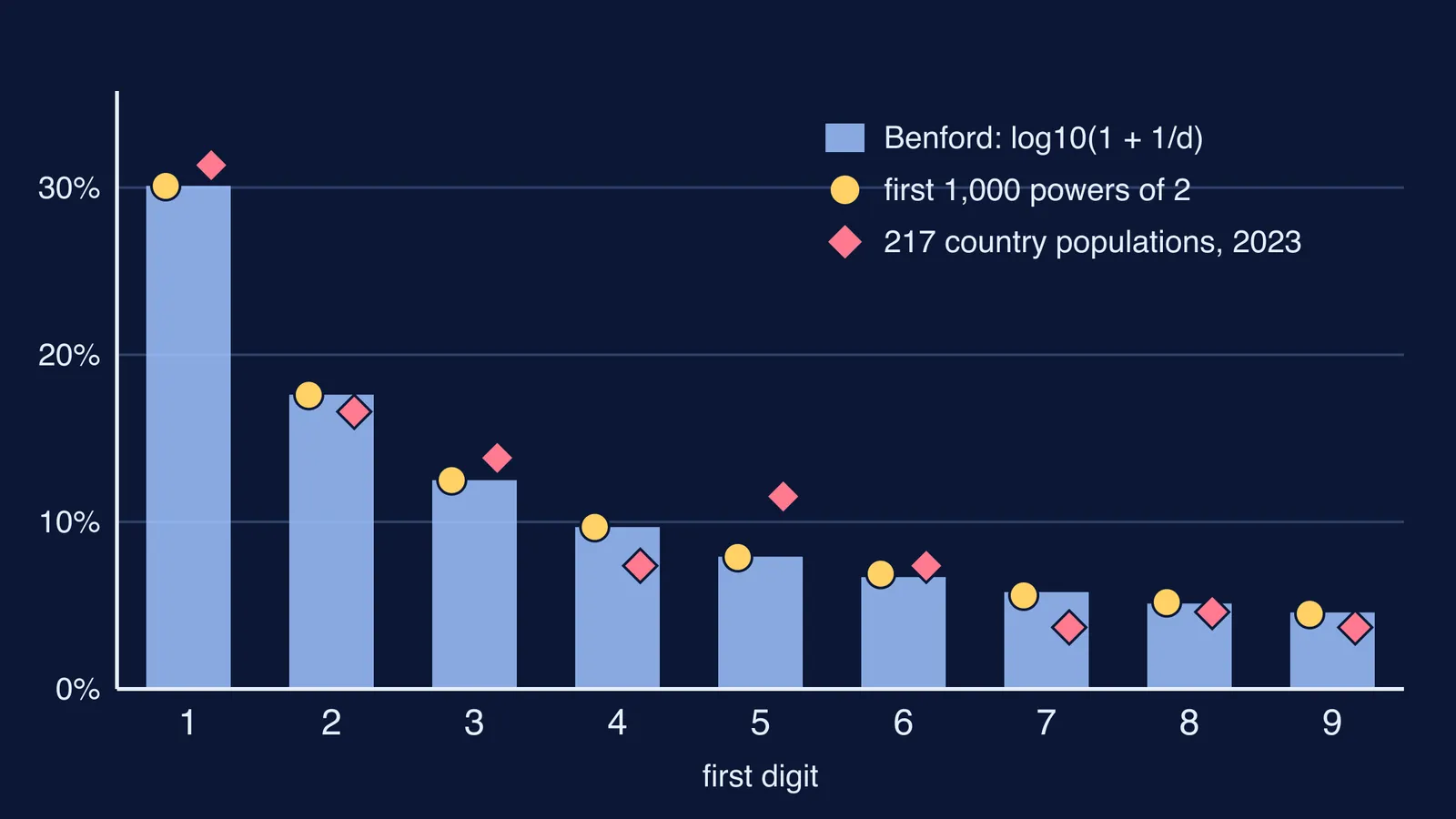
Country populations: in the World Bank's 2023 population figures for 217 countries and territories, 68 start with 1 (31.3%), 36 with 2 (16.6%) and only 8 with 9 (3.7%).
Powers of 2: of the first 1,000 powers, from 2^0 to 2^999, 301 start with 1, 176 with 2, 125 with 3 and only 45 with 9.
Benford's law says the share of numbers with first digit d is log10(1 + 1/d). As Steven W. Smith shows in his chapter explaining Benford's law, that is 30.1% for 1 and 17.6% for 2; the same formula gives 12.5% for 3, down to 4.6% for 9. The powers of 2 match it almost exactly. The smaller population sample wobbles (more 5s than 4s), but slides clearly from 1 to 9.
Why do so many numbers start with 1?
Picture a logarithmic ruler, where 1, 10, 100 and 1,000 sit at equal spacing, the same idea behind why the decibel scale is logarithmic. Between 1 and 10, the stretch from 1 to 2 takes up log10 2, about 30.1% of the length (Smith); the stretch from 9 to 10 takes up only log10(10/9), about 4.6% (Benford). Every decade repeats the pattern.
Numbers spread smoothly across several powers of ten land roughly evenly along that ruler, so about 30% fall in a stretch that starts with 1. In Smith's words, the law is followed by distributions that are "wide compared with unit distance along the logarithmic scale", and not by narrow ones.
Growth helps too: going from 1 to 2 means doubling, but 9 to 10 is a small step, so steadily growing quantities spend longer with a leading 1. Theodore Hill showed in Statistical Science in 1995 that if distributions are picked at random and samples from each are pooled, the first digits of the combined sample converge to Benford's distribution, which helps explain why mixed real-world tables fit.
How do you find the first digit of 2^10 without a calculator?
Take the log: log10(2^10) = 10 × 0.30103 = 3.0103.
Keep only the part after the decimal point: 0.0103.
It lies between log10 1 = 0 and log10 2 = 0.301, so the first digit is 1.
Check: 2^10 = 1,024.
Now try 2^20 (it is 1,048,576). If a step felt shaky, our guide to logarithm rules and common mistakes covers them.
When does Benford's law not apply?
The law needs numbers that range freely over several orders of magnitude. Smith shows that random numbers from a bell curve with mean 5 and standard deviation 3 do not follow it (Smith). Expect it to fail when:
The range is narrow. Adult heights in centimetres almost all begin with 1 because of the tight range, not because of Benford.
Numbers are assigned. Phone numbers, roll numbers and PIN codes follow whatever scheme someone chose.
There are built-in limits. Marks out of 80, or prices set just under ₹1,000, are bunched by rule.
The list is short. A few dozen values wobble a lot.
Hill's paper mentions the law's application to detecting fraud in accounting data. Figures that should follow Benford but don't are a reason to look closer, not proof of cheating.
Try it yourself: a 20-minute first-digit check
Pick 100 or more numbers spanning several powers of ten: river lengths from an atlas, district populations from the Census, or 2^1 to 2^100.
Tally only the first digits and turn each count into a percentage.
Compare with the formula's shares (see Smith's chapter): 30.1, 17.6, 12.5, 9.7, 7.9, 6.7, 5.8, 5.1 and 4.6%.
Repeat with your classmates' heights and watch the pattern disappear.
Like coin tosses, the pattern only settles once you have many values; see why probability works over many trials. A log ruler is easier to see than to read, and the Fermi Simulation Lab has interactive simulations for ideas like it. If logarithms are the gap, the Fermi Concept Library has a lesson for every concept in mathematics.