

On this page
Augmented reality (AR) puts virtual objects on top of your view of the real world, so a molecule or a magnetic field appears to sit on your desk. That is the definition used in a systematic review of 68 AR studies by Murat Akçayır and Gökçe Akçayır.
Does augmented reality help you learn science?
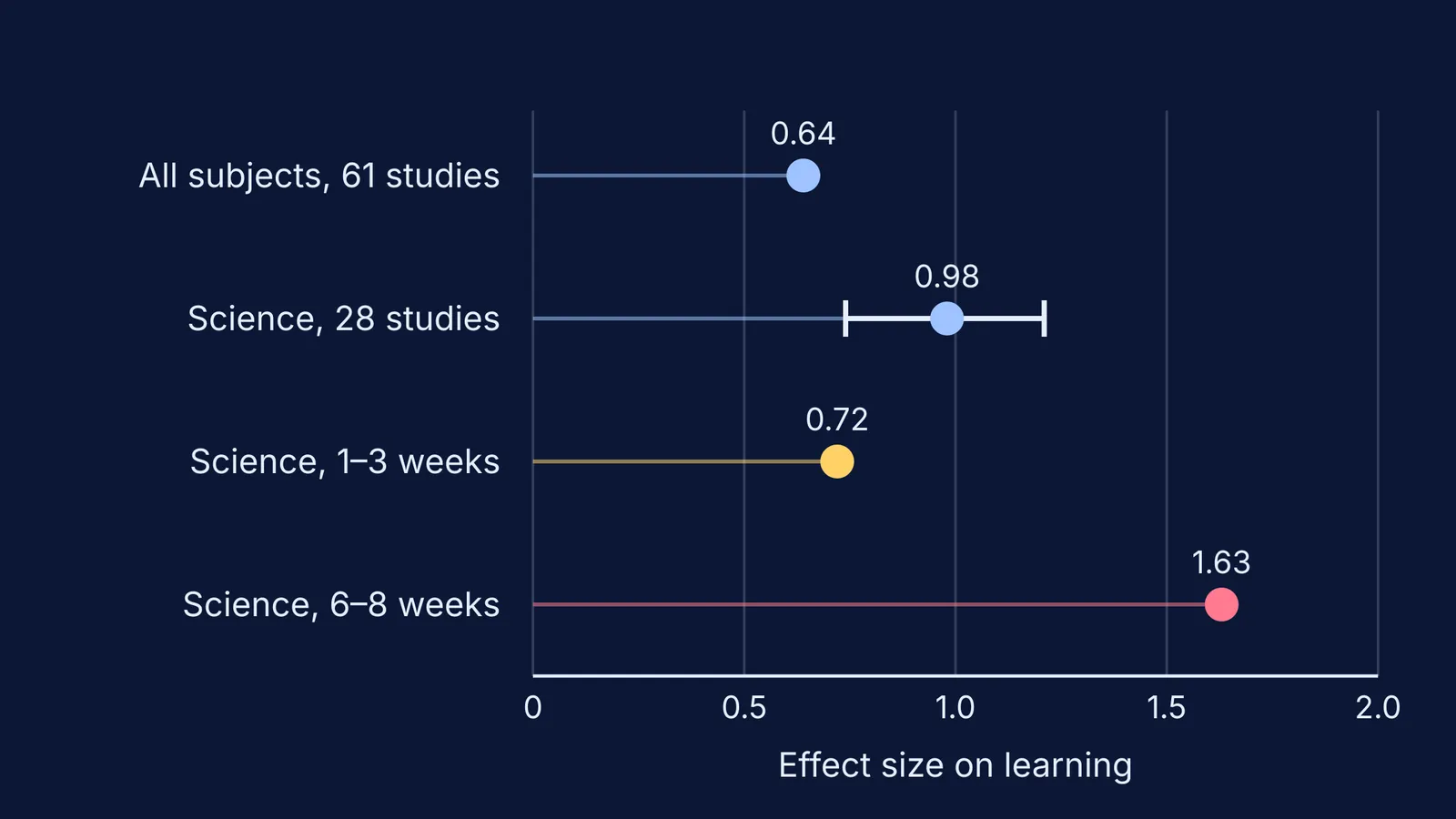
On average, yes. A meta-analysis of 61 studies by Juan Garzón, Juan Pavón and Silvia Baldiris found that AR has a medium effect on learning effectiveness (d = 0.64). Its studies, from 2012 to 2018, covered many subjects and age groups.
A science-only analysis found a larger effect. A 2026 meta-analysis by Sarina Mae Barcenas and Maricar Prudente pooled 28 studies from 2020 to 2025 with 2,841 secondary school students in biology, chemistry, physics and earth science, and found a large overall effect (g = 0.98). The subject did not significantly change the result.
A larger review of 134 experimental and quasi-experimental studies led by Hsin-Yi Chang found AR helped at all three levels it measured: students' responses such as motivation, their knowledge and skills, and their performance.
Two cautions. Check what AR was compared with: an ordinary lesson is an easier benchmark than a good animation or a teacher with a model kit. And results varied a lot between studies: Barcenas and Prudente report substantial heterogeneity (I² = 80.67%), so the average hides some AR lessons that did little.
Which science topics is AR useful for?
AR is most promising where the thing you need to see is three-dimensional or invisible. The Akçayır review notes that AR helps learners visualise abstract concepts and unobservable phenomena, giving electron movements and magnetic fields as examples.
Two studies show what that looks like:
Fields: in a study by María Blanca Ibáñez and colleagues, 64 high school students learned the basics of electromagnetism with either an AR app or a web-based app. The AR approach was more effective for learning electromagnetic concepts and phenomena. Because the comparison was another digital app rather than a textbook, this is a fairer test.
3D structures: Su Cai, Xu Wang and Feng-Kuang Chiang built an AR tool for junior high chemistry, tested in Shenzhen, where students moved and combined 3D models of particles using markers. It had a significant supplemental learning effect and helped low-achieving students more than high-achieving ones.
The Chang review adds a warning: 3D visualisation in AR needs careful design and evaluation. We cover the non-AR versions of these skills in seeing molecules in 3D and reading electric and magnetic field lines.
If your trouble is picturing a field or a wave, you don't need a headset: the Fermi Simulation Lab has interactive simulations for ideas that are easier to see than to read.
How much of the effect is just novelty?
Some of it, possibly. Akçayır and Akçayır point out that in most studies they reviewed, AR was new to the students, and that researchers sometimes mentioned an uncontrolled novelty effect that might diminish over time. The same review lists the costs: the most reported challenge was that AR is difficult for students to use, and some studies found it needed more time or caused cognitive overload.
There is a counterpoint. If excitement did all the work, longer use should shrink the gain. Barcenas and Prudente found the opposite: AR used for 6 to 8 weeks had a larger effect (g = 1.63) than AR used for 1 to 3 weeks (g = 0.72). Longer studies may differ in other ways, though. A similar question comes up in our post on what studies found about virtual reality in science lessons.
How should you use AR for science revision?
Pick the right topic: 3D shapes (molecular geometry, crystal lattices, the chambers of the heart) or invisible fields. Skip AR for definitions and numerical drills.
Write one question before you open the app, so you know what to look for.
Close the app and draw what you saw from memory.
Test yourself with a problem that needs the picture.
A worked example. A long straight wire stands upright with current flowing upward. Which way does the field point at a spot just east of the wire (ignore Earth's own field)? An AR field app would show circles around the wire, running anticlockwise when seen from above: thumb along the current, fingers curl with the field. Close the app and sketch it. On the east side, anticlockwise circles run northward, so the field points north. If your sketch says south, your curl is backwards.
For parents weighing an AR app or kit, ask three questions. Does it cover a topic your child finds hard to picture? Will they use it for several weeks, not one evening? Does it ask them to predict or explain, rather than just watch?
If you are not sure which topics to start with, Fermi's AI tutor works out what you already know and builds a plan for the session, drawing the figure or running the simulation where a picture helps.
Pick one hard-to-picture topic this week and try the four steps.


