

On this page
Ask a chatbot whether work done by a gas is positive or negative and you may get a confident answer that is right in one of your textbooks and wrong in the other. Your two NCERT books disagree on purpose, so the fix is one line: make the AI state its sign convention for work and heat before it solves anything, then check it against your book.
Is work done by a gas positive or negative?
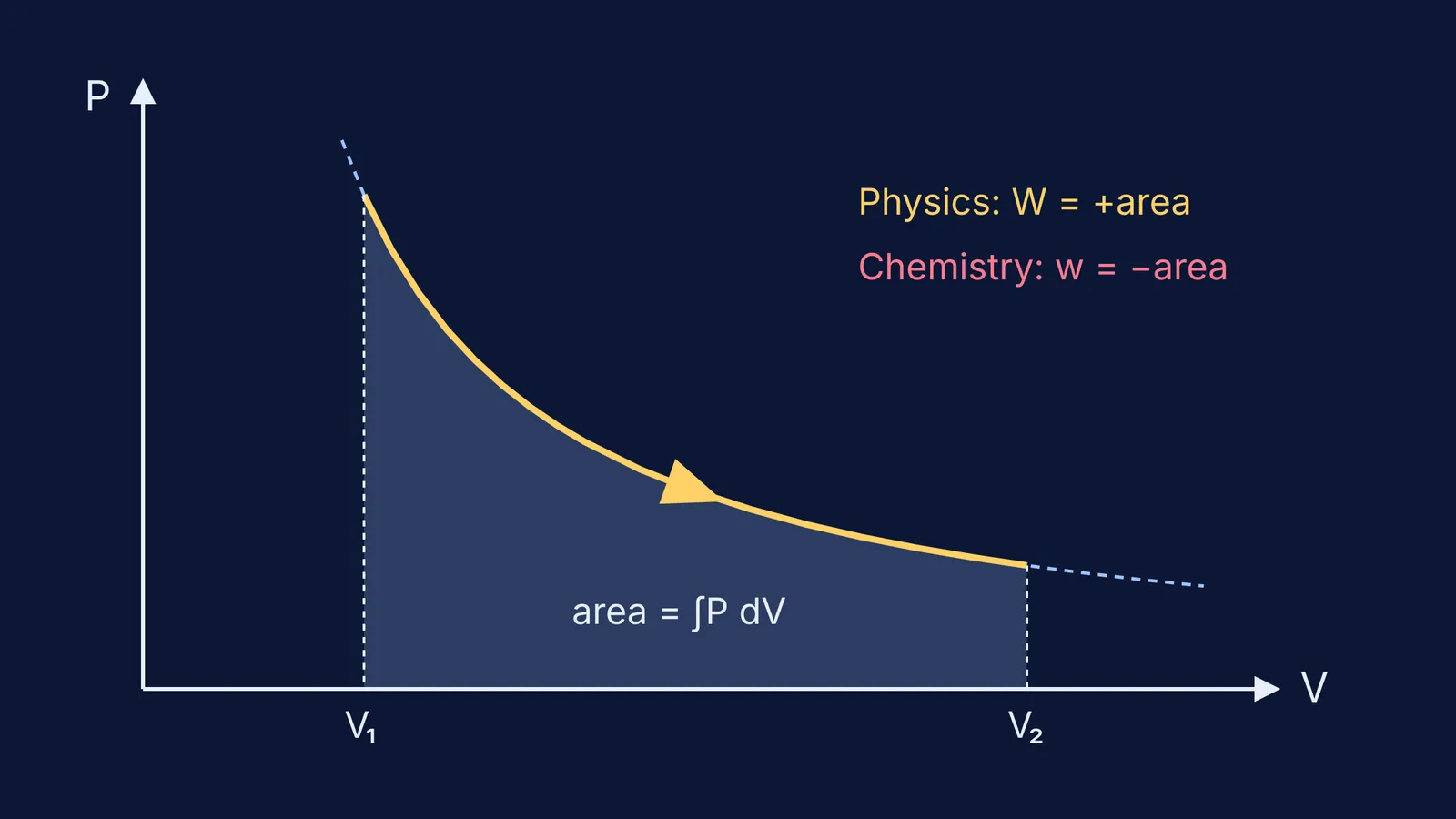
Physics convention. The NCERT Class 11 Physics chapter on thermodynamics writes the first law as ΔQ = ΔU + ΔW, where ΔQ is heat supplied to the system and ΔW is work done by the system on the surroundings. In this convention, a gas that expands does positive work.
Chemistry convention. The NCERT Class 11 Chemistry chapter on thermodynamics writes the first law as ΔU = q + w and says that, by IUPAC conventions, w is positive when work is done on the system. In this convention, a gas that expands has a negative w, and the book's formula for pressure-volume work is w = −p_ex ΔV.
Heat is positive when it flows into the system in both books. Only work flips.
Why do AI answers mix up the sign of work?
A chatbot learns from physics books, chemistry books and forum posts that don't agree. If your question doesn't name the subject, it picks a convention without telling you, and sometimes switches halfway: ΔU = q + w from chemistry, then W = PΔV from physics with a plus sign. Every line looks reasonable, but the answer is off by twice the work term.
The trap exists inside one chapter too. In Problem 5.1 of the NCERT Chemistry chapter, when "w amount of work is done by the system", the answer is ΔU = q − w, because w there is a size, not a signed quantity.
What should you type before asking a thermodynamics question?
Paste these lines before your question and fill in the subject:
"This is a Class 11 [Physics or Chemistry] question from NCERT."
"Before solving, write your first-law equation and say in words whether work is counted as done by the gas or on the gas, and when heat is positive."
"Use that convention in every step. If a quantity is only a magnitude, say so."
"At the end, say whether the gas expanded or was compressed, and check that the sign of work matches."
Then check the first line of the reply against this list:
Physics: ΔQ = ΔU + ΔW, ΔW is done by the gas, expansion gives positive work.
Chemistry: ΔU = q + w, w is done on the gas, expansion gives negative w.
Both: heat flowing into the gas is positive.
If it doesn't match your book, correct it before reading further.
Does the sign convention change the answer?
For ΔU, no, as long as you stay consistent. NCERT Physics works through turning 1 g of water into steam at atmospheric pressure. The heat supplied is 2256 J, the volume goes from 1 cm³ to 1671 cm³, and the work done by the water is about 1.013 × 10⁵ Pa × 1670 × 10⁻⁶ m³ ≈ 169.2 J, so ΔU = 2256 − 169.2 = 2086.8 J (NCERT Physics, section 11.5).
Now do it the chemistry way. Heat flows in, so q = +2256 J. The water expands against the atmosphere, so w = −p_ex ΔV = −169.2 J. Then ΔU = q + w = 2256 + (−169.2) = 2086.8 J.
Same ΔU; only the sign on the work changed. The real mistake is mixing the two: w = +169.2 J in the chemistry equation gives ΔU = 2425.2 J, which is wrong. The convention line in your prompt is there to catch exactly that.
For practice, try these first law numericals linking Q, W and ΔU, then use this checklist for checking AI answers to thermodynamics numericals.
How can you check the sign yourself in ten seconds?
Picture the piston. If the gas pushes it out, the gas does work on the surroundings: positive in physics, negative in chemistry.
Check ΔU last. It depends only on the state, so both conventions must give the same ΔU.
Use the isothermal case. For isothermal expansion of an ideal gas, ΔU = 0, so ΔQ = ΔW: all the heat supplied goes into work (NCERT Physics, section 11.5).
This heat engine cycle on a P-V diagram shows why the direction you travel along the curve decides the sign of the work.
If the sign keeps slipping in your own working, the Fermi Problem Library has worked problems with a step-by-step solver that explains the reasoning rather than printing an answer, so you can see where the sign enters. Fermi's AI tutor holds a line of reasoning across a whole session and checks understanding as it goes, which is the habit this prompt tries to build into any chatbot.
Next time you open a chatbot for a gas question, type the convention line first.


