

On this page
You paste a weak acid question into an AI chatbot. It writes Ka = x²/C, takes a square root and gives a pH. Often that works. Sometimes it has dropped a term it should not have. Here is what to ask, and a two-minute check.
What is the 5% rule for weak acids?
For a weak acid HA at starting concentration C, Ka = x²/(C − x), where x is [H⁺]. The shortcut drops the x on the bottom, so x ≈ √(Ka·C).
Chemistry LibreTexts/13%3A_Acid-Base_Equilibria/13.03%3A_Finding_the_pH_of_weak_Acids_Bases_and_Salts) calls the usual test the "five percent rule": if the first value of x is more than 5 percent of the concentration it is subtracted from, the approximation is not justified. The same page warns that the approximation will not generally be valid when the acid is very weak or very dilute.
Why 5%? ChemTeam explains that Ka and Kb values are typically known only to about ±5%, so a smaller error is lost in the data anyway.
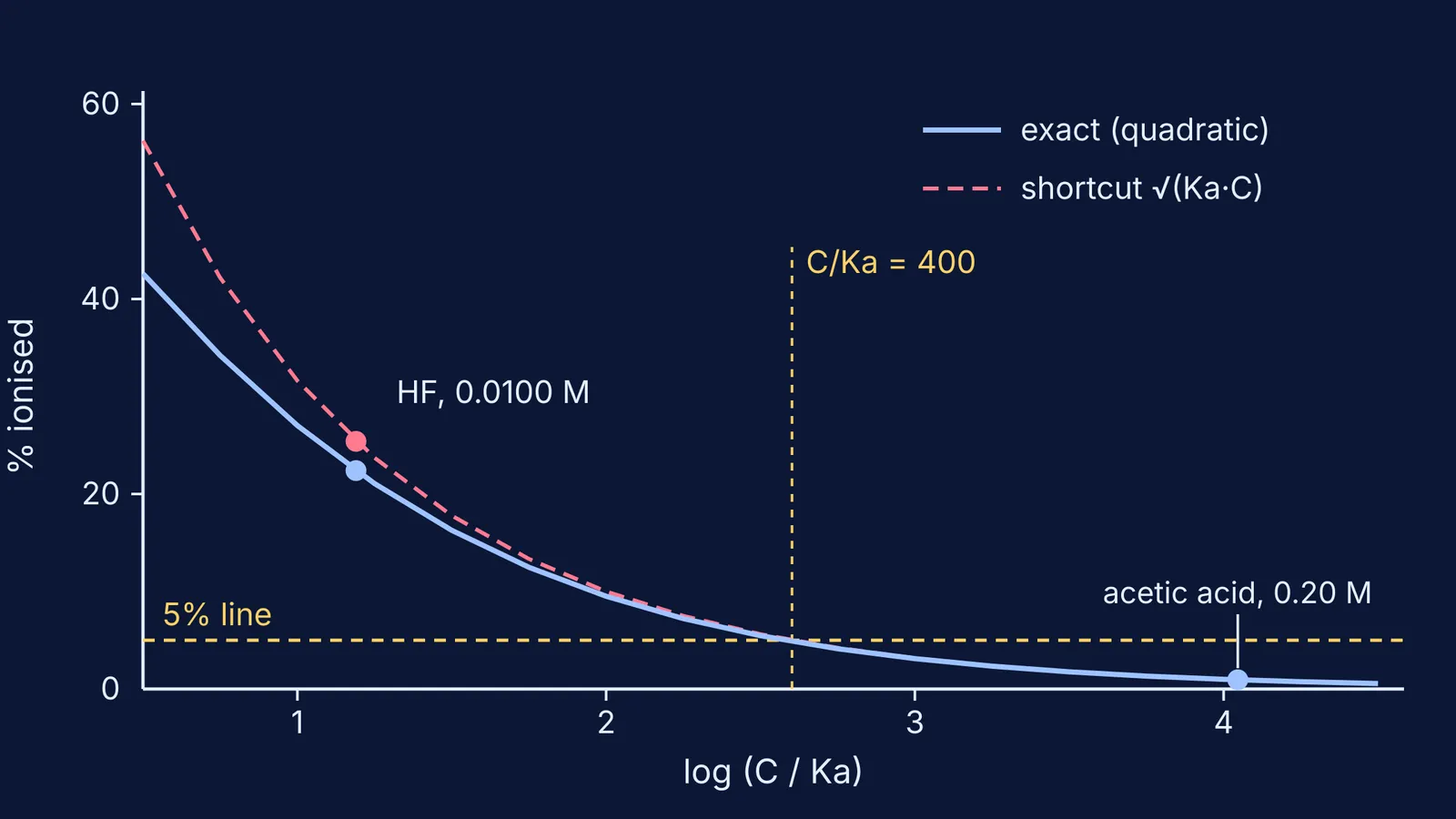
A quick pre-check follows from the algebra: with the shortcut, x/C = √(Ka/C), so x stays under 5% of C only when C/Ka is at least about 400.
How do I ask AI whether the weak acid approximation is valid here?
Don't just ask for the pH. Ask the AI to show the decision against ChemTeam's 5% test:
"Before solving, write the Ka expression with (C − x) in it."
"Solve using the approximation, then tell me x as a percentage of C."
"If that is over 5%, solve the quadratic and give me both pH values."
"Put your final x back into x²/(C − x) and show me the number you get."
The fourth line matters most: it turns the AI's claim into a number you can check.
Worked example: does the shortcut hold for 0.0100 M HF?
ChemTeam's example gives the Ka of HF as 6.46 × 10⁻⁴ and asks for the pH of a 0.0100 M solution. With the approximation, the percent dissociation comes to 25.4%, so ChemTeam says the quadratic must be used. (C/Ka is only about 15.) The full check:
Shortcut: x = √(6.46 × 10⁻⁴ × 0.0100) = 2.54 × 10⁻³ M, so pH = 2.60. But x is 25.4% of C. Fail.
Plug back: (2.54 × 10⁻³)² ÷ (0.0100 − 0.00254) = 8.66 × 10⁻⁴. About a third above the given Ka.
Quadratic: x² + Ka·x − Ka·C = 0 gives x = 2.24 × 10⁻³ M, so pH = 2.65. Plugging the unrounded x back returns 6.46 × 10⁻⁴.
Now the opposite case. LibreTexts works through 0.20 M acetic acid with Ka = 1.8 × 10⁻⁵ and gets x = 1.9 × 10⁻³ M, pH 2.7, on the same weak acid page/13%3A_Acid-Base_Equilibria/13.03%3A_Finding_the_pH_of_weak_Acids_Bases_and_Salts). That x is under 1% of 0.20 M, and plugging it back gives 1.82 × 10⁻⁵, within 1% of Ka. The shortcut is fine. To run this logic in reverse, see our guide on finding Ka from the pH of a weak acid.
Does the 5% rule work for buffer questions too?
Not directly, but the same idea applies. The Henderson-Hasselbalch equation, pH = pKa + log([A⁻]/[HA]), uses starting concentrations in place of equilibrium ones: the same kind of shortcut. Chemistry LibreTexts/Acids_and_Bases/Buffers/Henderson-Hasselbalch_Approximation) gives two conditions: the log of the base-to-acid ratio should lie between −1 and 1 (a ratio between 0.1 and 10), and the buffer molarity should be 100 times Ka.
To check an AI's buffer answer, ask it to turn its pH back into [H⁺] and compare that with the acid and salt concentrations. Take 0.0010 M HF with 0.0010 M NaF. Henderson-Hasselbalch gives pH = pKa = 3.19. But that means [H⁺] = 6.5 × 10⁻⁴ M, which is 65% of 0.0010 M, and 0.0010 M is nowhere near 100 × Ka. Solving x(0.0010 + x) = Ka(0.0010 − x) exactly gives pH 3.49 instead. To watch buffer pH respond to added acid or base, try our buffer solution simulation.
A 60-second checklist before you trust the AI's pH
Did it write (C − x), or jump straight to x²/C?
Did it state x as a percentage of C? Over 5% means quadratic (ChemTeam).
For a buffer: is the ratio between 0.1 and 10, and are the concentrations around 100 times Ka or more (LibreTexts/Acids_and_Bases/Buffers/Henderson-Hasselbalch_Approximation))?
Did plugging x back return the Ka in the question?
The same habit works on any AI answer; see our post on checking NCERT exercise answers with AI.
The Fermi Problem Library has worked problems with a step-by-step solver that explains the reasoning rather than printing an answer. And Fermi's AI tutor notices where a student is stuck and decides whether to explain, ask or show, so the approximation step gets talked through, not skipped.
Next time an AI gives you a pH, ask for the percentage, then plug it back.


