On this page
For tens of thousands of medical aspirants across India, biology feels intuitive while physics feels like a barrier of mathematics. The National Eligibility cum Entrance Test (NEET-UG) assigns Physics 180 marks across 45 questions, as structured by the National Testing Agency. Yet because most NEET students choose the Physics-Chemistry-Biology stream and leave mathematics after Class 10, entering Class 11 mechanics creates friction. You understand physical concepts, but when a problem demands algebraic rearrangement or coordinate calculus, you freeze.
An AI tutor can change this dynamic—not by printing completed solutions, but by acting as an on-demand mathematics diagnostic coach during physics problem-solving.
Why does NEET physics feel so maths heavy?
The core challenge in NEET physics is rarely the physical concept; it is mathematical representation. In introductory kinematics, students must simultaneously track physical states and coordinate calculus. In *American Journal of Physics*, researchers Lillian C. McDermott, Mark L. Rosenquist, and Emily H. van Zee (1987) identified persistent confusion between physical trajectories and coordinate graphs. Later, Robert J. Beichner (1994) evaluated 895 students using the Test of Understanding Graphs in Kinematics (TUG-K), documenting slope-height confusion and difficulty calculating area under non-horizontal curves.
Leaving mathematics after Class 10 removes two years of practice with differentiation, trigonometry, and vectors. As cognitive load theory by John Sweller (1988) demonstrates, lacking automated mathematical schemas overloads working memory during multi-step numericals, leaving little capacity for physical reasoning.
What does tutoring research say about numerical problem-solving?
Generic chatbots often worsen this issue. Pasting a question into an answer bot returns a full derivation. Reading completed solutions creates an illusion of understanding, but leaves you stuck on the next numerical.
Tutoring research reveals a better path. In *Educational Psychologist*, Kurt VanLehn (2011) showed that step-based intelligent tutoring systems achieved an effect size of d = 0.76 compared to answer-based computer instruction (d = 0.31), performing nearly as effectively as human tutors (d = 0.79).
The takeaway for NEET aspirants is decisive: understanding develops from inspecting intermediate steps. A review comparing AI tutors that teach to answer chatbots shows that conversational scaffolding forces you to articulate mathematical connections rather than copying answers.
How to prompt an AI tutor for step-by-step math scaffolding?
To turn an AI tutor into a mathematics bridge for NEET physics, use this three-step protocol:
Decouple the physical law from calculation: State the governing principle in words first. Ask the tutor to confirm your physical setup before calculating.
Isolate the specific algebraic roadblock: Tell the AI tutor where your pencil stopped rather than asking for the full solution. For example, prompt: "I set up 40 = 2t + 0.5 × 10 × t². Do not solve for t. Walk me through rearranging this into standard quadratic form ax² + bx + c = 0 step by step."
Request faded practice pairs: Once you finish a calculation, ask for an isomorphic problem: identical mathematical structure with different numbers or physical contexts.
When practising numericals, focus on getting AI feedback on step-by-step physics solutions by typing out your algebraic reasoning line by line.
Which mathematical foundations should NEET aspirants prioritise?
You do not need Class 12 engineering mathematics to solve NEET physics numericals. You need fluency in four recurring tools:
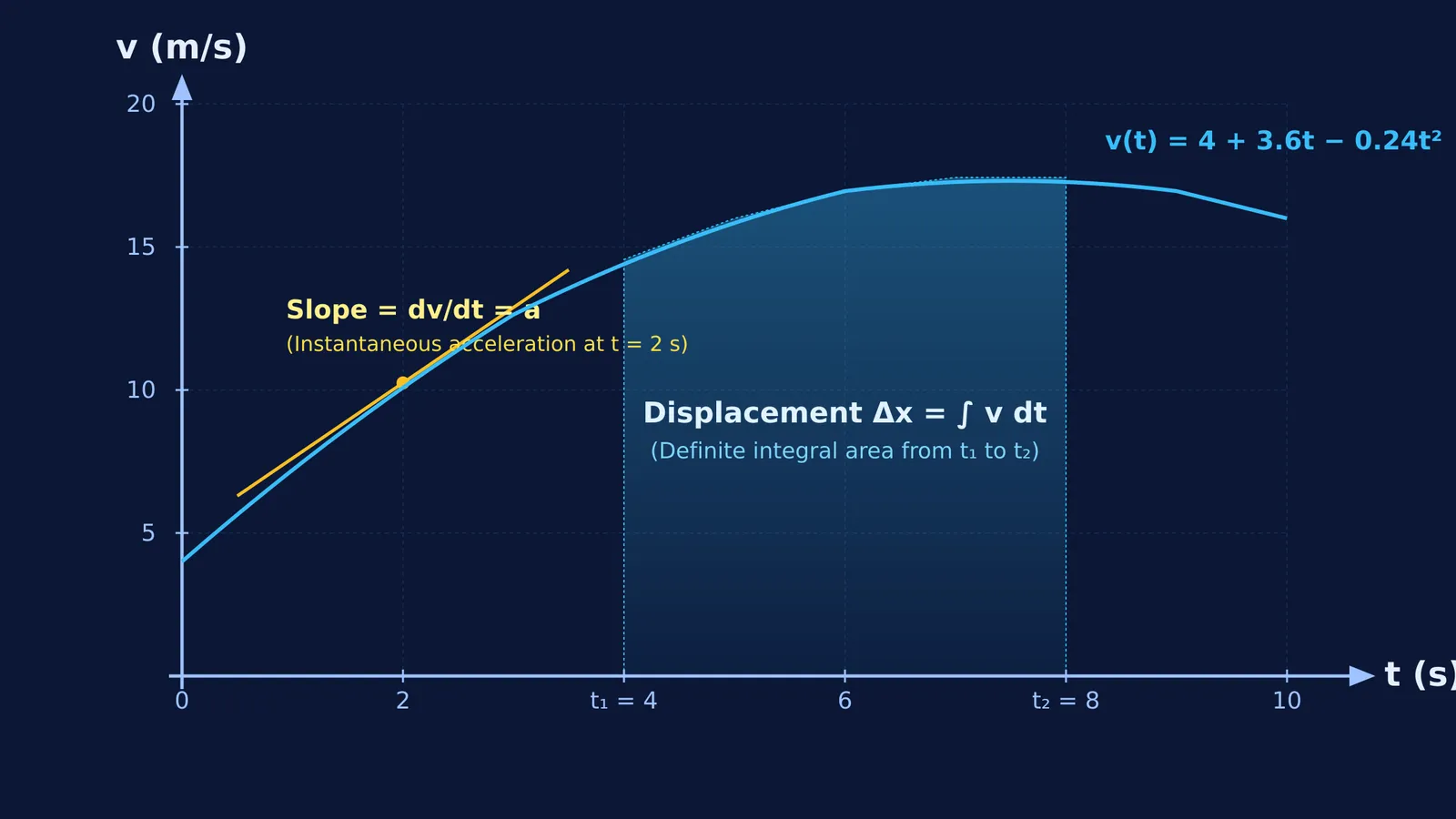
Graph interpretation: Recognise that curve slope dy/dx represents rate of change (such as acceleration a = dv/dt), while area under the curve represents accumulated product (such as displacement Δx = ∫ v dt). This skill is essential when converting PV, PT and VT graphs in thermodynamics.
Trigonometric resolution: Decomposing vectors into orthogonal components (F cos θ and F sin θ), standard 3-4-5 right triangles (sin 37° ≈ 0.6, cos 37° ≈ 0.8), and small-angle approximations (sin θ ≈ tan θ ≈ θ in radians).
Proportional reasoning: Master direct ratios: if kinetic energy K ∝ v², doubling velocity quadruples kinetic energy without calculating intermediate values.
Elementary power-rule calculus: Master basic derivatives, d(tⁿ)/dt = n·tⁿ⁻¹, and integrals, ∫ tⁿ dt = tⁿ⁺¹/(n+1).
How does Fermi's AI tutor teach step by step?
Solving numericals without fear requires a learning environment that spots where mathematical hesitation begins.
The Fermi Problem Library provides worked problems with a step-by-step solver that explains the reasoning rather than printing an answer. When you encounter a multi-step numerical, the solver separates the physical setup from subsequent algebraic steps.
For ideas that are easier to see than to read, the Fermi Simulation Lab provides interactive simulations. You can adjust initial conditions to see how graphs of position, velocity, and acceleration respond in real time.
Across your daily preparation, Fermi's AI tutor works out what you already know and builds a plan for the session, deciding whether to explain, ask, or show. By pinpointing the exact algebra and graphing sub-skills that cause hesitation, the tutor turns intimidating numericals into manageable, repeatable steps.