On this page
In Class 9, algebra moves on to polynomials and geometry starts asking for proofs. An AI chatbot can help with both, or quietly do the thinking for you. How you use it decides which.
Why shouldn't AI just give you the answer?
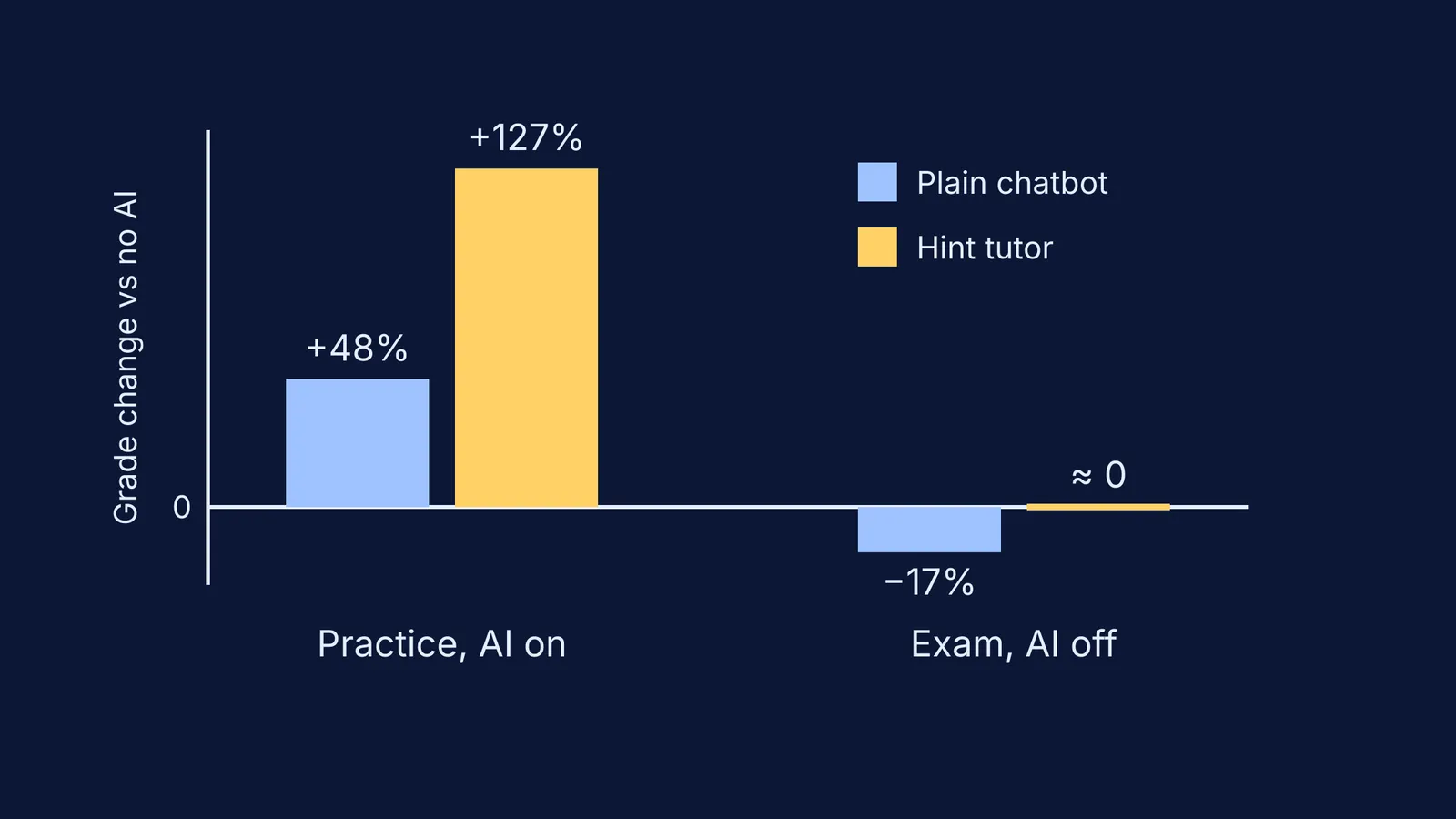
The clearest evidence comes from a field experiment published in PNAS in 2025 by Hamsa Bastani and colleagues (Bastani et al., PNAS). Nearly a thousand high school maths students in Turkey practised with either a standard ChatGPT-style tool, a version with prompts designed to protect learning, or no AI at all (Knowledge at Wharton summary).
While they had AI, grades on practice problems rose by 48% with the plain chatbot and by 127% with the guarded tutor, according to the study's abstract (PNAS). When AI was taken away for the exam, students who had used the plain chatbot scored 17% lower than students who never had access (PNAS). The authors report that, without guardrails, students used the AI as a “crutch” during practice, and that the safeguards in the guarded tutor largely mitigated the harm. That tutor was designed to guide students with hints rather than give answers directly (Knowledge at Wharton).
The lesson: practice that feels easy with AI is not the same as being able to do it alone, and your exams are on paper. A related piece covers what a 2024 study of ChatGPT hints in maths found.
How should a Class 9 student use AI for maths?
Use AI as a coach that gives the smallest useful nudge, and do the writing yourself. Climb this hint ladder one rung at a time, stopping as soon as you can move.
Ask which idea or chapter result applies, without any working.
Ask for the first step only.
Ask the AI to check a step you wrote and say whether it is right, not to fix it.
Only after a real attempt, ask for a full solution, then close it and redo the problem on paper.
Then explain each step back in your own words. This is called self-explanation: telling yourself why a step follows from the one before. A 2018 meta-analysis of 69 effect sizes from 64 research reports found that prompting learners to self-explain while studying or solving problems had an overall weighted mean effect of g = 0.55 (Bisra et al., Educational Psychology Review). Our guide to the self-explanation technique for worked examples shows how to do it.
What does this look like on a real problem?
Take a Class 9 polynomials question: factorise 2x² + 7x + 3. Here is a script to follow.
You: “Don't solve it. Which method should I try for 2x² + 7x + 3?” The AI should point you to splitting the middle term.
You, on paper: the product of 2 and 3 is 6, and you need two numbers that multiply to 6 and add to 7. That gives 6 and 1.
You: “I wrote 2x² + 6x + x + 3. Is this step right? Just yes or no and why.”
You, on paper: 2x(x + 3) + 1(x + 3) = (2x + 1)(x + 3).
You check it yourself with the factor theorem: put x = −3 and get 18 − 21 + 3 = 0, so (x + 3) is a factor.
For geometry, draw the figure yourself, mark what is given, then ask “Which congruence rule might fit? Don't write the proof.” To revise the chapter itself, see our explainer on polynomials in Class 9 and the factor theorem.
Fermi's AI tutor is built to teach rather than answer: it notices where you are stuck and decides whether to explain, ask or show, so a session moves at the pace of your own working.
How can you plan a week of maths with AI?
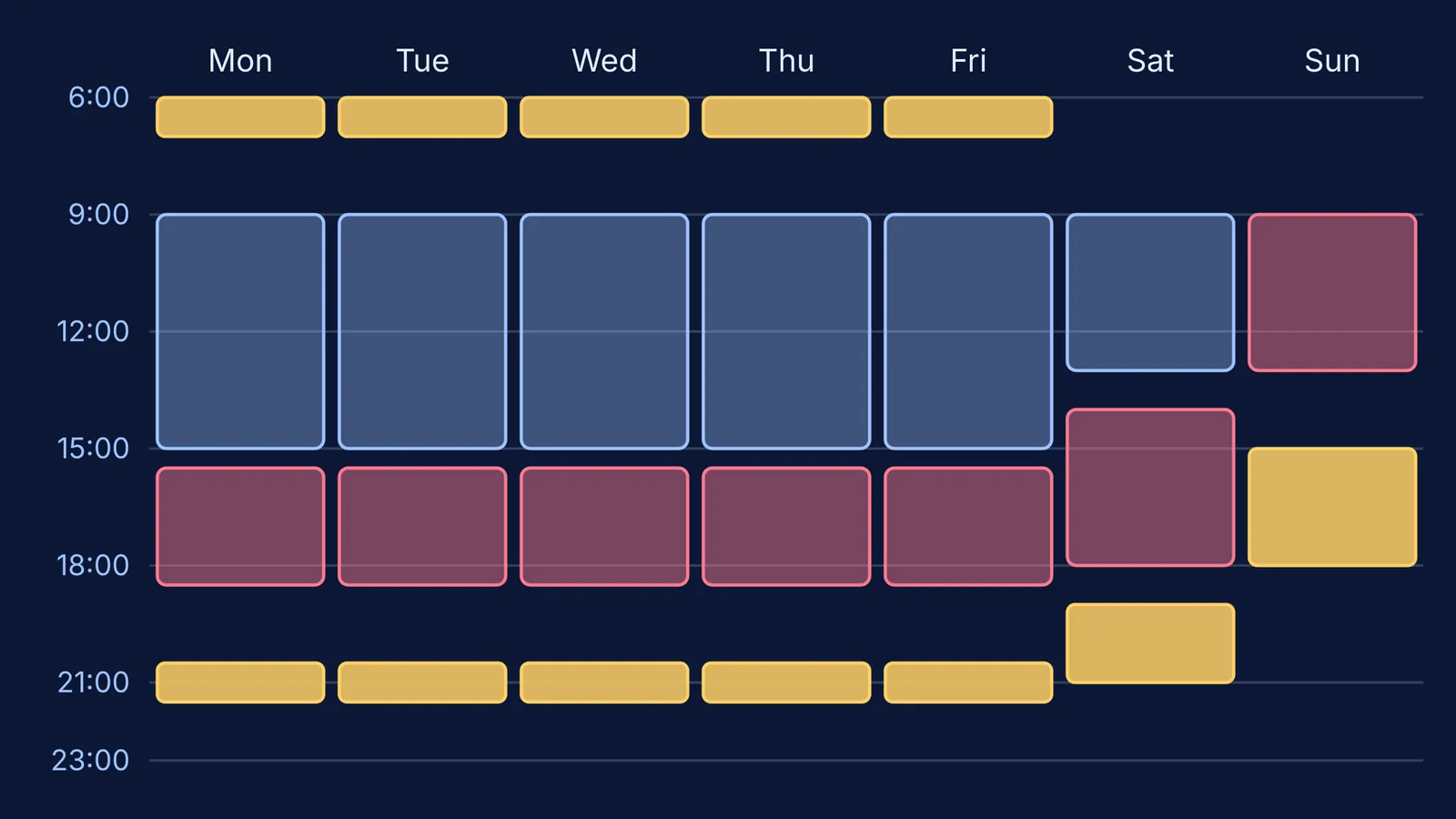
Monday: read the textbook section and solve its examples on paper, no AI.
Tuesday: try the exercise, climbing the hint ladder when stuck.
Wednesday: redo the problems you needed hints for, without help.
Thursday: ask the AI for a similar question, solve it, and explain each step aloud.
Friday: mixed revision of older chapters on paper.
Weekend: note each mistake and its reason in a notebook.
When a method keeps going wrong, the Fermi Problem Library has worked problems with a step-by-step solver that explains the reasoning rather than printing an answer. Cover each step, predict it, then reveal it.
What should parents look for?
You do not need to know the maths to help. Ask to see the notebook, not the chat.
Good sign: short questions to the AI, long working on paper.
Warning sign: neat full solutions copied from the screen, with nothing crossed out.
A useful question at dinner: “Explain one step you got stuck on today and how you got past it.”
If maths worry starts affecting sleep or mood, talk to a school counsellor, or call Tele MANAS, the free 24x7 national mental-health helpline, on 14416 (IIT Kanpur counselling service page).
Start this week with one chapter and the hint ladder, and judge progress by what you can do on paper.