

On this page
When you read the chapter on tissues, the definitions make sense. You see that epithelial tissue covers the body, while connective tissue supports it. But when an exam asks you to identify the tissue in the lining of a blood vessel or the husk of a coconut, you might blank out.
This happens because reading builds familiarity, not recall. A 2006 study in *Psychological Science* found that prior testing produced substantially greater long-term retention than studying, even though studying repeatedly increased students' confidence in their ability (10.1111/j.1467-9280.2006.01693.x). To remember the location and job of each tissue, you need to practise retrieving the information.
How do I ask AI to quiz the location and job of plant and animal tissue types?
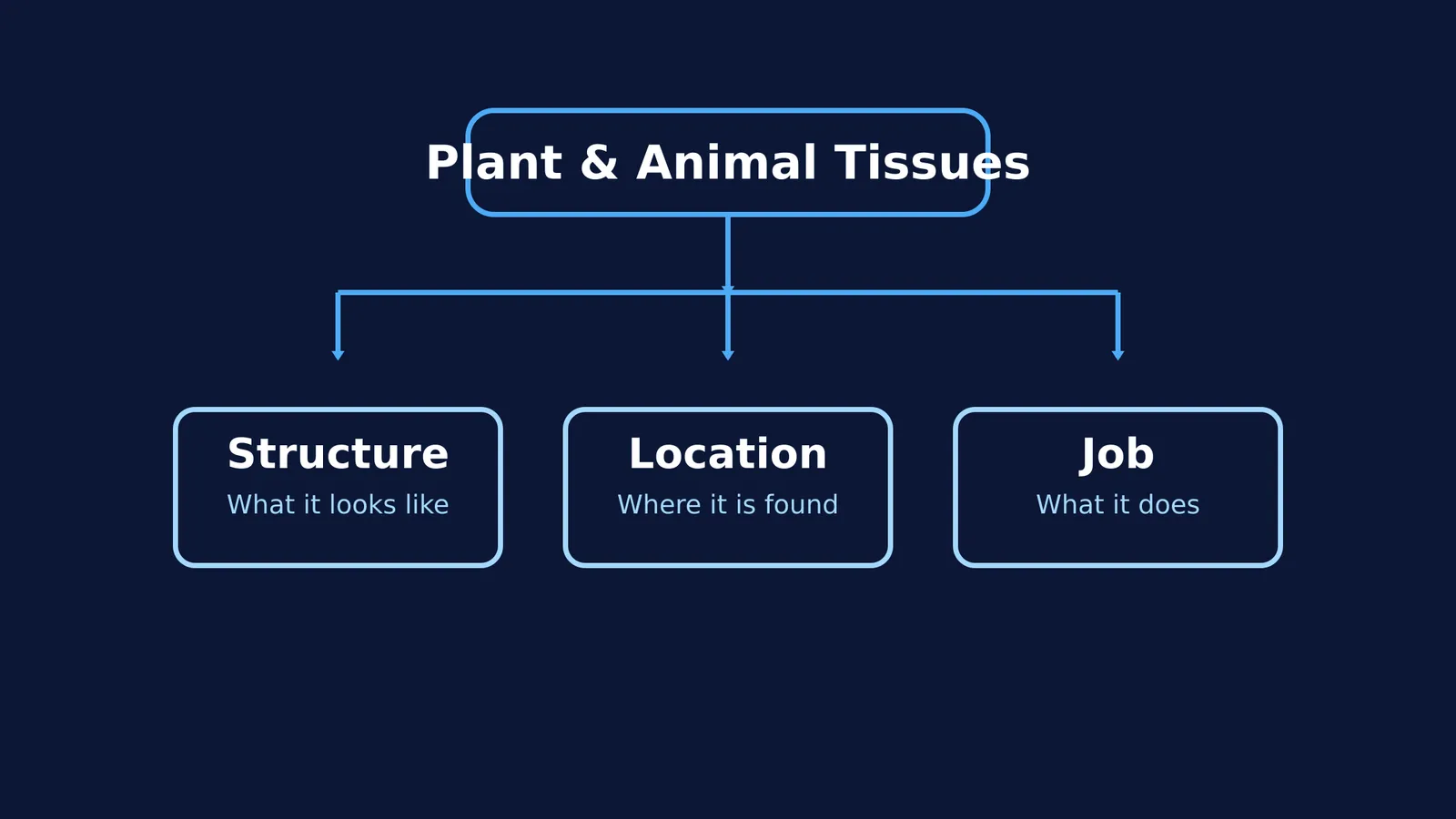
Instead of just asking for a summary, you can use AI to build an active testing session. You want to be tested on the three core pillars: structure, location and job.
Here is a script you can paste into your AI tool to start the quiz:
"I am studying plant and animal tissues."
"Ask me one question at a time."
"Describe a specific tissue based on its structure, location or job."
"Ask me to identify the tissue type and explain my reasoning, and wait for my answer."
For example, the AI might ask: "I am a plant tissue made of dead cells with thick walls. I am found in the veins of leaves and the hard covering of seeds. What am I?" You would answer "Sclerenchyma", and then explain why. If you are preparing for exams, you can also explore related topics like differentiation and dedifferentiation in plants to see how these tissues form.
For instance, when studying animal tissues, you might struggle with the difference between striated, smooth, and cardiac muscles. You can prompt the AI to focus entirely on muscle tissues for five minutes. It might ask, "I am an involuntary muscle tissue found in the walls of your stomach. I lack striations. What am I?" Retrieving "smooth muscle" from your memory, rather than just rereading a list of muscles, forces your brain to secure that connection.
How should you use NCERT figures with an AI quiz?
When the AI confirms your answer, your study session is not over. The NCERT textbook figures are heavily tested in exams, especially in biology.
Take the AI's description and look at the corresponding diagram in your book. If the AI quizzes you on the ciliated epithelium in the respiratory tract, find that specific figure. Look at the hair-like cilia on the surface. Does the picture match the description of the structure? If you are discussing how these cells divide, you might also revise cytokinesis in plant and animal cells.
In plant anatomy, differentiating between parenchyma, collenchyma, and sclerenchyma can be tricky because they all sound similar. Your NCERT diagrams show the thick corners of collenchyma cells and the narrow lumens of sclerenchyma. When the AI describes the "unevenly thickened cell walls at the corners" of a plant tissue, manually finding that exact diagram in your book reinforces the visual memory. You connect the text-based clue from the AI to the visual evidence in front of you.
If you are stuck and need a guided approach, Fermi's AI tutor can work out what you already know and build a plan for the session. It teaches rather than answers: it notices where a student is stuck and checks understanding as it goes.
What if the AI gives an unfamiliar tissue example?
AI tools can sometimes bring up examples that are correct in nature but outside your syllabus. If the AI mentions a tissue location you do not recognise, do not panic.
Ask the AI to stick to the examples provided in your textbook syllabus, or use it as an opportunity to ask what if questions to ask an AI tutor to deepen your understanding of the underlying concept.
By blending the active recall of an AI quiz with the visual confirmation of your textbook diagrams, you stop passively reading and start actively learning.


