On this page
Ask a chatbot which law punishes cheating in India and there is a fair chance it answers "Section 420 of the Indian Penal Code". For a civics project written today, that is out of date. Three new criminal laws, the Bharatiya Nyaya Sanhita (BNS), the Bharatiya Nagarik Suraksha Sanhita and the Bharatiya Sakshya Adhiniyam, came into force on 1 July 2024, according to the Ministry of Home Affairs year-end review on PIB. They replaced the Indian Penal Code, the Code of Criminal Procedure and the Indian Evidence Act.
Why does AI still mention IPC instead of the new criminal laws?
Training cutoff. A language model learns from text collected up to a date, called its knowledge cutoff. Unless the tool searches the web while answering, anything after that date is invisible to it.
The cutoff is blurrier than it looks. A 2024 study by Jeffrey Cheng and colleagues found that a model's "effective cutoff" often differs from the cutoff its makers report, partly because new web crawls contain a lot of old pages (Cheng et al., Dated Data, arXiv).
Old text outnumbers new text. The old criminal laws ran for over 150 years, as the foreword to the Delhi Police Academy's BNS handbook puts it. Judgments, guides and news from that time all say "IPC", so a model has likely seen the old numbers far more often than the new ones.
Drafts muddy the record. The bills the Lok Sabha passed on 20 December 2023 were the "(Second)" versions of the three bills (PIB, 20 December 2023), so the web also holds text about earlier drafts.
This is the same root problem we covered in why AI may not know this year's exam pattern: rules change faster than training data.
Which IPC sections changed number under the BNS?
Many of them. The BNS has 358 sections where the IPC had 511, according to the PIB release on the Lok Sabha debate. So you cannot assume an old IPC number carries over unchanged.
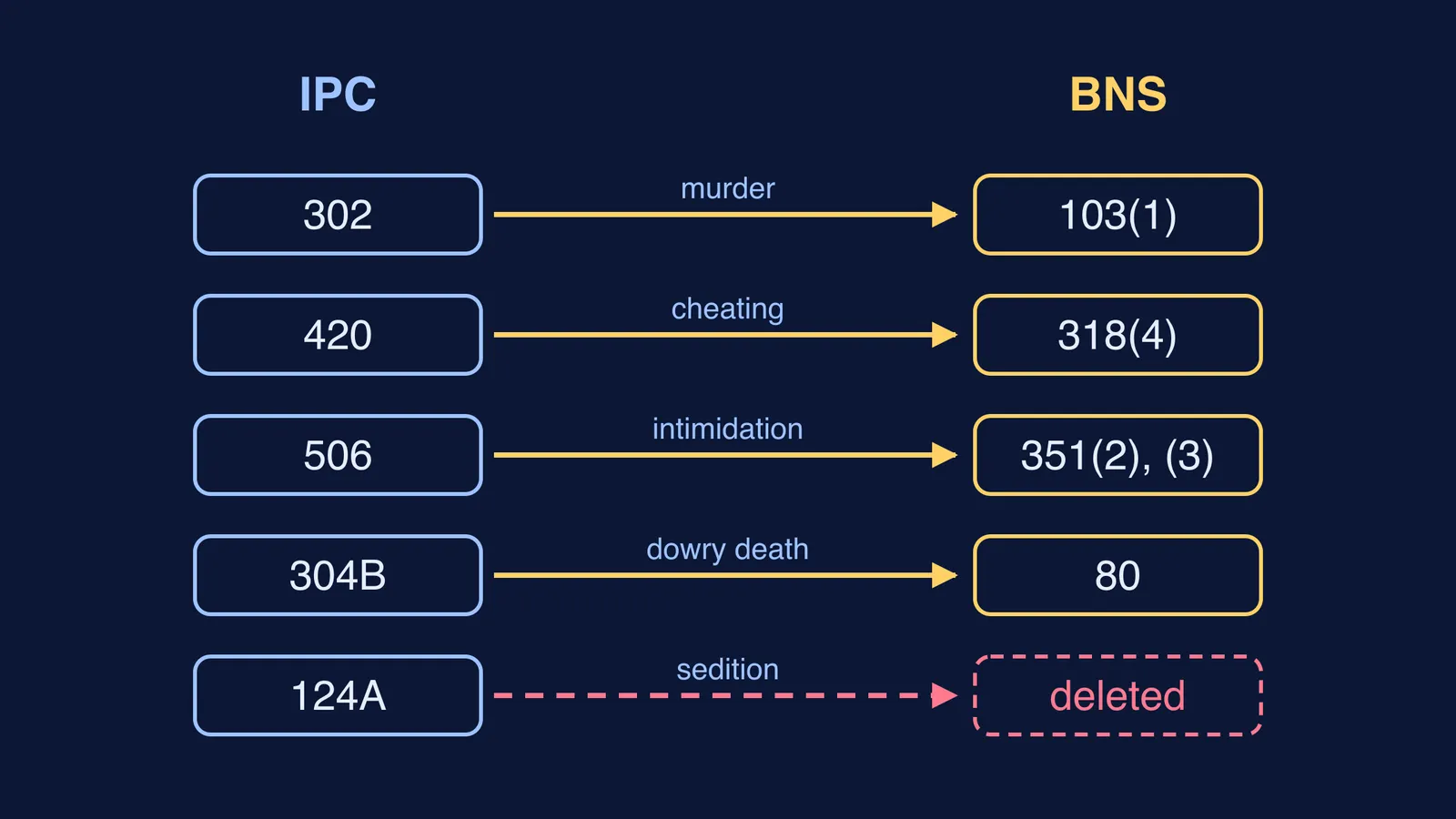
These pairs come from the commonly used sections table (Annexure VII) and the deleted sections list (Annexure III) in the Delhi Police Academy's BNS handbook:
Murder: IPC 302 is now BNS 103(1)
Cheating: IPC 420 is now BNS 318(4)
Criminal intimidation: IPC 506 is now BNS 351(2) and 351(3)
Dowry death: IPC 304B is now BNS 80
Common intention: IPC 34 is now BNS 3(5)
Sedition: IPC 124A is listed as deleted
How do you spot outdated legal facts in an AI answer?
Mark every checkable claim. Underline Act names, section numbers, years, and words like "currently" or "proposed".
Ask the AI about its own limits. Paste: "What is your knowledge cutoff? Was this law amended or replaced after that date? Give the current Act and section, and tell me if you are unsure." Confidence is not proof.
Check one official source per claim. Use a PIB release, a ministry or police handbook, or the Act itself. Skip blogs that do not show their source.
Watch for drafts. "Bill" is not "Act", and a "(Second)" bill replaced an earlier version. Make sure you are quoting the law that was passed and is in force.
Write it in both forms. Give the current section first and the old one in brackets, then the source and the date you checked it.
Once you have the official text, paste it in and ask the AI to answer only from it; see how to make AI answer only from your notes.
Worked example: fixing one AI sentence
Say an AI gives you this line for a Class 9 civics project: "Criminal intimidation is punished under Section 506 IPC, and sedition under Section 124A."
Act name: the IPC was replaced on 1 July 2024 (PIB, linked above). Flag it.
Section 506: the Delhi Police handbook maps it to BNS 351(2) and 351(3). Fix it.
Section 124A: the same handbook lists it as deleted. Do not guess what replaced it; read the BNS text before you write anything more.
Your corrected line: "Since 1 July 2024, criminal intimidation is covered by Section 351 of the Bharatiya Nyaya Sanhita, 2023 (formerly IPC 506). The Delhi Police BNS handbook lists IPC 124A, sedition, as deleted." Add the source and the date you checked.
Does this apply to other civics and policy facts?
Yes. Any rule that changes, from exam patterns to data protection rules, can be stale in an AI answer. Ask every time: what is the claim, when was it true, and which official page says so today? Our four-point checklist for reading an AI answer critically turns this into a habit.
The habit carries over to science and maths too. Fermi's AI tutor teaches rather than just answering: it decides whether to explain, ask or show, and checks your understanding as it goes, so you practise questioning an answer instead of copying it.
Pick one AI answer from your current project and run the five steps on it tonight.