

On this page
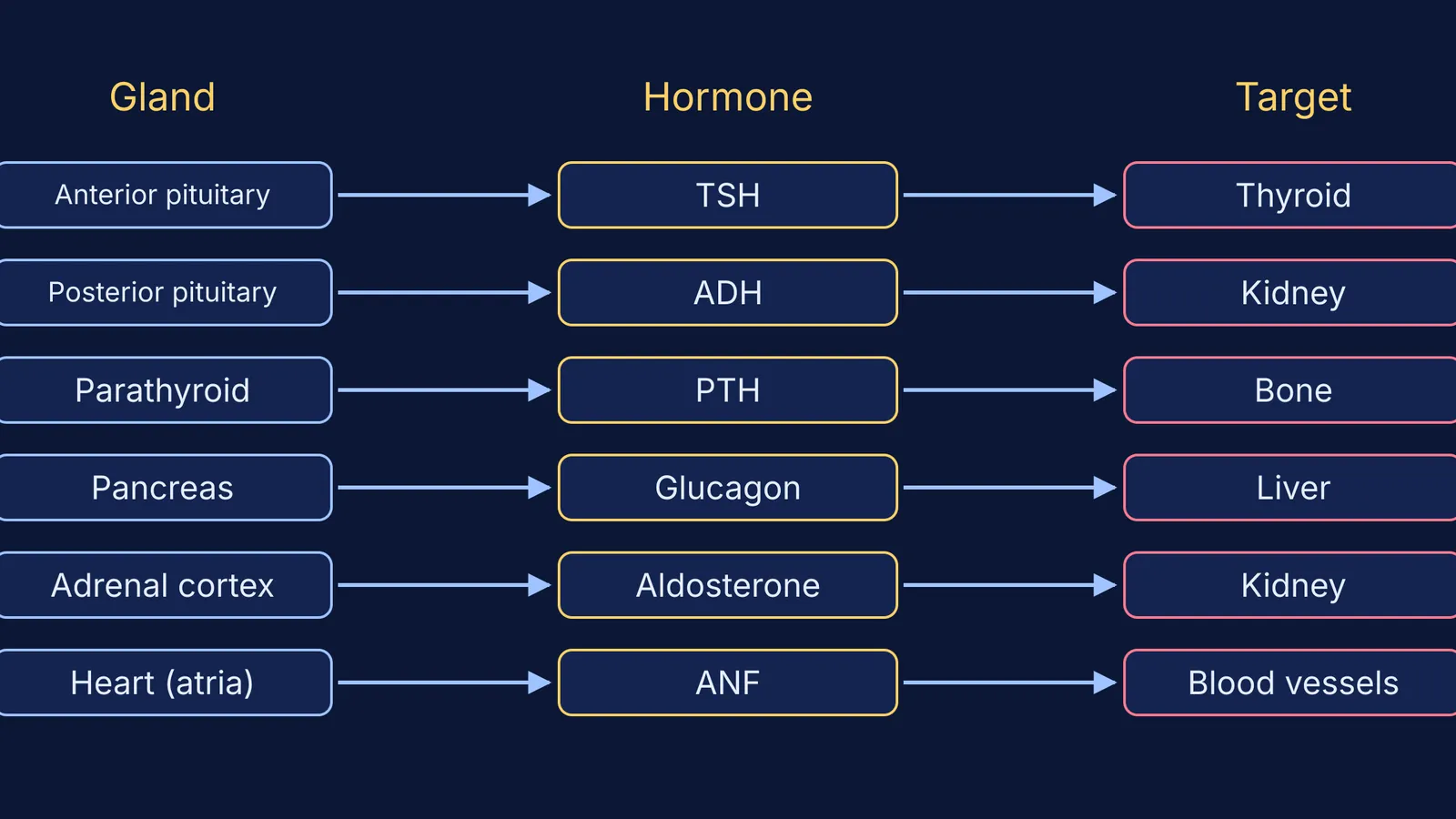
The endocrine chapter is really one big table: which gland makes which hormone, what the hormone acts on, and what goes wrong when there is too much or too little. An AI chatbot can draft that table in seconds. The catch is that it learned from far more than school books, so it may add diseases, causes and wording that your chapter never uses. Let the AI draft the table, then check every row against NCERT Class 11 Biology, Chapter 19: Chemical Coordination and Integration.
How do you ask AI to make a gland-hormone-target table?
Give it the chapter, the columns and a rule for the disorder column. You can copy this prompt:
"Make a table for NCERT Class 11 Biology Chapter 19, Chemical Coordination and Integration. Columns: gland or tissue, hormone, target organ or cells, main action, disorder. Fill the disorder column only if the NCERT chapter names one for that hormone; otherwise write 'not named in NCERT'. Do not add hormones that are not in the chapter. Mark any row you are unsure of with a question mark."
Unless you paste in the text, the AI cannot see your book, so the prompt narrows its answer without guaranteeing it.
Which disorders does NCERT actually name?
Tick each disorder row against what the NCERT chapter says:
Gigantism, pituitary dwarfism and acromegaly: over-secretion of growth hormone causes gigantism, low secretion causes pituitary dwarfism, and excess growth hormone in adults, especially in middle age, can cause acromegaly. Check that the AI keeps the age split.
Diabetes insipidus: an impairment in the synthesis or release of ADH (vasopressin), so the kidney is less able to conserve water. It belongs in the ADH row, not the insulin row.
Goitre and cretinism: iodine deficiency causes hypothyroidism and an enlarged thyroid (goitre). NCERT ties cretinism to hypothyroidism during pregnancy, which affects the growing baby.
Exophthalmic goitre (Graves' disease): a form of hyperthyroidism with an enlarged thyroid, protruding eyeballs, higher basal metabolic rate and weight loss.
Addison's disease: underproduction of adrenal cortex hormones, which alters carbohydrate metabolism and causes acute weakness and fatigue.
Diabetes mellitus: prolonged hyperglycaemia, with glucose lost in urine and harmful ketone bodies formed; the chapter summary links it to insulin deficiency and/or insulin resistance.
The chapter names no disorder for PTH, thyrocalcitonin, thymosins, melatonin, ANF or the gut hormones. If the AI writes one in, it may be true in medicine, but it is not in your chapter. Move it to a separate 'beyond NCERT' list rather than learning it as syllabus. For the growth hormone rows in more depth, see our explainer on dwarfism, gigantism and acromegaly.
Where else does an AI-made hormone table slip?
Next, check these rows against the same chapter:
Oxytocin and vasopressin: the posterior pituitary stores and releases them, but the hypothalamus makes them. A good table says both.
Thyrocalcitonin: it comes from the thyroid, not the parathyroid, and lowers blood calcium while PTH raises it. Our post on parathyroid hormone vs thyrocalcitonin walks through the pair.
Targets: glucagon acts mainly on liver cells; insulin mainly on hepatocytes and adipocytes; aldosterone on the renal tubules; secretin on the exocrine pancreas; CCK on both the pancreas and the gall bladder.
Hormones without a gland: ANF comes from the atrial wall of the heart, erythropoietin from the juxtaglomerular cells of the kidney, and gastrin, secretin, CCK and GIP from the gastrointestinal tract.
Numbers: NCERT says a normal human pancreas has about 1 to 2 million Islets of Langerhans, only 1 to 2 per cent of the pancreatic tissue (NCERT Chapter 19). If the AI gives a different figure, use the book's.
How do you revise from the checked table?
A corrected table is only useful if you can produce it yourself.
Cover every column except 'gland' and write the rest from memory.
Cover the 'disorder' column and name the hormone fault behind each disease.
Paste your corrected table back into the AI and ask it to quiz you only from that table, one row at a time.
Keep the 'beyond NCERT' list on a separate page so it does not blur into your syllabus.
If you make memory aids for the table, check those too; our guide to checking AI-made NEET biology mnemonics shows how.
If one idea keeps slipping, such as why a mother's hypothyroidism affects her baby, the Fermi Concept Library has a lesson for each concept in biology. Fermi's AI tutor can work out what you already know and build a plan for the session, checking your understanding as it goes.
Tonight, ask for the table, check the disorder column against Chapter 19, and quiz yourself on the rows you corrected.


