On this page
Speaking is often the hardest part of a school French or German course to practise at home. An AI chatbot can play the shopkeeper or the host family, but left alone it tends to correct far more than you asked for. Below is a five-minute role-play script that keeps the AI at your level and has it correct only grammar your class has covered.
Role-play is part of the course itself. The CBSE German syllabus for Classes IX and X (2025-26) gives “speaking activities – role play, presentations, recitation” 5 of the 20 internal assessment marks in Class IX, and says the stress “is now not so much on grammar but on communication”.
Why should AI correct only the errors from your syllabus?
Because a chatbot will otherwise fix too much. A 2023 evaluation of ChatGPT as a grammar checker by Fang and colleagues found it detected errors well but showed “over-correction tendencies” and did not stick to minimal edits. Ten corrections on one sentence, half on grammar you have not met, teach you little.
Level matters too. On the Europass guide to the CEFR levels, A2 spoken interaction means “I can communicate in simple and routine tasks requiring a simple and direct exchange of information on familiar topics and activities.” Your syllabus tells you which structures you are expected to use at your stage.
How the AI corrects you matters as well. In a study of four primary-level French immersion classrooms, Lyster and Ranta (1997) found that teachers mostly used recasts (saying the student’s sentence back correctly), and these rarely led students to correct themselves. Hints, clarification requests, repeating the error and asking the student to try again led to more self-repair. A meta-analysis of 33 studies by Shaofeng Li (2010) found a medium overall effect of corrective feedback, and the effect was maintained over time.
What should you type to start a role-play?
Note the scene and the two or three grammar points of your current textbook lesson, then paste this prompt, filling in the brackets:
You are my conversation partner for a short role-play in [German/French]. My level is about [A2; ask your teacher] and I study [Class 9 CBSE German, Lesson 2].
The scene: [I am in a department store buying a present]. You play [the shop assistant]. Use simple sentences at my level.
Correct only these points: [um ... zu, damit]. Ignore every other mistake while we talk.
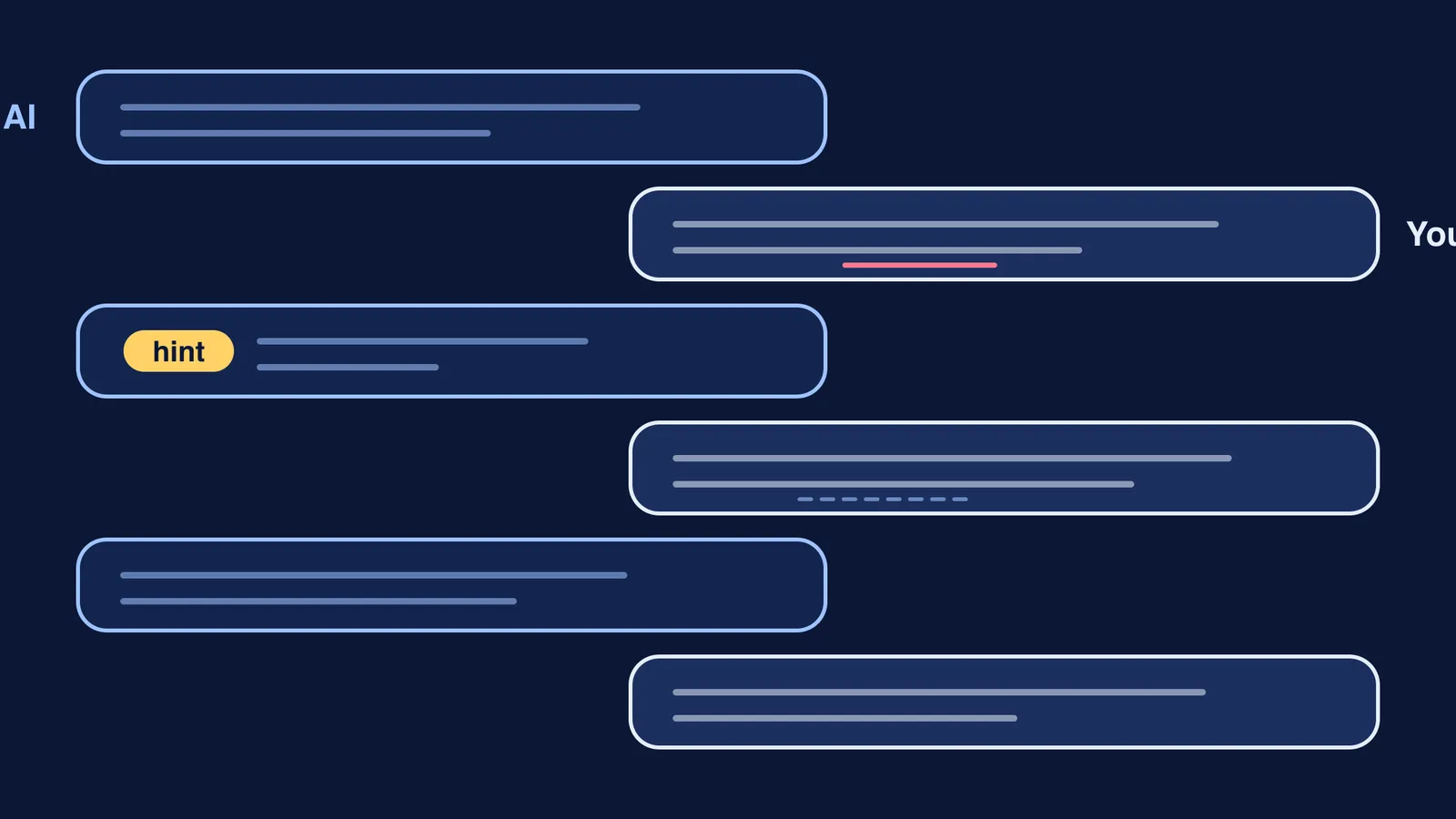
When I make one of those mistakes, do not give me the right sentence. Give a short hint in English and let me try again. One correction per turn at most.
Keep each reply to one or two sentences and end with a question.
After 8 to 10 turns, stop. List my corrected mistakes and up to three other mistakes you noticed, so I can ask my teacher.
A worked example: Class 9 German, shopping
The CBSE syllabus pairs Class IX Lesson 2, “Shopping and consumption”, with the subordinate clauses “um...zu” and “damit”, so those go on the correction list.
AI: Guten Tag! Kann ich dir helfen?
You: Ja, ich suche ein Geschenk. Ich bin hier, um ein Geschenk für mein Bruder kaufen.
AI: Hint: look at the end of your “um” clause. Which small word is missing before the verb?
You: Ich bin hier, um ein Geschenk für mein Bruder zu kaufen.
AI: Super! Was mag dein Bruder?
Notice what the AI left alone. “Für mein Bruder” should be “für meinen Bruder”, because “für” takes the accusative, but that is not on today’s list, so it waits for the end-of-session summary. You fixed the target error yourself, which is the kind of repair Lyster and Ranta saw more often after hints and prompts than after recasts.
For French, use the same steps: take the scene and grammar points from your own chapter, for example a café order using the partitive, and list only those.
What are the limits of practising with AI?
It can be wrong. Fang and colleagues found that ChatGPT could not reliably correct agreement and tense errors that span several sentences. If a correction contradicts your textbook, trust the textbook and ask your teacher.
It drifts. After a few turns it may start correcting everything again or use harder words. Paste rule 3 again.
Typing is not speaking. Text chat cannot hear your pronunciation. Read your lines aloud anyway, and rehearse the assessed role-plays with classmates.
Privacy and age. Do not share your full name, school or phone number. Check the chatbot’s age rules with a parent before signing up.
The same method works beyond languages, for example when you interview a scientist with AI and fact-check every answer. Parents can also read how to help your child learn a new school language at home and whether AI voice chat helps with spoken English.
We build Fermi’s AI tutor for STEM subjects, not languages. It notices where a student is stuck and decides whether to explain, ask or show.
Start with tonight’s lesson: one scene, two grammar points, ten turns.