

On this page
If you are also preparing for JEE Main, CUET Physics and Chemistry can look like the easy cousin. They are different rather than easier, and an AI tutor helps most when you set it up for that.
What do CUET domain subjects actually test?
The CUET (UG) 2026 Information Bulletin from NTA says domain subjects are set as per the NCERT syllabus. The same bulletin says each test paper has 50 compulsory multiple-choice questions and lasts 60 minutes. A correct answer earns 5 marks and a wrong one costs 1 mark. The official CUET Physics syllabus lists Class 12 units, starting with electrostatics, current electricity and magnetic effects of current.
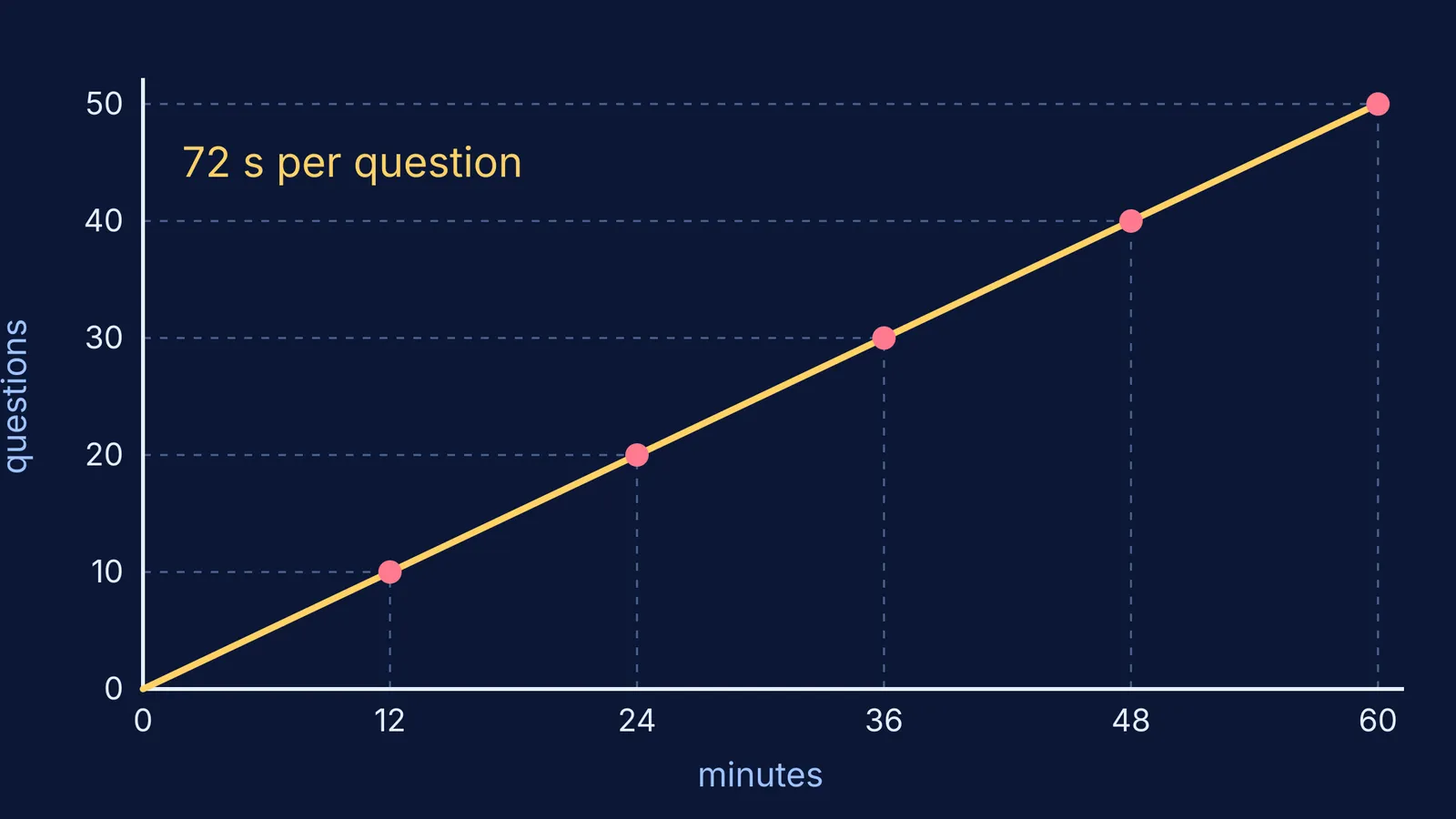
Divide 60 minutes by 50 questions and you get 72 seconds per question. That leaves little room for long derivations, so it pays to know NCERT concepts, graphs and standard results well enough to recognise them at once.
Rules can change each year, so read the bulletin for your exam year on the official CUET website when it is released.
How is CUET question style different from JEE Main?
The JEE (Main) 2027 Information Bulletin sets 25 questions per subject in Paper 1: 20 MCQs in Section A and 5 questions in Section B whose answer you type in as a number. CUET domain papers are MCQs only. A JEE question often chains several ideas and some arithmetic; with about 72 seconds each, a CUET question has less room for that and is better practised as one NCERT idea at a time.
Here is one topic both ways. We wrote these examples; they are not from past papers.
CUET-style: A charged parallel plate capacitor is disconnected from the battery, and a dielectric slab that fills the whole gap is slid between the plates. Which stays the same: capacitance, charge, potential difference or stored energy? Answer: charge, because it has nowhere to go. Capacitance rises by the dielectric constant K, so V = Q/C and the energy Q²/2C both fall.
JEE-style: The slab is thinner than the gap, plate area, gap and K are given, and you type the new capacitance in picofarads, rounded to a whole number. Now you need the series-capacitor model, unit conversions and careful arithmetic.
JEE practice trains the second skill. CUET needs the first, done fast.
How should you use an AI tutor for CUET physics and chemistry?
How you use it matters. In a field experiment with nearly a thousand high school maths students, published in PNAS, Hamsa Bastani and colleagues found that students who practised with a standard ChatGPT-style GPT-4 tutor had 17% lower grades than students who never had AI, once access was taken away. A second version, with prompts designed to safeguard learning, largely avoided that harm. For CUET, that means letting the tutor question you, not finish your work for you.
Try this loop, one NCERT chapter per session:
Read the NCERT chapter, including its end-of-chapter summary.
Ask the tutor for 15 one-idea MCQs from that chapter, and answer each within 72 seconds without looking anything up.
For every miss, ask which NCERT idea it tested and what you confused it with. Then find that idea in the textbook yourself, because AI can be wrong and NCERT is the reference.
Write each miss as a one-line rule in an error log, and re-quiz yourself on those rules a few days later.
What to type:
Quiz me on NCERT Class 12 Chemistry, Coordination Compounds. One concept per question, four options, no long calculations. Wait for my answer before telling me if I am right.
I picked (b). Do not tell me the answer yet. Give me one hint about the idea I am missing.
Write three more questions that test the same idea in different words.
Our guide to learning from the wrong options in MCQs shows how to get more out of each miss.
Where does Fermi fit in?
If a miss shows a gap in the concept itself, the Fermi Concept Library covers every concept in physics, chemistry, biology, mathematics and computing, each with its own lesson. If you keep choosing the wrong method on numericals, the Fermi Problem Library has a step-by-step solver that explains the reasoning rather than printing an answer. And Fermi's AI tutor works out what you already know and builds a plan for the session, so you sit down to one chapter and a clear next step.
What should parents and dual-track students watch for?
If your child is taking JEE Main and CUET in the same year, do not treat CUET as leftover JEE practice. Give it its own weekly slot of NCERT-only, timed MCQ drills. Check which CUET subjects DU courses accept before deciding how much time Physics and Chemistry deserve, and plan for the CUET General Test alongside.
Start tonight with one chapter, 15 questions, a 72-second clock and an error log.


