

On this page
The Common University Entrance Test (CUET) UG General Test (Section III) is an optional but highly popular section designed to evaluate your general aptitude. Because it covers everything from geometry to current affairs, preparing for it can feel overwhelming for many students.
However, studying for an aptitude test is fundamentally different from studying for a board exam. Rather than memorising textbooks, your focus must shift to strategy selection, adaptability, and speed. You need a structured approach to master the wide variety of topics.
What is the syllabus for the CUET General Test?
The National Testing Agency (NTA) defines a broad syllabus covering five main areas. The test does not require advanced calculus or physics; instead, it tests your foundational knowledge and your ability to apply it quickly.
General Knowledge and Current Affairs: Static GK (including history, geography, and polity) and important current affairs from recent months.
General Mental Ability and Numerical Ability: Number systems, fractions, decimals, and basic arithmetic operations.
Quantitative Reasoning: The simple application of basic mathematical concepts taught till Grade 8. This includes important topics like direct and inverse proportion in Class 8, percentages, geometry, and linear equations in one variable.
Logical and Analytical Reasoning: Verbal and non-verbal reasoning, including series completion, coding-decoding, and critical thinking exercises.
How many questions are in the CUET General Test?
The exam is a Computer Based Test (CBT) where you must answer 50 questions out of 60 within 60 minutes (NTA).
This gives you an average of 72 seconds per question. The marking scheme awards +5 for every correct answer, but subtracts 1 mark for every incorrect answer. Because of this negative marking scheme, accuracy is just as critical as speed. Guesswork will actively pull your overall score down, making careful preparation essential.
How to prepare for the quantitative and reasoning sections?
Most students prepare for maths by using "blocked practice"—doing a large batch of percentage problems on Monday, a batch of geometry problems on Tuesday, and reasoning problems on Wednesday.
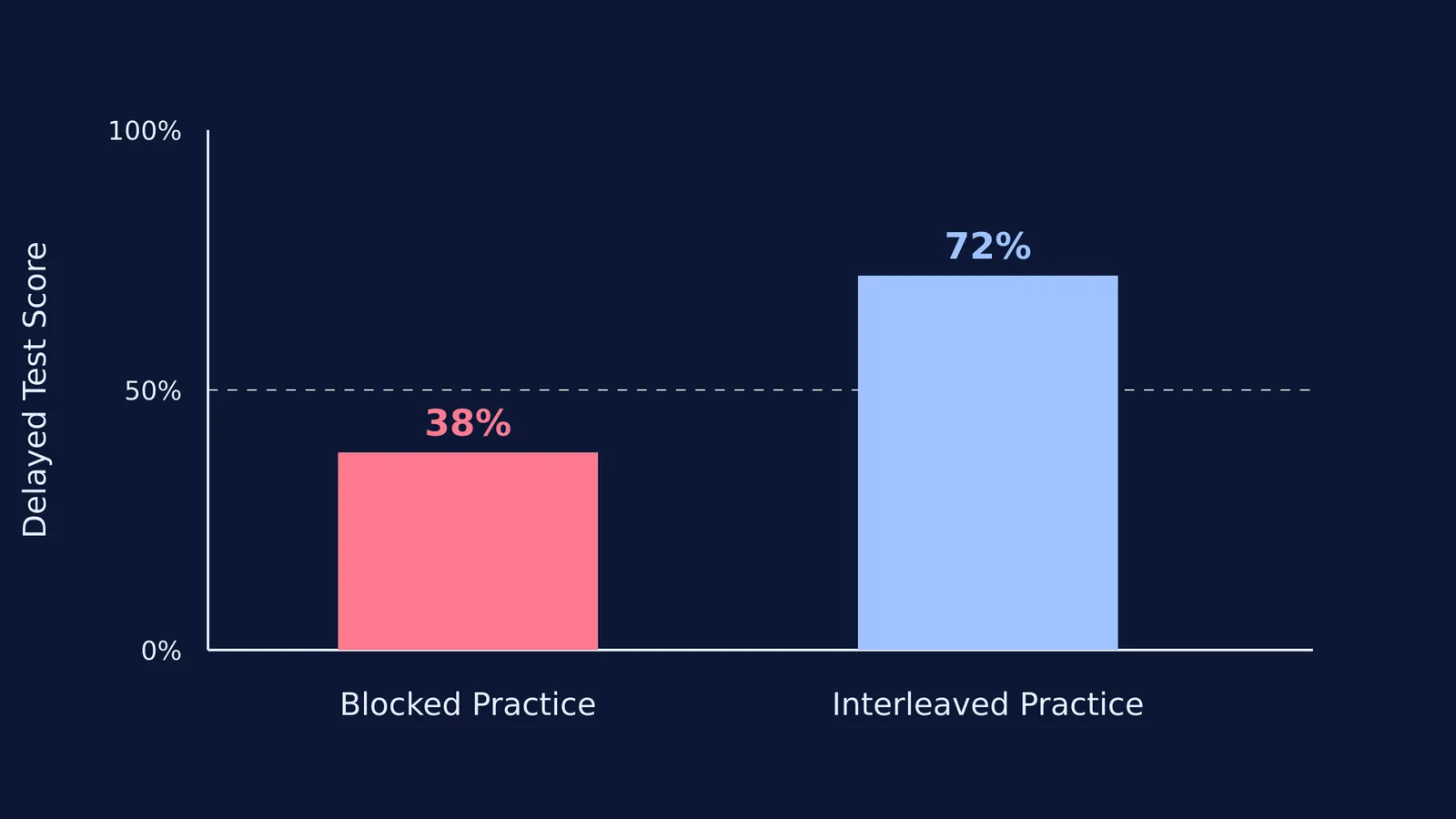
Research in cognitive science shows that this is an inefficient way to study. In a landmark study published by the US National Institutes of Health, seventh-grade mathematics students who used interleaved practice (mixing different types of problems in a single session) scored 72% on a delayed test, while those who used blocked practice scored only 38% (PubMed).
Why does interleaving work so well for entrance exams? On the CUET, problems are presented in a random order. You must first look at a question and decide *which* strategy to use before you can actually solve it. Interleaved practice trains your brain to make this choice, whereas blocked practice skips this crucial step entirely.
If you find yourself stuck on foundational maths concepts, you can review them in the Fermi Concept Library, which maps out every idea in mathematics. If you are making mistakes by choosing the wrong method, the Fermi Problem Library offers worked problems with a step-by-step solver that explains the underlying reasoning rather than just printing the final answer.
A daily practice plan
Instead of dedicating whole days to single subjects, structure your daily study sessions to mix topics across the syllabus. This keeps your mind agile and ready for the real exam format.
Morning session: Current Affairs and GK
Read daily news summaries or review static GK flashcards. Since this section relies purely on factual memory, small, frequent reviews are much better than long, exhausting cramming sessions. Consistency is key here.
Afternoon session: Interleaved Problem Solving
Create a mixed practice set containing quantitative reasoning questions, logical reasoning questions, and numerical ability questions. Time yourself strictly to simulate the intense pressure of the computer-based exam, leaving plenty of time at the end to review your mistakes and understand where you went wrong.
Evening session: Targeted Review
Spend this time reviewing the specific concepts you got wrong during the afternoon session. This targeted approach ensures you are always improving. If you are unsure where to begin, Fermi's AI tutor can work out what you already know and build a plan for the session, so you sit down to a clear next step.
By treating the General Test as a test of strategy selection rather than just subject knowledge, and by mixing your daily practice, you can build the speed and accuracy needed to excel on exam day.


