On this page
If your school has an English speaking and listening assessment coming up, an AI voice chat makes a patient practice partner. It can give you a topic, time you, ask follow-up questions and point out where your answer wandered. What it cannot do well is judge how you sound. Below is a prompt, a worked example and a one-week plan.
What does a school speaking and listening test check?
In the CBSE Class X English Language and Literature curriculum for 2026-27, the Assessment of Listening and Speaking Skills carries 5 marks of internal assessment. The same document lists four parameters:
Interactive competence: starting the conversation, taking turns, staying relevant
Fluency: cohesion, coherence and speed of delivery
Pronunciation
Language: grammar and vocabulary
Its suggested rubric scores each on five levels. At the top level for fluency, a student "speaks fluently almost with no repetition & minimal hesitation" and "develops topic fully & coherently". Teachers may plan their own activities, so ask your teacher what yours will look like.
For Classes XI and XII, the CBSE English Core curriculum for 2026-27 says "testing of oral skills must be made an important component of the overall testing pattern". Other boards set their own formats, so check your school's circular.
Does practising with an AI chatbot actually help?
The research is cautiously positive. A meta-analysis of 31 studies by Boning Lyu, Chun Lai and Jianing Guo, published in the International Journal of Applied Linguistics, found that chatbots had a medium effect on second-language learning (g = 0.608). It covered language learning in general, not only speaking, and the effect depended on things like the chatbot's modality and whether generative AI was involved, so how you use it matters.
What prompt should you give the AI?
Turn on voice mode and say or paste this:
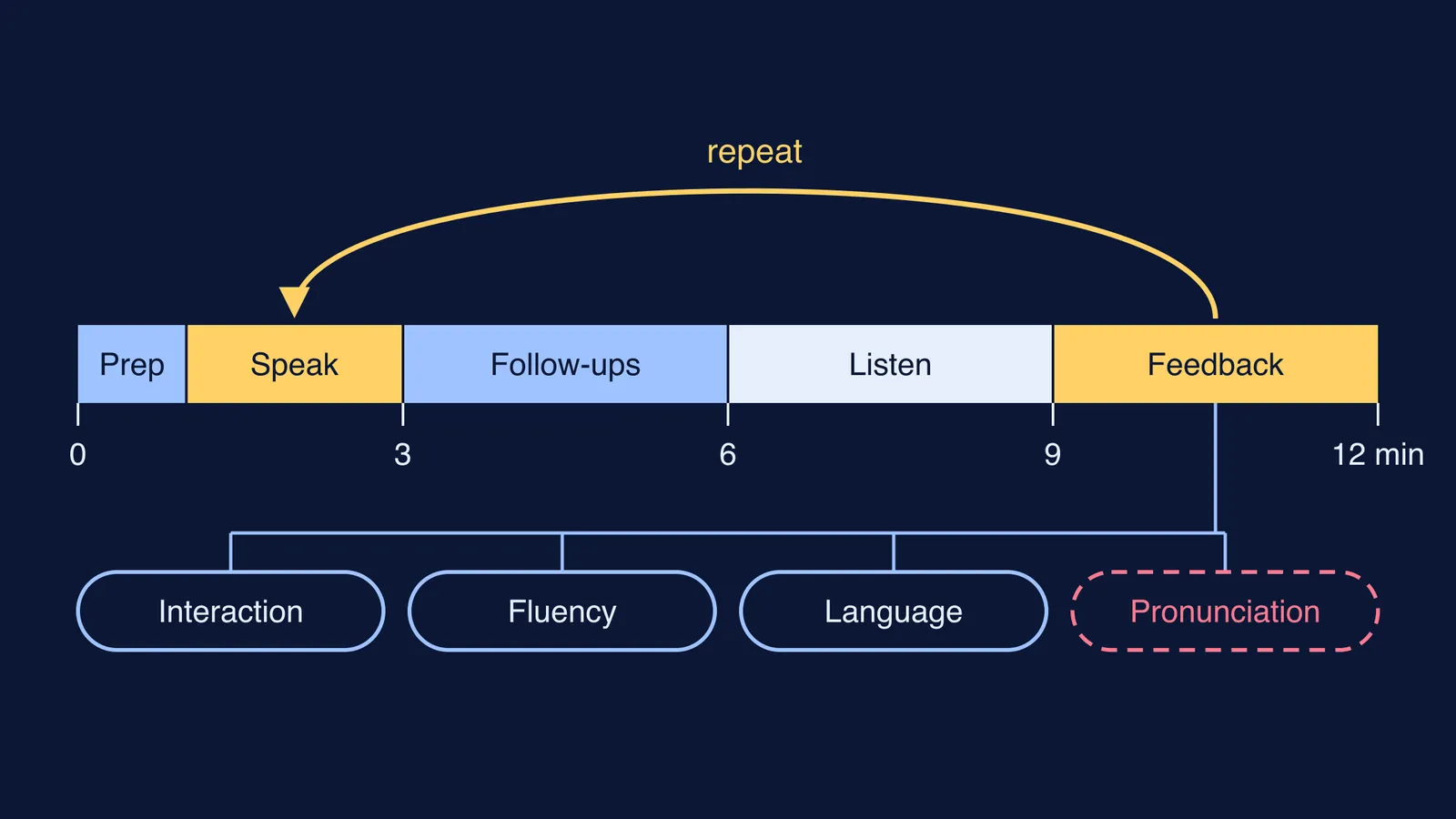
"You are the examiner for my Class 10 English speaking and listening assessment. Run one round at a time. First, give me a topic suitable for a student in India and wait one minute while I prepare. Second, let me speak for two minutes without interrupting. Third, ask me three follow-up questions, one at a time, based on what I actually said. Fourth, read me a passage of about 150 words and ask me three questions about it. Fifth, give feedback on interaction, fluency and coherence, and grammar and vocabulary, quoting my exact words for each point. Finish with one thing to fix in the next round."
Good topics: a festival your family celebrates; phones in school; a book that changed your mind.
Here is a worked round. Topic: "Should homework be banned?" You open with: "Homework is very much important because, um, teachers give it." A useful follow-up from the AI would be: "You said homework is important. Can you give an example from your own week?" Useful feedback quotes you: "You said 'very much important'; 'very important' is enough. You also paused with 'um' before 'because'. Try a signpost: 'I have two reasons. First...'" Then run the same topic again, fixing only that one thing.
Can AI check your English pronunciation?
Only partly. Many voice chats hear you through speech recognition: they turn your voice into text and respond to the text. If it guesses the word you meant, a mispronounced word can disappear before feedback starts.
Recognition is also not equally accurate for everyone. In a 2026 study in TESOL Quarterly, Yuna Bae and Okim Kang used Siri and Google Assistant to transcribe English from second-language speakers, including speakers of Indian English. The AI systems' transcription accuracy varied by first language. Five human experts who transcribed one of the data sets did not show this bias. So:
If the AI misunderstands you, your pronunciation is not necessarily wrong. At its top level, the CBSE rubric describes a student who "is always comprehensible" and "uses appropriate intonation"; it says nothing about copying a particular accent.
If the AI says your pronunciation is fine, that does not prove it either.
Record yourself, listen back, and play two minutes to a teacher or a fluent adult.
A one-week rehearsal plan
Day 1: ask your teacher about the format, then run one round as a baseline.
Days 2 to 4: one round of about 12 minutes a day, new topic, one fix each time.
Day 5: record yourself and play it to a person for pronunciation.
Day 6: practise with a classmate, because turn-taking is marked and an AI rarely cuts in the way a classmate does.
Day 7: one light round, then rest.
If nerves are the bigger problem, our guide on how to prepare for an oral test or viva in school has steps for the day itself. Parents can read whether AI voice chat can help your child practise spoken English.
The same out-loud habit helps with a science viva: Fermi's AI tutor works out what you already know, builds a plan for the session and checks your understanding as it goes.
Start tonight with one round, and save the AI's best comment for tomorrow.