On this page
You have a formula, a periodic table and a question asking for the mass percent of each element. It is easy to get almost right. Here is a three-check routine: you do the working, and an AI chatbot checks it, not the other way round.
How do you calculate percentage composition?
NCERT's Class 11 textbook gives the rule in Unit 1, Some Basic Concepts of Chemistry: mass % of an element = mass of that element in the compound × 100 ÷ molar mass of the compound. The same chapter works through ethanol (C2H5OH, molar mass 46.068 g) and gets 52.14% carbon, 13.13% hydrogen and 34.73% oxygen.
The method has three steps:
Find the molar mass: multiply each element's atomic mass by the number of its atoms in the formula, then add.
For each element, divide its share of that mass by the molar mass and multiply by 100.
Add the percentages. They should come to 100.
The atomic masses in NCERT's ethanol example (C 12.01, H 1.008, O 16.00) are rounded versions of the abridged standard atomic weights from IUPAC's atomic weights commission (CIAAW), which lists carbon as 12.011, hydrogen as 1.0080 and oxygen as 15.999. Use the values your exam paper gives.
What is the percentage composition of glucose?
Glucose is C6H12O6. With the atomic masses from NCERT's ethanol example:
Carbon: 6 × 12.01 = 72.06 g
Hydrogen: 12 × 1.008 = 12.096 g
Oxygen: 6 × 16.00 = 96.00 g
Molar mass: 72.06 + 12.096 + 96.00 = 180.156 g
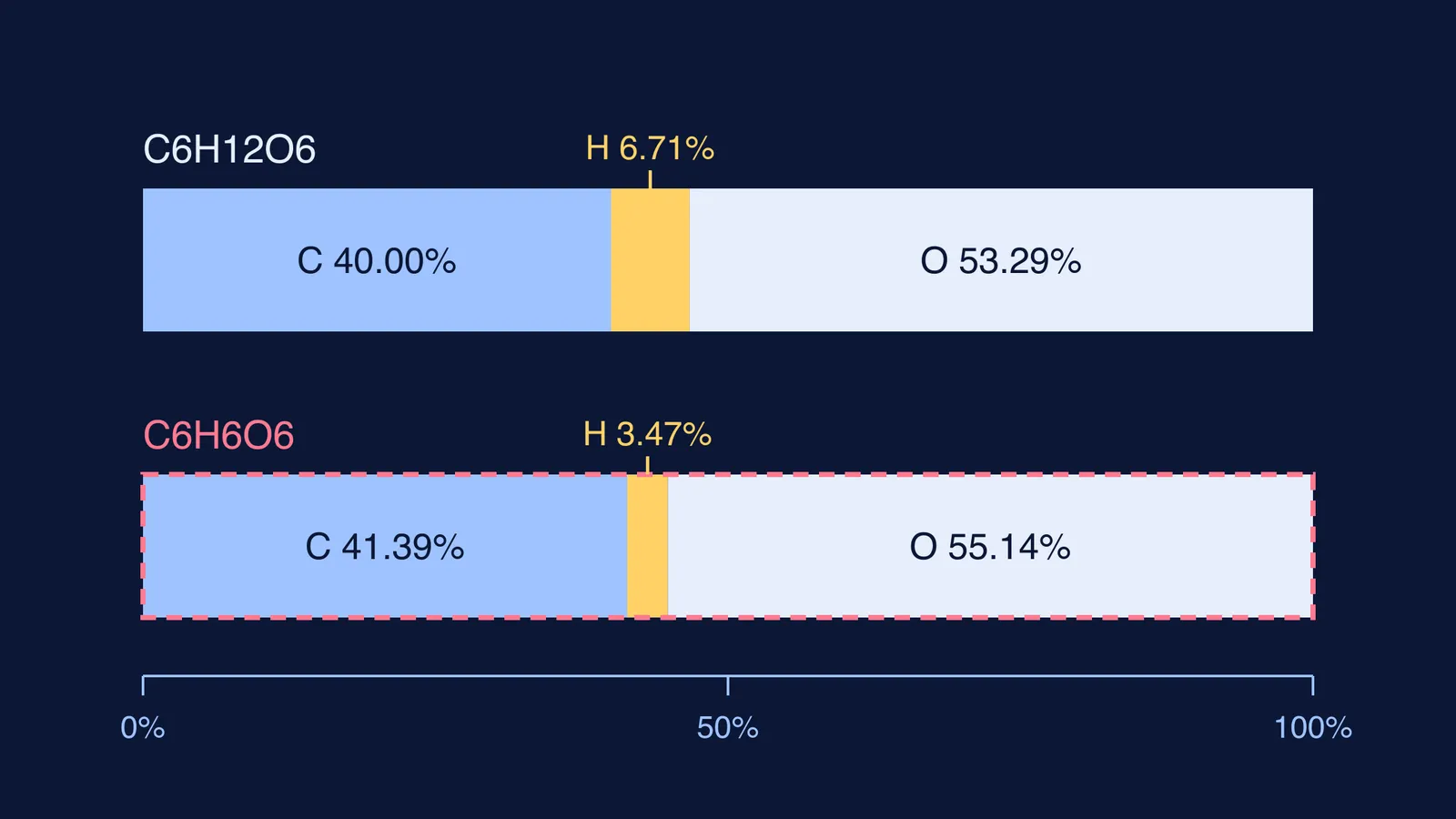
So carbon is 72.06 ÷ 180.156 × 100 = 40.00%, hydrogen is 12.096 ÷ 180.156 × 100 = 6.71%, and oxygen is 96.00 ÷ 180.156 × 100 = 53.29%. Total: 100.00%. NCERT's own Problem 1.1 uses 12.011 for carbon and gets 180.162 u, so stick to the atomic masses you are given.
Why isn't “adds up to 100%” enough?
Suppose you miscount and use 6 hydrogens instead of 12. Your molar mass becomes 174.108 g, and you get carbon 41.39%, hydrogen 3.47% and oxygen 55.14%. Add them: 100.00%.
When every element is divided by the same molar mass, even a wrong one, the total comes out at 100. So the 100% check catches slips in dividing or adding, but not a wrong atom count or a wrong atomic mass. You need two more checks:
Molar mass check: recount the atoms from the formula, including anything in brackets, and compare each atomic mass with the table you were given.
Reverse check: turn your percentages back into a formula, the way NCERT's Problem 1.2 does. Take 100 g, divide each element's mass by its atomic mass, then divide by the smallest result.
For the correct glucose answer, 40.00 ÷ 12.01, 6.71 ÷ 1.008 and 53.29 ÷ 16.00 give 3.33 : 6.66 : 3.33. That is 1 : 2 : 1, or CH2O, and 180.156 ÷ 30.026 = 6 takes you back to C6H12O6. The miscounted answer gives 1 : 1 : 1, which does not match the formula, so the error shows up.
How do you get AI to check your answer without doing it for you?
Do the full working on paper first. Then paste it into a chatbot with a prompt like this:
“I calculated the percentage composition of [compound and formula]. Here is my working: [paste]. Do not give me the answer. Tell me only which step is wrong, if any: 1) the number of atoms of each element I took from the formula; 2) each atomic mass I used, against these values: [list], and the molar mass I added up; 3) whether my percentages add to 100 within rounding. Then convert my percentages back to the simplest whole-number ratio and tell me whether it matches the formula.”
Give the AI your atomic masses, or it may flag third-decimal differences as mistakes. Asking it to name the wrong step, rather than redo the sum, keeps the thinking with you. If it finds an error, fix that line yourself and check again.
Can you trust the AI's check?
Not blindly. In a study first posted in 2023, Siru Ouyang and colleagues sorted GPT-4's mistakes on complex chemistry problems from the SciBench benchmark into four types. Calculation errors made up 14.4% and incorrect chemistry knowledge 11.3% of the cases they examined, while reasoning errors were the largest group at 34.7%. Newer chatbots may do better, but any of them can mis-multiply or misremember an atomic mass, just as you can.
If you and the AI disagree, redo that line by hand.
If your mistakes are in the method rather than the arithmetic, the Fermi Problem Library has worked problems with a step-by-step solver that explains the reasoning rather than printing an answer. And Fermi's AI tutor works out what you already know and builds a plan for the session, so you can firm up the mole concept before moving on to empirical formulas.
Next time, run all three checks before you call a sum done.