On this page
In 1303, a wandering teacher named Zhu Shijie published a book that pushed algebra further than previous works. His masterwork, *Jade Mirror of the Four Unknowns* (*Siyuan yujian*), showed how to set up and solve complex systems of equations using up to four variables. It would take centuries for mathematics in Europe to reach the same level.
Who was Zhu Shijie and what was the Jade Mirror?
Zhu Shijie lived during the Yuan dynasty in China, a period of great mathematical flourishing 2. For more than twenty years, he travelled the country teaching mathematics to a growing number of students 1. His reputation as an educator spread widely, but it is his 1303 book, the *Jade Mirror of the Four Unknowns*, that cemented his legacy as one of the most significant mathematicians in history.
The book is a comprehensive text arranged into three volumes containing 288 problems 1. Zhu started with an existing mathematical technique called the "method of the celestial unknown", which was traditionally used to solve equations with one variable. He then expanded this idea to handle two, three, and finally four unknown quantities simultaneously. To keep track of these different variables on a counting board, he assigned each a specific position and name: Heaven, Earth, Man, and Matter. In modern algebra, these correspond directly to variables like x, y, z, and w.
How did the Jade Mirror of the Four Unknowns solve equations?
When you have a system of equations with several variables, the key mathematical strategy is to eliminate them one by one until you are left with just a single variable. Zhu Shijie developed a systematic way to arrange the coefficients of his multi-variable equations on a grid-like counting board. By carefully adding, subtracting, and multiplying the rows, he could systematically eliminate Heaven, Earth, and Man. This step-by-step process left him with a single, highly complex polynomial equation in terms of Matter.
Once he had reduced the system to a single equation, he could solve it numerically. His methods were advanced, allowing him to find solutions for polynomial equations up to the 14th degree 1.
This systematic method of breaking down polynomials was part of a larger mathematical tradition in China. It built on earlier algebraic breakthroughs like Qin Jiushao and the general method behind the remainder theorem, and geometric foundations laid by Liu Hui and how doubling a polygon's sides closes in on pi.
Was Pascal's triangle in the Jade Mirror?
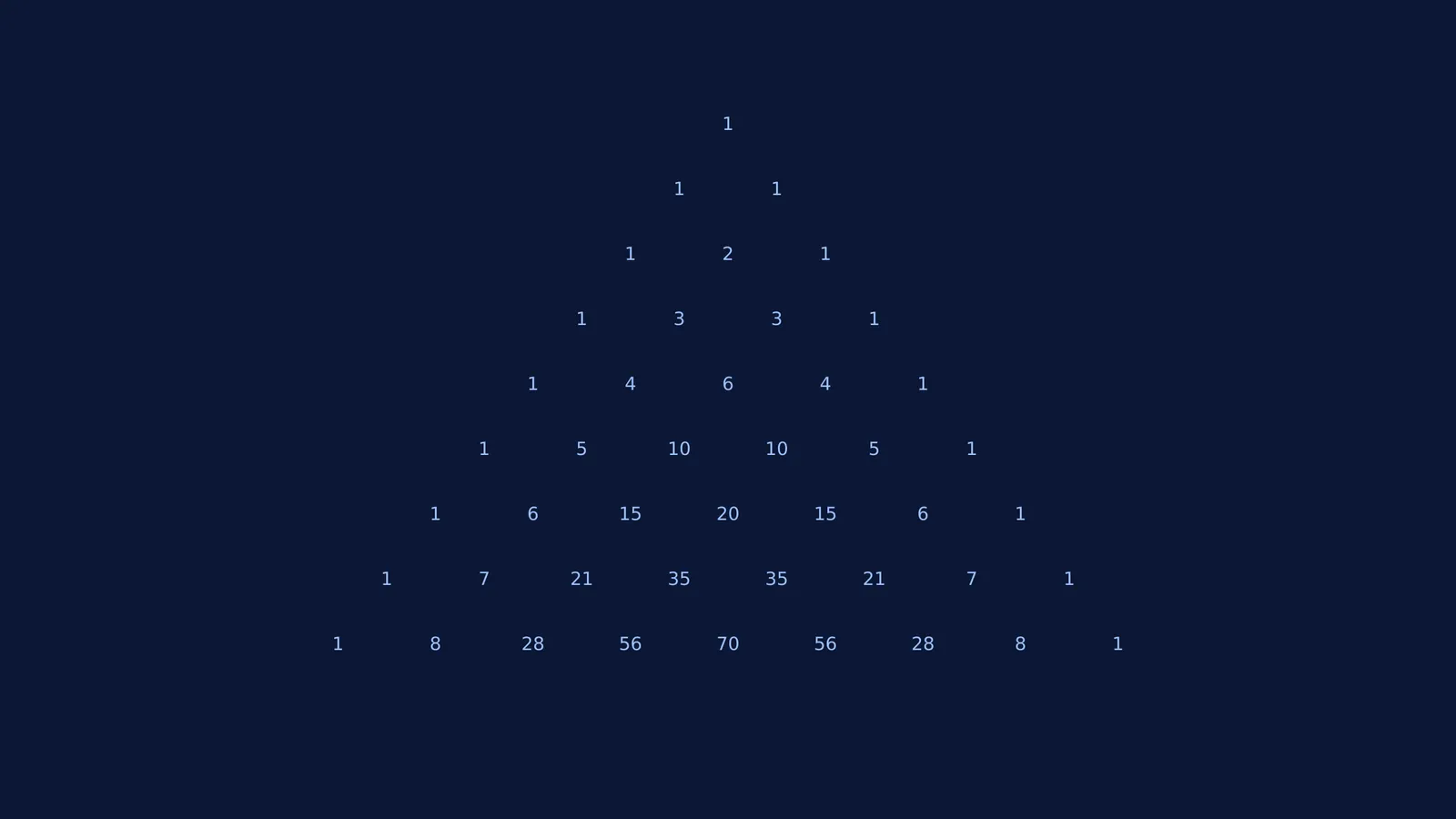
Yes. The *Jade Mirror* famously includes a detailed diagram of the arithmetic triangle, a pattern that European mathematicians would later name after the French mathematician Blaise Pascal in the 17th century. Zhu generously referred to his diagram as the "table of the ancient method of powers up to the eighth", openly acknowledging that the triangle had been discovered by Chinese mathematicians long before him 1.
Zhu used the coefficients from this triangle to solve intricate problems involving finite series and progressions. He developed formulas to sum integers, squares, and higher-order series. For example, he tackled a complicated recruitment problem where soldiers are hired according to a "cube law": 3³ soldiers on the first day, 4³ on the second, 5³ on the third, and so on. Using his deep understanding of finite differences and series summation, he calculated that after 15 days, the total number of recruited soldiers would be exactly 23,400 1.
What can students learn from Zhu Shijie?
Zhu Shijie's work elegantly demonstrates the power of having a reliable, repeatable system. When faced with the complexity of four unknowns, he did not rely on trial and error or guessing. Instead, he used a highly structured process of elimination to turn a tangled web of relationships into one solvable equation.
If you are stuck on a tough system of equations in your own coursework and do not know which variable to eliminate first, the Fermi Problem Library has worked problems with a step-by-step solver that explains the reasoning rather than printing an answer. Breaking the problem down into manageable steps, just as Zhu did on his counting board over seven hundred years ago, is always the surest way to find the solution.