On this page
In Class 12 you meet this reaction as one textbook line: carbonyl compound, hydrazine, potassium hydroxide, heat, and out comes CH2. Behind it are two chemists who found the same thing within a year of each other, and a third who later made it practical.
Who discovered the Wolff–Kishner reduction?
Nikolai Matveevich Kizhner (also written Kishner or Kischner) was a Moscow-trained organic chemist who, according to his Wikipedia biography, became full professor of organic chemistry at Tomsk, in Siberia, in 1901 and returned to Moscow in 1913.
His paper appeared in the Journal of the Russian Physical-Chemical Society in 1911 (volume 43, pages 582 to 595), and an English translation by Vladislav Suntsov and David E. Lewis appeared in the Bulletin for the History of Chemistry in 2015.
Ludwig Wolff (1857 to 1919) was a professor at the University of Jena in Germany, as recorded in his Wikipedia biography. His 1912 paper in Justus Liebigs Annalen der Chemie is titled, in translation, "Method for replacing the oxygen atom of ketones and aldehydes by hydrogen".
The two men worked independently, which is why the reaction carries both names.
What did Kishner and Wolff actually do?
Kizhner's method, in his own words in the unabridged translation, was simple: put 1 to 2 grams of dry potassium hydroxide in a flask, add a little of the hydrazone, and heat "until nitrogen is evolved, after which the reaction continues by itself" while the hydrocarbon distils over.
In one run he decomposed 12 grams of the hydrazone of 3-methylcyclohexanone and collected 5 grams of methylcyclohexane, a 54% yield (unabridged translation).
Cyclohexanone hydrazone hydrate reacted most energetically of all; he warned that "if enough of this substrate is used at one time, the reaction may end with an explosion".
Wolff reached the same result another way. As summarised here, he heated hydrazones or semicarbazones in ethanol with sodium ethoxide in a sealed tube at about 180 °C.
How did Huang Minlon change the reaction in 1946?
Kizhner started from a hydrazone made beforehand, and Wolff needed a sealed tube. In 1946 Huang Minlon published "A Simple Modification of the Wolff-Kishner Reduction" in the Journal of the American Chemical Society.
His version, as described in this overview, refluxes the carbonyl compound with hydrazine hydrate and sodium hydroxide, distils off water and excess hydrazine, and lets the temperature rise to about 200 °C.
In his report, one keto acid was reduced in 95% yield, against 48% by the older procedure (same overview). High-boiling solvents such as ethylene glycol, the one in your textbook, reach these temperatures without a sealed tube.
How does the Wolff–Kishner reduction work?
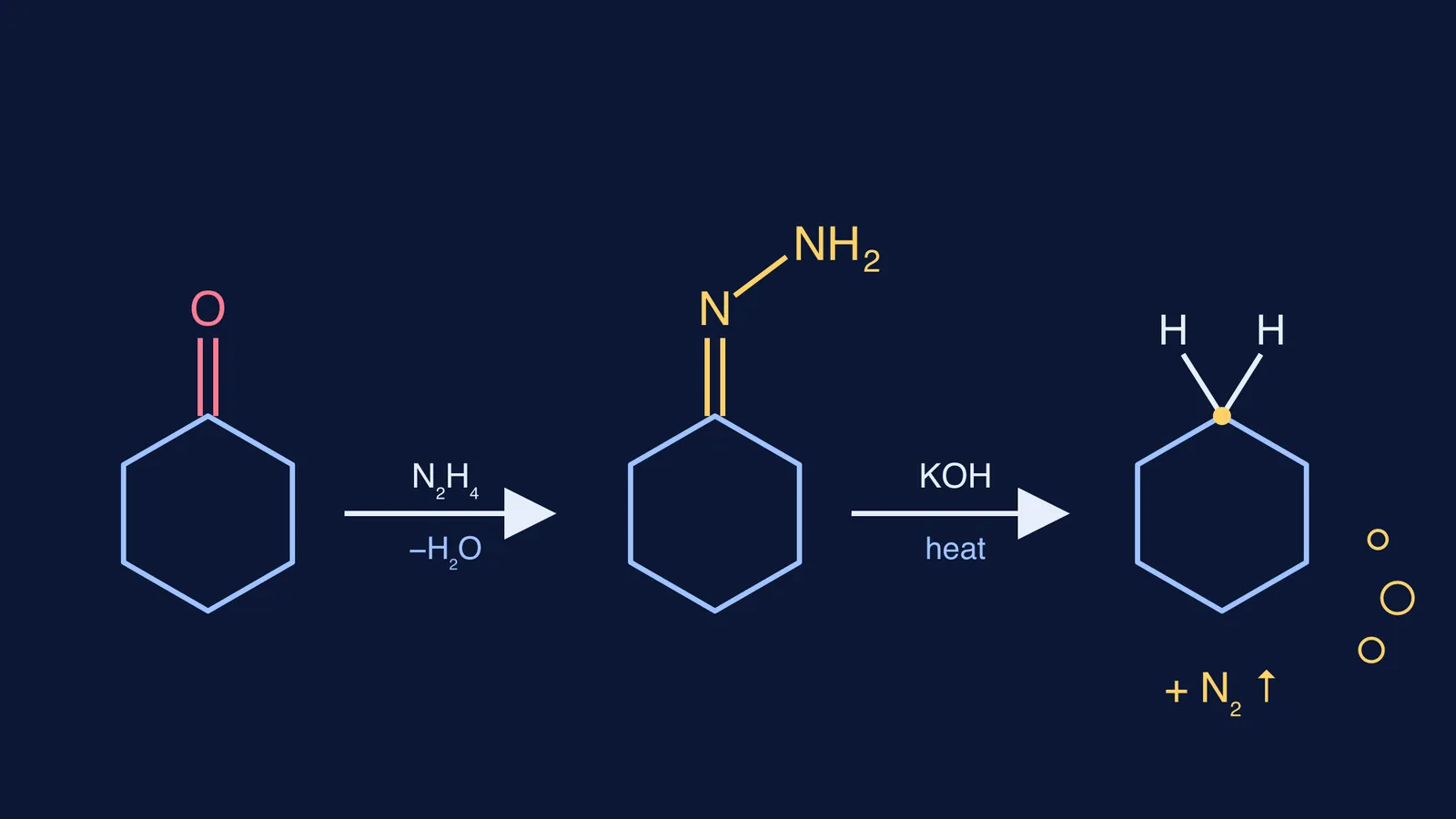
The reaction has two stages, as set out by the Organic Chemistry Portal:
Hydrazine (NH2NH2) condenses with the aldehyde or ketone, losing water, to give a hydrazone (C=N–NH2).
Strong base and heat pull protons off nitrogen and move them to carbon, step by step.
Nitrogen gas (N2) leaves, and the carbon that once held oxygen ends up as CH2.
The loss of nitrogen gas is the driving force (Organic Chemistry Portal).
When should you choose Wolff–Kishner over Clemmensen?
The NCERT Class 12 Chemistry chapter on aldehydes, ketones and carboxylic acids gives both reductions side by side: zinc amalgam and concentrated hydrochloric acid (Clemmensen), or hydrazine followed by heating with sodium or potassium hydroxide in a high-boiling solvent such as ethylene glycol (Wolff–Kishner).
They do the same job under opposite conditions. Wolff–Kishner is basic, so it suits molecules that survive base; Clemmensen is strongly acidic, so it suits molecules that survive acid (Organic Chemistry Portal).
Use this three-question check in a problem:
Is there a C=O you need to turn into CH2, not into an alcohol (that would be NaBH4 or LiAlH4)?
Does the molecule have a group that acid would damage, such as an acetal or an alcohol that could dehydrate? Choose Wolff–Kishner.
Does it have a group that base would damage, such as an ester that would hydrolyse or a halide that could be eliminated? Choose Clemmensen.
Worked example: you need ethylbenzene from acetophenone (C6H5COCH3), and the ring carries no other groups. Both routes work. Hydrazine gives the hydrazone C6H5C(=NNH2)CH3; heating with KOH in ethylene glycol releases N2 and leaves C6H5CH2CH3. Now change the question so the ring also carries an ester (COOCH3). Hot KOH would hydrolyse that ester, so the expected answer is Clemmensen.
If the ideas behind the mechanism blur together, the Fermi Concept Library covers every chemistry concept, each with its own lesson and its place in the map.
When you practise conversions, the Fermi Problem Library has worked problems with a step-by-step solver that explains the reasoning rather than printing an answer.
Next time you write NH2NH2 over an arrow, picture a flask in Tomsk in 1911, a little KOH, and bubbles of nitrogen rising as a ketone loses its oxygen.