

On this page
Genetics is one of the few sciences whose name has a known author and date. William Bateson suggested it, first in a private letter and then to an international conference. He also made sure English-speaking scientists could read Mendel, and his sweet pea counts were among the first signs of what we now call linkage. This post covers his life, those three contributions, a worked example from his data, common mistakes, and what to learn from him.
Who was William Bateson?
A profile in the Journal of Genetics (2002), by Patrick Bateson, gives the outline. William Bateson was born on 8 August 1861. His father was for 24 years Master of St John's College, Cambridge. William took a first in natural sciences at Cambridge, specialising in zoology, and studied the embryology of Balanoglossus, a worm-like animal, in Chesapeake Bay in the United States. In 1894 he published Materials for the Study of Variation, collecting examples of sudden, discontinuous differences between individuals.
The John Innes Centre history page adds the rest. He became the first director of the John Innes Horticultural Institution at Merton on 1 January 1910, and held the post until he died on 8 February 1926, aged 64.
How did he bring Mendel to English readers?
The John Innes page records that Bateson introduced Mendel's work to Britain in the published version of a lecture to the Royal Horticultural Society on 8 May 1900, and arranged the first English translation of Mendel's paper in the Society's journal in 1901.
When critics attacked the new ideas, he replied with a book, Mendel's Principles of Heredity: A Defence (1902), which reprinted the translation. In its preface he wrote that "it seemed imperative that Mendel's own work should be immediately put into the hands of all who will read it". Of the risk that error would choke the truth, he wrote: "That fate must not befall Mendel now."
When did he name genetics?
On 18 April 1905, writing to the Cambridge professor Adam Sedgwick about a possible new chair, he said, as the John Innes page quotes: "No single word in common use quite gives this meaning, and if it were desirable to coin one, 'Genetics' might do."
He said it publicly at the Third International Conference on Hybridisation, held in London from 30 July to 3 August 1906. In his opening address, printed in the Report of the Third International Conference 1906 on Genetics, he said the science "is still nameless", and: "To meet this difficulty I suggest for the consideration of this Congress the term Genetics, which sufficiently indicates that our labours are devoted to the elucidation of the phenomena of heredity and variation." The published report itself carries the new name.
What did sweet peas reveal?
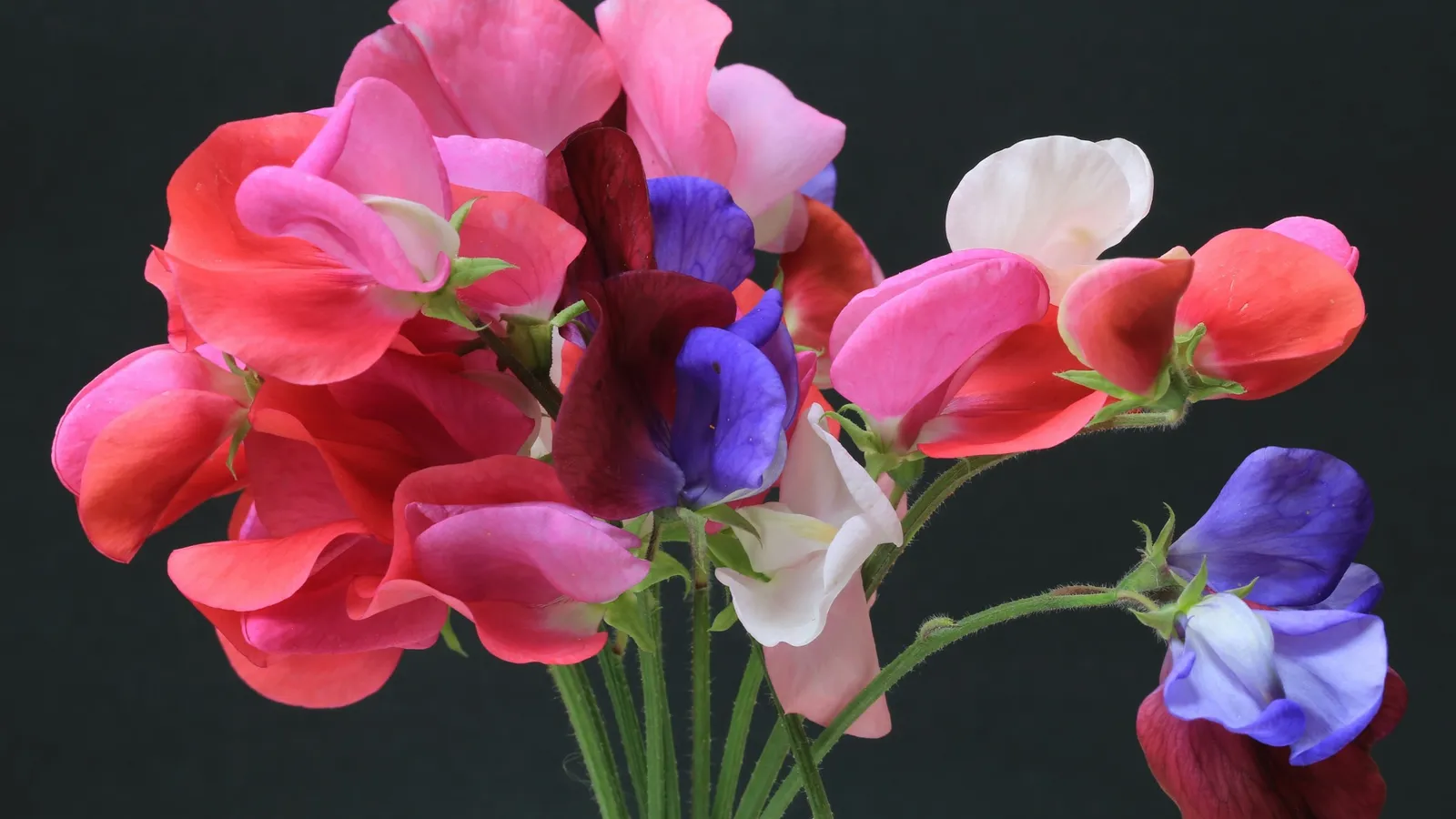
In his 1909 book Mendel's Principles of Heredity, Bateson described crosses with sweet peas differing in flower colour (purple, from a blue factor, or red) and pollen shape (long, dominant, or round). Across a whole family, long and round pollen came 3 to 1, as Mendel predicted. But among purples there was a large excess of long pollen, and among reds an excess of round. He called this "gametic coupling" and suggested the coupled combinations of gametes occurred about seven times as often as the others.
Worked example: checking the sweet pea counts
His book gives one F2 series for the coloured plants: purple long 1528, purple round 106, red long 117, red round 381.
Total. 1528 + 106 + 117 + 381 = 2132.
Expected under 9:3:3:1. 2132 × 9/16 = 1199; 2132 × 3/16 = 400 (twice); 2132 × 1/16 = 133.
Parental combinations. Purple long and red round together: 1528 + 381 = 1909, which is 1909/2132 = 89.5 per cent. Independent assortment would give 10/16 = 62.5 per cent.
Within each colour. Purples: 1528 : 106 is about 14 : 1 long to round. Reds: 381 : 117 is about 3.3 : 1 round to long. Mendel's rule predicts 3 : 1 long to round in both.
If gametes come in the ratio 7 : 1 : 1 : 7, as Bateson proposed, then 2 out of every 16 are new combinations, 12.5 per cent. Today we would call that the recombination frequency between two linked genes. Thomas Hunt Morgan later explained coupling by genes sitting on the same chromosome; see our posts on linkage and crossing over and Thomas Hunt Morgan.
What mistakes do students make here?
Assuming every two-gene cross gives 9:3:3:1. That needs independent assortment. Linked genes break it.
Reading excess parental types as an error. Bateson treated it as a real pattern to explain.
Mixing up gamete ratios and offspring ratios. 7:1:1:7 describes gametes; the F2 comes from combining them.
Crediting Bateson with the chromosome explanation. The J Genet profile notes he was reluctant to accept the full chromosome view.
If two-gene problems are where you lose time, the Fermi Problem Library has worked problems with a step-by-step solver that explains the reasoning. Our post on Mendel's pea experiments covers the starting point.
What can you take from how he worked?
Get the source into people's hands. He spread Mendel by translating and reprinting him.
Name things clearly. A good name helped a new field hold together.
Take exceptions seriously. The sweet peas that broke 9:3:3:1 pointed towards linkage.
Next step: work out the F2 ratio for two genes whose gametes form in the ratio 7 : 1 : 1 : 7, using a 16 × 16 grid or algebra, and compare it with Bateson's counts.


