

On this page
William Armstrong, 1st Baron Armstrong, transformed the 19th century by harnessing the power of water. In 1845, he proposed using the excess pressure from Newcastle's piped water system to power a quayside crane (Wikipedia).
How did William Armstrong's hydraulic crane work?
A year later, in 1846, the first hydraulic crane was installed at Newcastle Quayside (Wikipedia). Traditional steam cranes of the era were noisy, smoky, and extremely slow to start. In contrast, Armstrong's hydraulic cranes were silent, precise, and ready for immediate use.
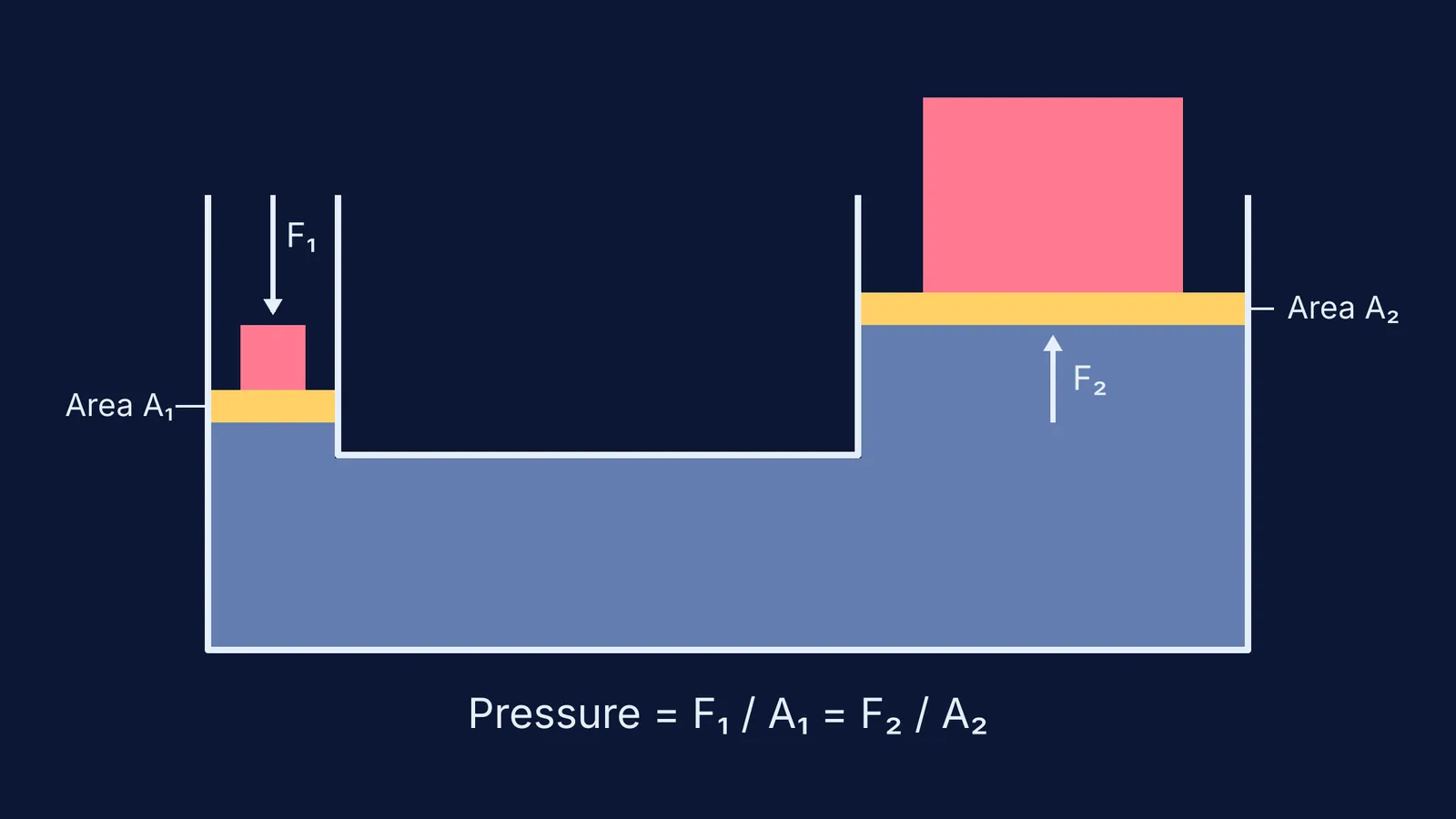
They worked on the principle of hydraulic multiplication: a fluid under pressure transmits that pressure equally in all directions. By applying pressure to a small piston, the water transferred an enormous force to a larger piston, allowing the crane to lift heavy cargo effortlessly.
The demand for this technology was immediate. By 1852, W. G. Armstrong and Company was producing an average of 100 cranes a year (Wikipedia). His hydraulic machinery was so reliable that it eventually operated the dock gates in Grimsby and the pumping engines for London's Tower Bridge. If you are studying fluid mechanics or wondering how an air bubble doubles in volume as it rises from a lake bed, mastering these pressure rules is essential. For a deeper look, the Fermi Simulation Lab offers interactive simulations for the ideas that are easier to see than to read, letting you test Pascal's law with virtual pistons.
How to solve a hydraulic lift problem
If you encounter a hydraulic crane or lift problem in your physics exams, use this three-step framework:
Identify the two areas: Find the cross-sectional area of the small piston (A₁) and the large piston (A₂). If you are given a radius or diameter, remember to calculate the area using πr².
Set the pressures equal: Pascal's law states that pressure applied to an enclosed fluid is transmitted undiminished. Write the equation P₁ = P₂, which expands to F₁ / A₁ = F₂ / A₂.
Solve for the missing force: If you need to lift a 1000 kg mass (F₂ = 9800 N), rearrange the formula to F₁ = F₂ × (A₁ / A₂) to find the exact force you must apply on the smaller piston.
Was Cragside the first house lit by hydroelectricity?
Having mastered hydraulics for industry, Armstrong turned his country estate, Cragside, into a living laboratory. The 1,700-acre estate featured five artificial lakes, including Tumbleton and Debdon, which were carefully engineered to provide high-pressure water (Wikipedia).
He used this water pressure to domesticate his industrial technology. The Cragside kitchen featured a hydraulic rotisserie spit and an early dishwasher, while a hydraulic lift moved passengers silently between floors. But his most famous achievement was electrical. In 1870, Armstrong installed a Siemens dynamo driven by water power, creating what is considered the world's first hydroelectric power station (Wikipedia).
In 1878, he installed an arc lamp in the picture gallery, making Cragside the first house in the world to be lit by hydroelectricity (Wikipedia). Two years later, in 1880, he upgraded the system with Joseph Swan's newly invented incandescent lamps. This made Cragside the birthplace of the modern smart home. As the Victorian periodical *The World* described it, the house was "[t]ruly the palace of a modern magician" (Wikipedia).
What can students learn from Armstrong's engineering?
Armstrong's career shows how solving one problem deeply can lead to breakthroughs in completely different fields. He did not originally set out to invent hydroelectricity; he started by noticing that a simple waterwheel on the River Dee was wasting most of its kinetic energy (Wikipedia).
His engineering was so foundational that it continues today. In 2014, the National Trust installed a 17-metre-long Archimedes' screw turbine at Cragside, which generates 12 kW of electricity—enough to light the historic house using the same lakes Armstrong built (National Trust). Furthermore, as early as 1863, Armstrong predicted that coal would run out within two centuries and actively advocated for renewable energy like solar and hydroelectric power (Wikipedia).
Understanding how water behaves is key to many classical physics concepts, much like making sink or float predictions in a buoyancy simulation. When you get stuck applying these core principles to new problems, the Fermi Problem Library provides worked problems with a step-by-step solver that explains the reasoning rather than printing an answer. This ensures you build the foundational logic required to engineer your own solutions.


