

On this page
In the mid-1850s, Wilhelm Weber and Rudolf Kohlrausch tried to settle what sounds like a bookkeeping question: how big is the electric unit of charge compared with the magnetic one? The answer came out as a speed, and that speed was close to the speed of light. A few years later James Clerk Maxwell used their number to argue that light itself is an electric and magnetic wave.
What did Weber and Kohlrausch publish in 1856?
In the 1850s you could measure charge two ways: by the push between two charged balls (electrostatic units), or by letting it flow as a current and measuring how strongly it turns a magnet (electromagnetic units).
The physicist André Koch Torres Assis explains in his history of the experiment.pdf) that the ratio between these two units has the dimensions of a velocity. To find its value, you have to measure one charge both ways: electrostatically first, then discharge it and measure the current electromagnetically.
That is what the two men did. The English translation of their full 1857 paper has sections on sharing charge between a Leyden jar and a large ball, on measuring it with a Coulomb torsion balance, and on reading the discharge with a tangent galvanometer. A shorter account appeared in 1856 in Annalen der Physik (Crossref record).
According to Assis, they first announced their value in 1855, and the constant in Weber's own equations came out at 4.39 × 10^8 m/s. That is √2 times 3.1 × 10^8 m/s, because Weber defined his constant with an extra factor of √2 (Assis, 2003.pdf)).
How did Maxwell use the Weber–Kohlrausch number?
Maxwell was building a mechanical model of space filled with tiny spinning cells. In Part III of "On Physical Lines of Force", printed in the Philosophical Magazine in January 1862 (Crossref record), he worked out how fast a sideways wobble would travel through that medium. The answer depended on the same ratio of units.
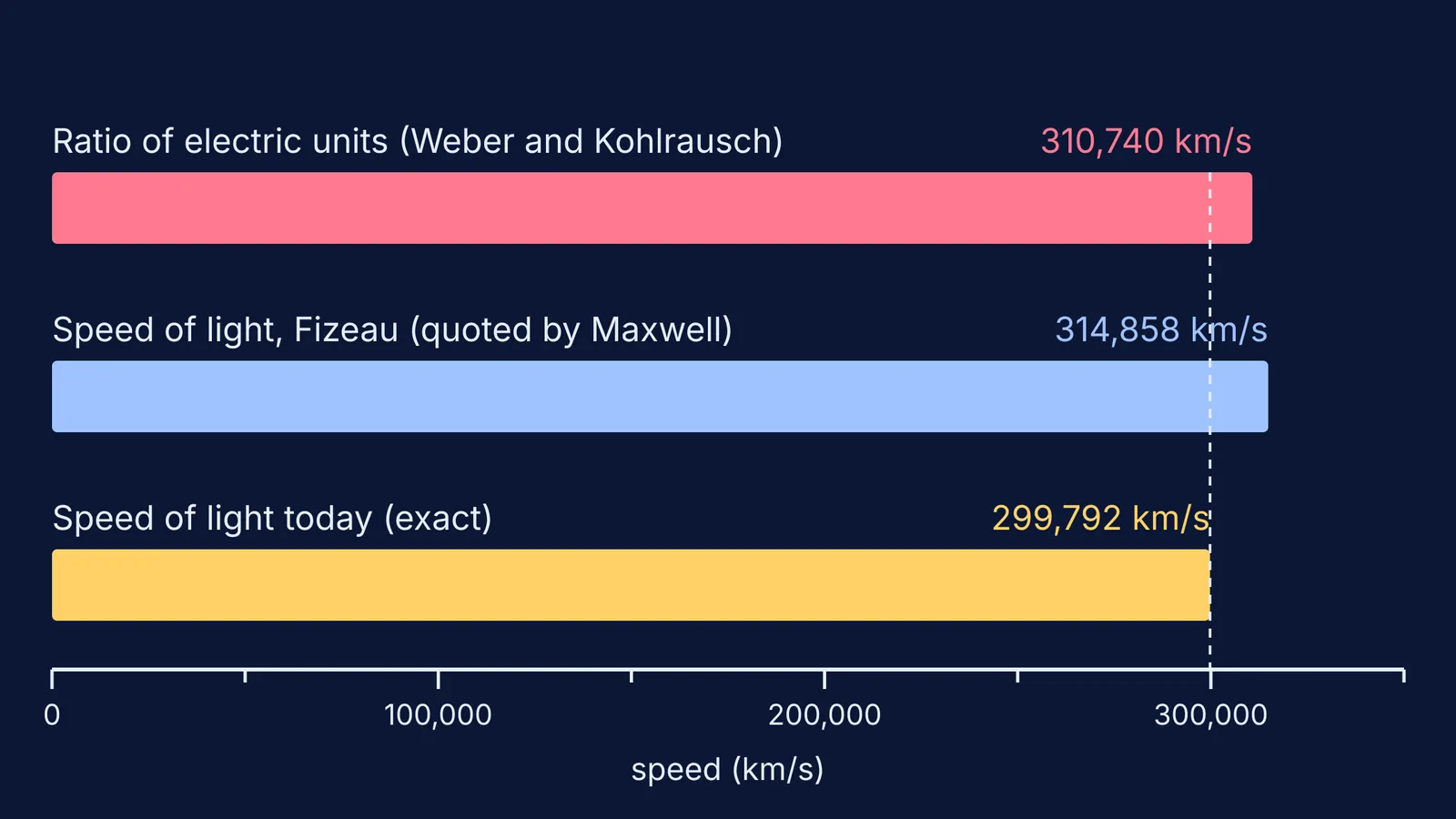
Using Weber and Kohlrausch's figure, Maxwell got 310,740,000,000 millimetres per second, or 310,740 km/s (Maxwell's text on Wikisource). On the same page he set it beside Fizeau's optical measurement of light: 314,858 km/s.
The two numbers differ by about 1.3 percent. Maxwell wrote that the agreement was so close "that we can scarcely avoid the inference that light consists in the transverse undulations of the same medium which is the cause of electric and magnetic phenomena" (Wikisource).
The spinning cells were later dropped, but the link stayed. Weber was no stranger to electrical measurement: see how Gauss and Weber built the first telegraph in 1833.
Why does 1/√(μ₀ε₀) equal the speed of light?
Today the same ratio sits inside a formula you meet in school: c = 1/√(μ₀ε₀). Here ε₀ sets the strength of electric forces and μ₀ the strength of magnetic forces between currents. You can check it with the official values.
The vacuum permittivity ε₀ is 8.8541878188 × 10^-12 F/m (NIST CODATA 2022).
The vacuum permeability μ₀ is 1.25663706127 × 10^-6 N/A² (NIST CODATA 2022).
Multiply them: μ₀ε₀ = 1.11265 × 10^-17 s²/m².
Take the square root: 3.33564 × 10^-9 s/m.
Take the reciprocal: 2.99792 × 10^8 m/s.
NIST lists the speed of light in vacuum as exactly 299,792,458 m/s (NIST). Your answer matches to six figures.
You can redo Weber and Kohlrausch's comparison with the old units too. The NIST Guide to the SI lists 1 abcoulomb (the electromagnetic unit) as 10 C and 1 statcoulomb (the electrostatic unit) as 3.335641 × 10^-10 C. Divide: 10 ÷ (3.335641 × 10^-10) = 2.99792 × 10^10. That is the speed of light in centimetres per second, because those old units were built on centimetres.
Our post on the value and units of the permittivity of free space walks through the units of ε₀.
How can you use this story when you study electromagnetism?
Weber, Kohlrausch and Maxwell used habits you can copy in any numerical:
When two constants appear in one formula, work out the units of their ratio. A hidden speed, length or time often tells you what the formula is about.
Compare a calculated number with an independent measurement, as Maxwell did with Fizeau's light speed.
Write units at every step, and say how close is close: Maxwell's two numbers were about 1.3 percent apart.
If μ₀ and ε₀ still feel like symbols to memorise, the Fermi Concept Library gives every concept in physics its own lesson and its place in the map. Waves made of electric and magnetic fields are hard to picture from a page, so the Fermi Simulation Lab has interactive simulations for ideas that are easier to see than to read.
Next time you write c = 1/√(μ₀ε₀) in an exam, remember that it began as a Leyden jar, a torsion balance and a galvanometer.


