

On this page
Why did Gauss and Weber string a wire across Göttingen?
In early 1833, mathematician Carl Friedrich Gauss directed the astronomical observatory at the University of Göttingen, while physicist Wilhelm Weber directed the university's Physics Cabinet. The two scientists were collaborating on measuring terrestrial magnetism, systematic work that soon led to the founding of the *Magnetischer Verein* (Magnetic Union) (Glassmeier and Tsurutani, 2014). To coordinate simultaneous observations, they needed to synchronize pendulum clocks at both facilities to within a fraction of a second.
They achieved this by constructing an overhead communications link. By Easter 1833, Gauss and Weber strung roughly 8,000 feet (about 2.4 kilometres of conductor) of copper wire across Göttingen's rooftops (Martín-Rodríguez et al., 2010). The double-wire line spanned 1.2 kilometres in a straight line, running from the observatory over the north tower of St. Johannis Church into Weber's laboratory in the Papendiek district (Göttingen Tourismus). While built to test circuit laws and synchronize clocks, the line quickly became the world's first working telegraph for transmitting text.
How did the 1833 electromagnetic telegraph send signals?
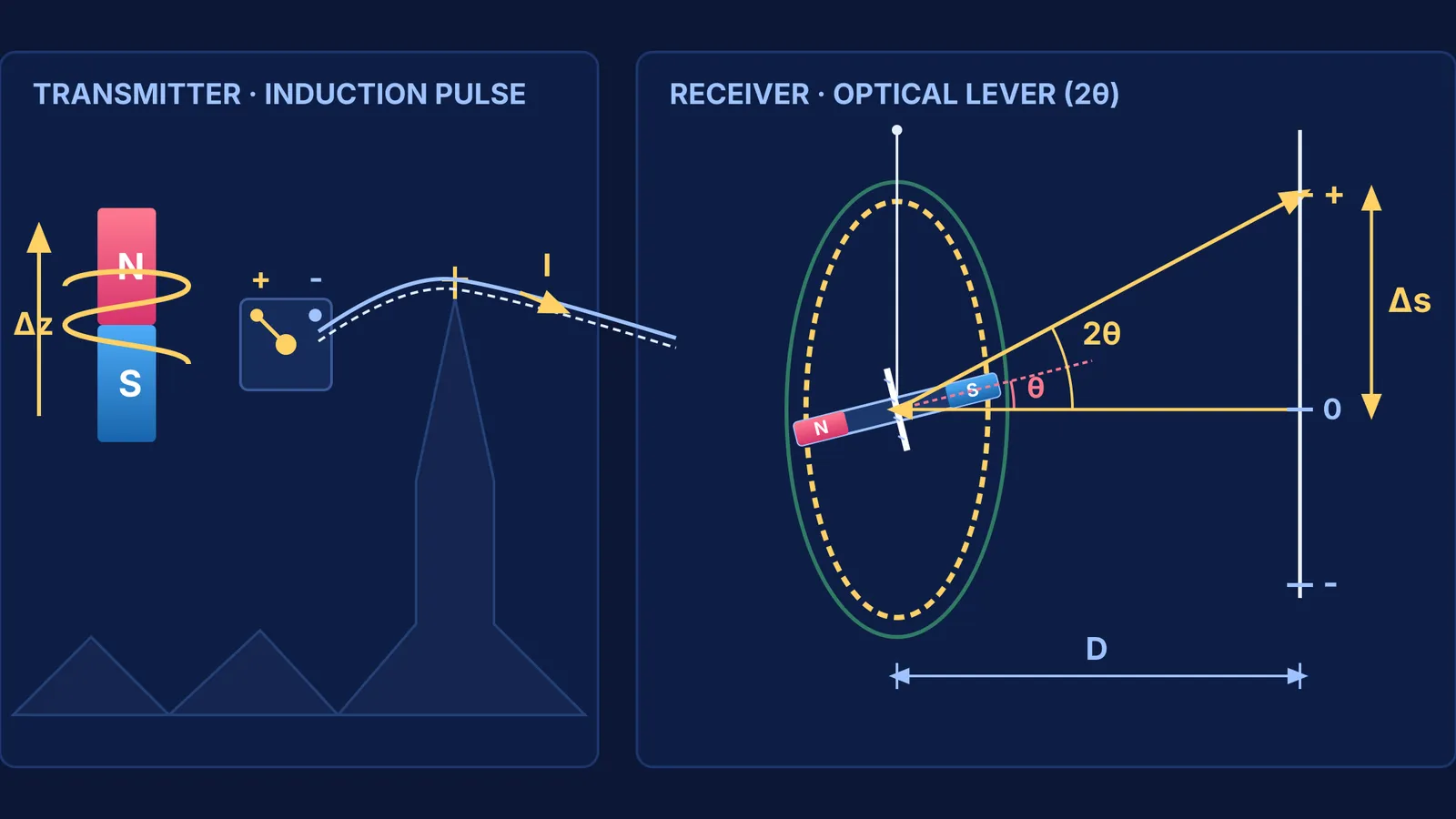
While Gauss and Weber initially pulsed current through their line using chemical galvanic batteries, maintaining wet chemical cells proved cumbersome. Drawing on Michael Faraday's conceptualisation of magnetic lines of force and his 1831 discovery of induction, they upgraded their transmitter by 1835 to a magneto-electric inductor: a permanent bar magnet fitted with a movable coil of insulated copper wire (Martín-Rodríguez et al., 2010).
Sliding the coil along the magnet induced a momentary voltage pulse governed by Faraday's and Lenz's laws of electromagnetic induction. Sliding it downward reversed the rate of flux change, producing an opposite pulse. Gauss paired the circuit with a commutator switch that inverted the polarity at will (Martín-Rodríguez et al., 2010). By coordinating mechanical strokes and switch positions, the transmitter dispatched sharp positive (+) or negative (-) electrical pulses through the 1.2-kilometre circuit without relying on chemical cells.
How did the mirror galvanometer decode binary pulses?
At the receiving end, the current entered a multiplier coil—50 turns at Weber's bench and 170 turns at Gauss's station (Martín-Rodríguez et al., 2010). Suspended inside by an unspun silk filament hung a magnetized steel bar. In 1833, the bar weighed roughly 1 pound (0.45 kilograms), later upgraded to bars weighing 25 to 100 pounds to prevent disturbance from ambient air currents (Needle telegraph, Wikipedia).
Because weak induction pulses produced only a fraction of a degree of deflection, Gauss mounted a small plane mirror on the suspension axis (Martín-Rodríguez et al., 2010). An observer viewed the reflection of a distant millimeter scale through a telescope.
A positive current swung the bar right; a negative current swung it left. Gauss and Weber mapped these movements into a binary alphabet. Common letters used short combinations—such as a single deflection for 'A' and 'E'—reaching speeds of 7 characters per minute (Needle telegraph, Wikipedia). Transmissions included the test alert *'Michelmann kömmt'* ('Michelmann is coming') and the motto *'Wissen vor Meinen, Sein vor Scheinen'* ('Knowledge before opinion, being before seeming') (Göttingen Tourismus). A surrounding copper ring generated eddy currents that damped oscillations, bringing the heavy magnet to rest after each pulse.
When studying electromagnetic induction and galvanometer dynamics for competitive exams like JEE, visualizing how eddy currents damp motion can be challenging from equations alone. The Fermi Simulation Lab provides interactive simulations for the ideas that are easier to see than to read, allowing students to test how changing coil turns and magnetic fields alter deflection.
Worked example: how did the optical lever magnify a tiny swing?
The optical lever—first systematised by Gauss for his magnetometers and telegraph receivers (Martín-Rodríguez et al., 2010)—is a classic demonstration of angular magnification in precision optics. Consider a pulse that rotates the suspended mirror by θ = 0.15° (0.00262 radians). The telescope and scale sit at a distance D = 3.5 metres from the mirror.
Calculate the angular deviation of the beam:
By the law of reflection, how rotating a plane mirror turns the beam by 2θ shows that rotating the mirror normal by θ deflects the reflected ray by 2θ: Δφ = 2θ = 2 × 0.15° = 0.30° (0.00524 radians).
Calculate the linear scale deflection:
For small angles in radians, the linear shift Δs on the scale is: Δs = D × tan(2θ) ≈ 2 × D × θ Δs ≈ 3.5 m × 0.00524 rad = 0.0183 m = 18.3 mm.
A mechanical turn of just 0.15° yields an 18.3-millimetre shift on the scale—easily resolved through a telescope.
For students working through torque, galvanometer sensitivity, and ray optics, the Fermi Problem Library features worked problems with a step-by-step solver that explains the reasoning rather than printing an answer.
What did the Göttingen telegraph teach modern physics?
The Göttingen line operated daily until late 1837, when Weber was dismissed as one of the 'Göttingen Seven' professors protesting the revocation of Hanover's constitution (Wilhelm Eduard Weber, Wikipedia). A lightning strike on December 16, 1845, finally destroyed the wires over St. Johannis Church (Martín-Rodríguez et al., 2010).
Their telegraph established lasting engineering foundations:
Absolute electrical units: Calibrating their apparatus led Gauss and Weber to define current and resistance using fundamental mechanical units, paving the way for the SI system where the weber (Wb) honors Weber (Wilhelm Eduard Weber, Wikipedia).
The optical lever: Gauss's mirror-and-scale setup became standard across experimental physics, later adopted in William Thomson's transatlantic cable galvanometers (Martín-Rodríguez et al., 2010).
Steinheil's ground return: In 1835, Gauss shared the system with Carl August von Steinheil, who proved on Bavarian railway trials in 1838 that the Earth itself could act as a return conductor, halving the wire needed for telegraph networks (Needle telegraph, Wikipedia).
Gauss and Weber proved that long-distance electric communication was achievable, grounding information theory in mathematical physics.


