On this page
V. S. Ramachandran was born in Tamil Nadu, finished his MD at Stanley Medical College in Chennai in 1974, and went on to direct the Center for Brain and Cognition at the University of California, San Diego (Nobel Conference profile, Gustavus Adolphus College). One of his best-known tools was a mirror standing upright in a box. With it he showed that what you see can change what you feel in a hand that is no longer there.
What is a phantom limb, and why can it hurt?
After an amputation, many people still feel the missing arm or leg, sometimes painfully. Ramachandran's early work pointed to the brain as the place to look.
Experiments on adult primates had shown that when the nerves from an arm stop sending signals, the brain area that used to respond to that limb starts responding to touches on the face. In a 1992 study, Ramachandran's team found the same thing in people: touching the lower face of one arm amputee produced sharply localised feelings in individual phantom fingers. In another patient, they found several complete maps of the phantom limb on the face, chest and armpit (Neuroreport, 1992). The brain's body map, in other words, is not fixed wiring.
How does Ramachandran's mirror box work?
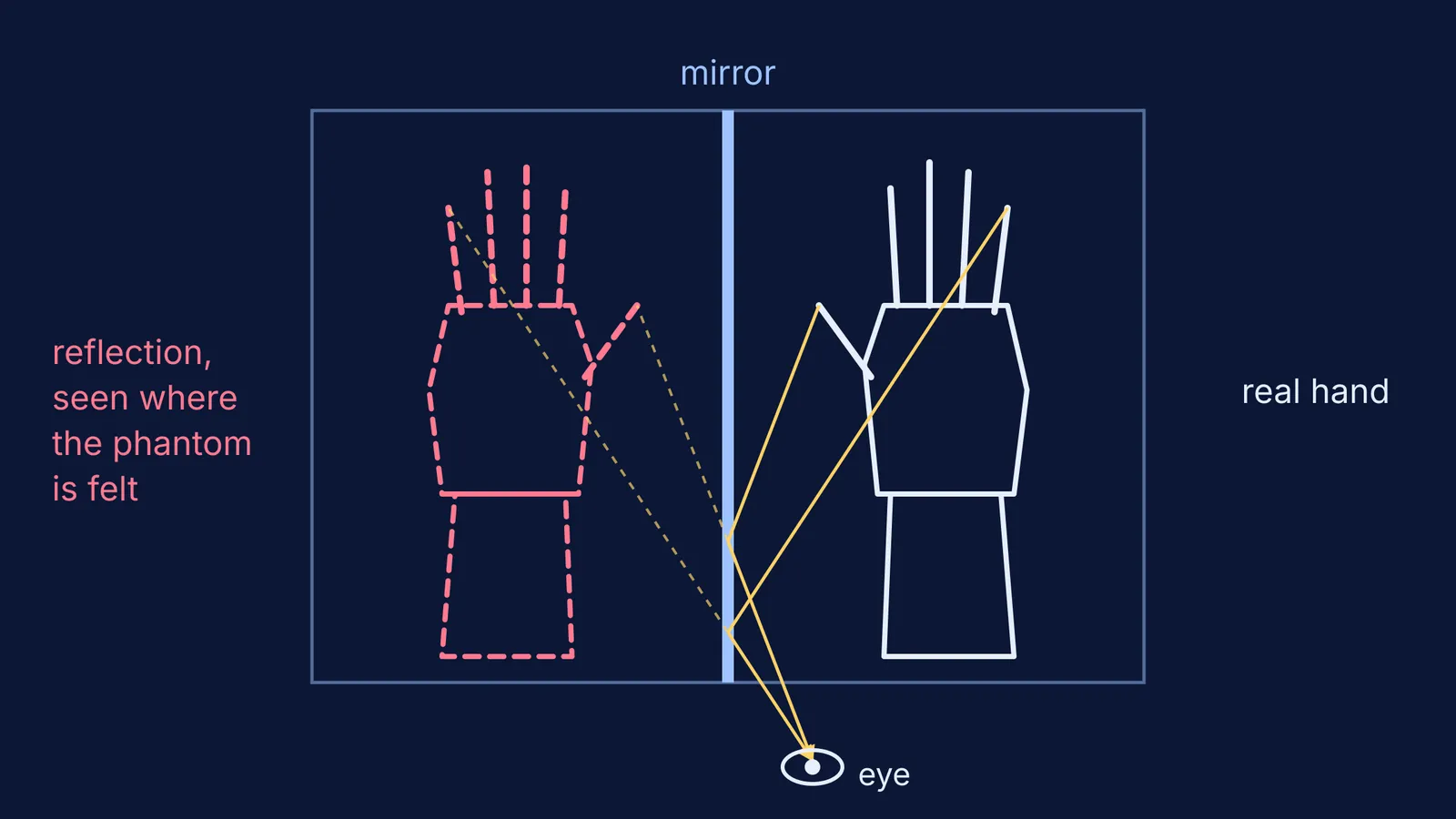
In 1996 Ramachandran and his co-author D. Rogers-Ramachandran described what they called a "virtual reality box". A mirror stands upright on a table so that the reflection of the patient's intact hand is "superimposed" on the felt position of the phantom (Proceedings of the Royal Society B, 1996). The patient moves the real hand and sees what looks like the missing hand moving.
They tried it with ten patients. The paper reports:
In six patients, moving the normal hand made the phantom feel as if it moved too.
One man, D.S., felt movement in his phantom for the first time in ten years.
Five patients had painful, involuntary "clenching spasms" in the phantom hand. In four of them the spasm eased when the mirror helped them "open" the hand, which they could not do without it.
The authors concluded there is "a considerable amount of latent plasticity even in the adult human brain" (Proceedings of the Royal Society B, 1996).
Does mirror therapy for phantom limb pain actually work?
One small study is only a start. In a 2007 trial at Walter Reed Army Medical Center, 22 people with lower-limb amputations were assigned to mirror therapy, a covered mirror, or imagining the movements (New England Journal of Medicine, 2007). Eighteen finished, six per group. After a month, all six in the mirror group reported less pain. In the covered-mirror group, 17% reported less pain and 50% reported more. In the imagining group, 67% reported more (ScienceDaily report of the trial).
The wider evidence is more cautious. A 2016 systematic review found 20 studies, only 5 of them randomised controlled trials (163 patients). Seventeen of the 18 studies on pain reported a benefit, but the evidence was weak, so the reviewers could not recommend mirror therapy as a first treatment (Annals of Physical and Rehabilitation Medicine, 2016).
This article explains the science; it is not a treatment guide. Anyone with pain after an amputation should work with a doctor or physiotherapist. If pain or worry is wearing you down, Tele MANAS offers free counselling round the clock on 14416 (IIT Kanpur counselling page on Tele MANAS).
How can you try the mirror illusion in a biology class?
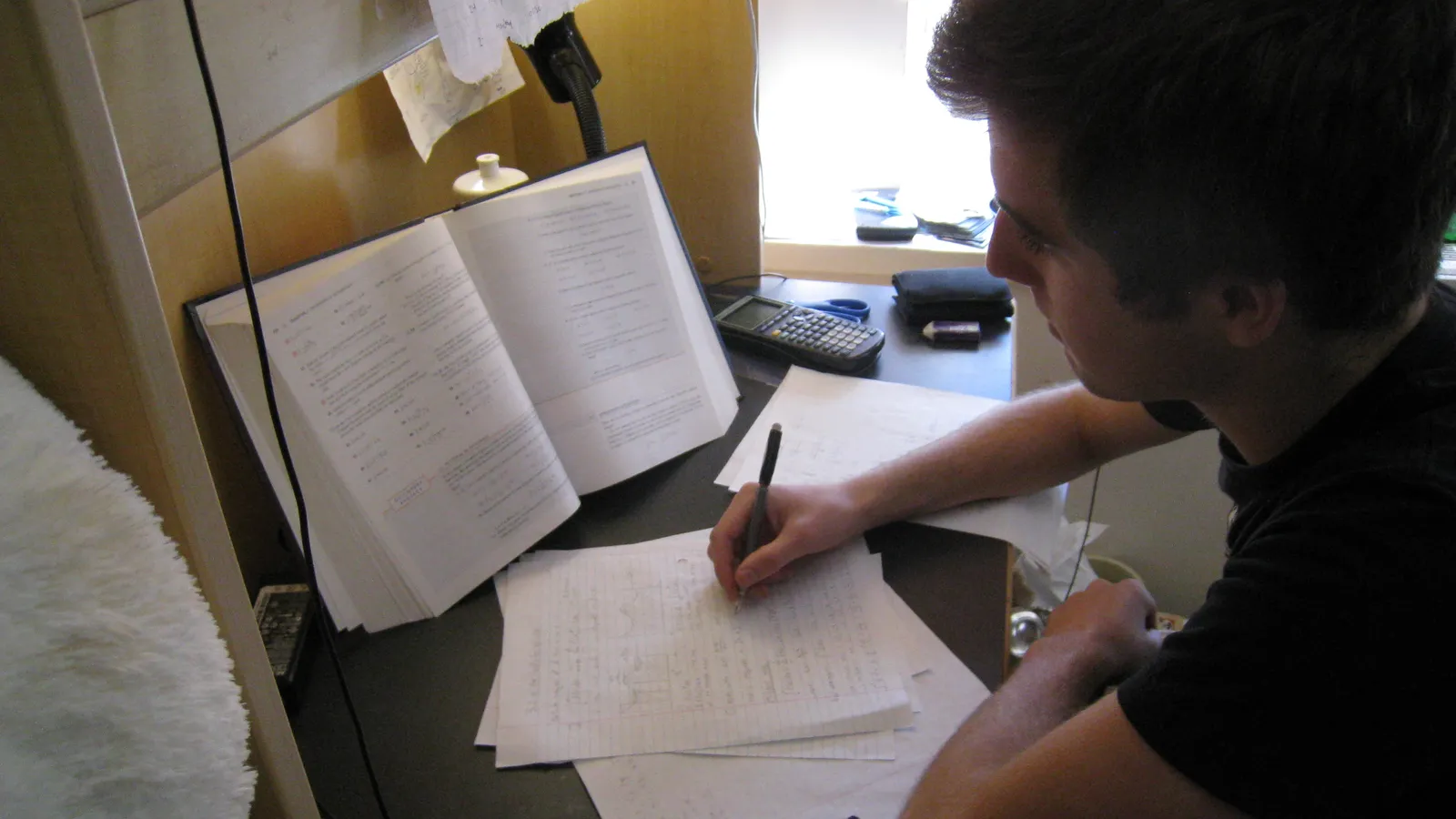
You can explore the optics and the perception safely with two healthy hands. Predict first, then observe.
Stand a flat mirror upright on a table, its edge pointing towards you.
Put your right hand on the reflecting side and your left hand behind the mirror, out of sight, in the same pose.
Lean so the reflection of your right hand sits where your hidden left hand is.
Tap the same fingers on both hands together for a minute, watching only the reflection.
Keep the hidden hand still while the visible hand keeps tapping, and note what you feel.
Then answer three questions. Why does a reflected right hand look like a left hand? How far behind the mirror is the image? Did seeing the hand change what you felt in the hidden one? The first two have exact answers, explained in our post on lateral inversion in a plane mirror. The third is Ramachandran's question. If ray diagrams are hard to picture, the Fermi Simulation Lab has interactive simulations for ideas that are easier to see than to read.
What does the mirror box teach about the brain?
Ramachandran's experiments suggest that even an adult brain's body map can shift when it gets new, consistent input. For the background, read how Korbinian Brodmann divided the cortex into numbered areas and how Donald Hebb explained that cells that fire together wire together.
If the nervous-system chapter feels like a list of unconnected terms, the Fermi Concept Library gives every concept in biology its own lesson and its place in the map.