

On this page
In 1949, the Canadian psychologist Donald Hebb published *The Organization of Behavior*, where he proposed a physical basis for learning. Hebb wrote: "When an axon of cell A is near enough to excite a cell B and repeatedly or persistently takes part in firing it, some growth process or metabolic change takes place in one or both cells such that A's efficiency, as one of the cells firing B, is increased" (Source).
Hebb's insight was remarkable because it predated the discovery of the exact molecular mechanisms of memory. He realised that learning could not just be a software update; it had to involve physical changes to the hardware of the brain. When we experience something new, neurons communicate by sending electrical signals across tiny gaps called synapses. If cell A routinely sends a signal that helps cell B to fire, the synapse between them undergoes a structural change to make the connection more efficient.
Decades later, in a 1992 article for *Scientific American*, the neurobiologist Carla Shatz summarised this idea with a phrase that has become famous: "cells that fire together, wire together" (Source).
This process is known as synaptic plasticity. When you learn a new concept, you activate a specific network of neurons. If you fire that network repeatedly, the brain builds thicker, stronger connections between those cells. In 1973, researchers T. V. P. Bliss and T. Lømo proved this physical change happens in the brain, a process they called long-term potentiation (Source).
Why does timing matter?
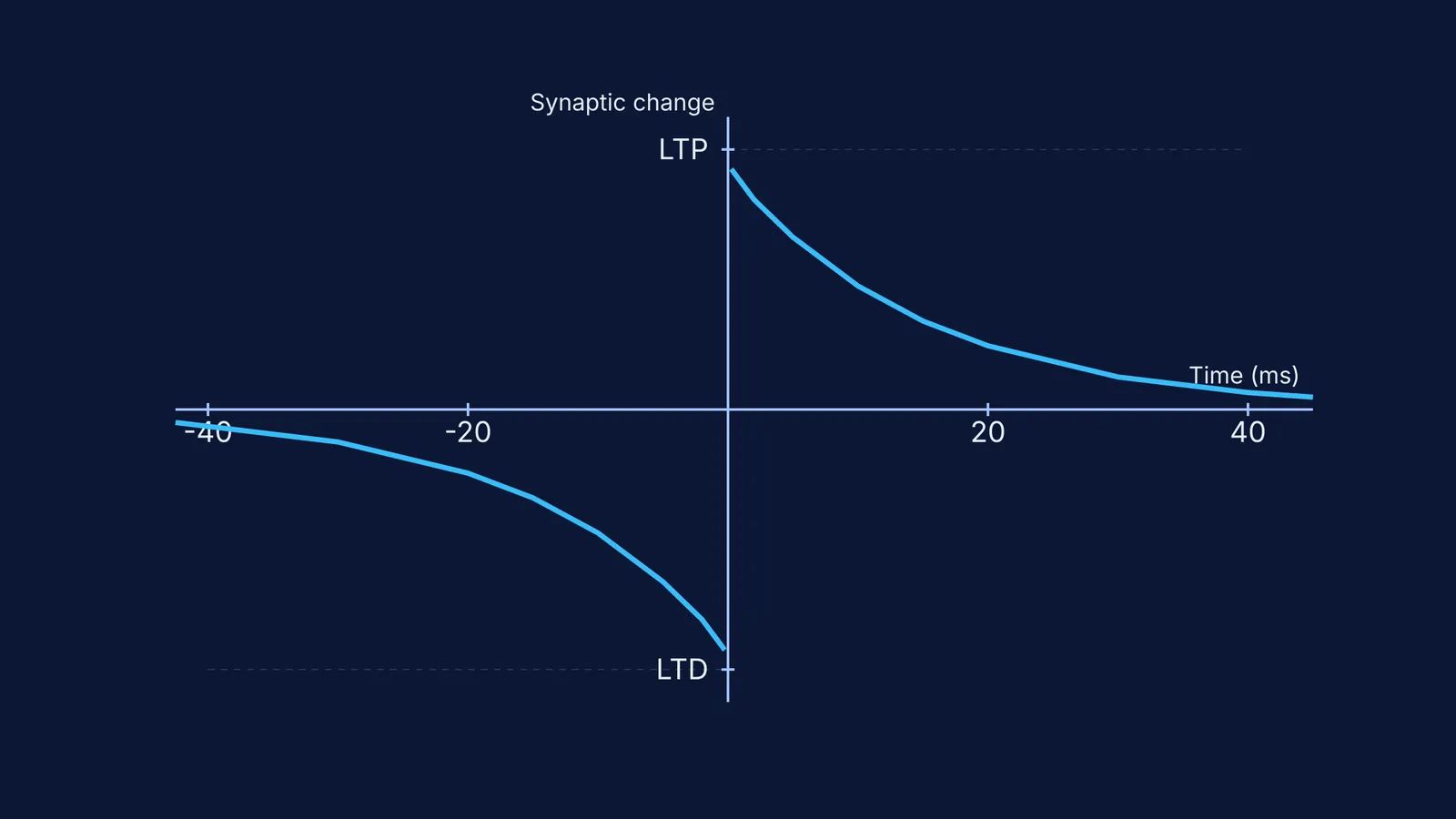
In the decades since Hebb's book, modern neuroscience has refined his idea into Spike-Timing-Dependent Plasticity (STDP). It turns out that for two cells to wire together strongly, the order of their firing is crucial.
For a connection to experience long-term potentiation—meaning the synapse becomes stronger—the first neuron (the sender) must fire just milliseconds before the second neuron (the receiver) (Source). This precise timing implies a causal relationship, where the first cell is actively helping to trigger the second.
If the cells fire in the wrong order, or if they fire completely out of sync, the brain assumes the connection is not useful. The synapse then undergoes long-term depression and becomes weaker. This "use it or lose it" pruning mechanism is just as crucial as strengthening. Without it, the brain would become overwhelmed with noise, unable to distinguish a meaningful pattern from random static. For a deeper look at the anatomy behind these pathways, you can review the parts of the human brain.
How does Hebb's rule apply to studying?
When you sit down to study for an exam like JEE Main or NEET-UG, you are fundamentally trying to rewire your brain. Hebb's rule explains why simply reading a textbook or highlighting notes does not produce lasting results. These methods are passive. They might activate a few visual or auditory neurons, but they do not force the specific problem-solving circuits to fire in the correct sequence.
To wire a concept into long-term memory, you must actively retrieve it from your own mind. A landmark 2008 study published in *Science* by psychologists Jeffrey Karpicke and Henry Roediger proved this by testing students on a new vocabulary list. The students who continuously tested themselves after initially learning an item remembered significantly more a week later than those who simply continued studying the material (Source).
This is why working through problems is essential. Even if you struggle, the effort of retrieving the information activates the cells together. When you use the Fermi Problem Library, the step-by-step solver does not just print the final answer; it explains the reasoning and checks your understanding as it goes. This forces your brain to actively fire the right sequence of steps, wiring the method deeply into your memory.
How do you build study habits that stick?
Habits themselves are nothing more than well-worn neural pathways. By applying Hebbian principles, you can make the act of studying feel automatic rather than exhausting.
Consistency is the primary driver of this process. Every time you sit down at your desk at the same time and open your books, you fire the "study habit" circuit. Over weeks and months, that specific sequence of actions wires together so strongly that studying requires less willpower.
If you often find yourself staring at a blank page and struggling to begin, Fermi's AI tutor can help break the friction. It works out what you already know and builds a plan for the session, meaning you always sit down to a clear, actionable next step.
Finally, to protect these fragile new connections, you must ruthlessly eliminate distractions. Every time your phone vibrates, a completely different neural circuit fires, interrupting the sequence you are trying to strengthen. As a recent study on the "brain drain" effect demonstrated, even having a phone on your desk can hurt focus and drain your cognitive capacity (Source).
By testing yourself frequently, working through problems actively, and studying consistently without interruptions, you use the fundamental biology of your brain to your advantage. You are not just memorising facts for tomorrow; you are physically wiring your neurons for long-term success.


