

On this page
Every time you write (R)-butan-2-ol in a JEE answer, you are using a rulebook that three chemists built over fifteen years. It tells you which of two mirror-image molecules you mean, using one letter. Here is who wrote it, why it changed, and how to apply it without the usual slips.
Who devised the R and S rules?
Vladimir Prelog was born in Sarajevo on 23 July 1906, studied and taught in Prague, worked in Zagreb from 1935, and joined ETH Zurich's Laboratory of Organic Chemistry in 1941, according to ETH Zurich's biography of Prelog. He led that laboratory from 1957 to 1965, won the 1975 Nobel Prize in Chemistry with John Cornforth for his work on the stereochemistry of organic molecules and reactions, and died in Zurich on 7 January 1998, the same page records.
The system began without him. In 1951 Robert Sidney Cahn and Christopher Ingold published "Specification of configuration about quadricovalent asymmetric atoms" in the Journal of the Chemical Society. Prelog joined them for "The specification of asymmetric configuration in organic chemistry", a 14-page paper in Experientia in 1956. ETH Zurich says Prelog "teamed up with" Cahn and Ingold to develop the convention, which "is used to specify the sense of chirality in molecules clearly."
Why did the rules keep changing?
Chirality itself had been known for a century, ever since Louis Pasteur separated mirror-image tartrate crystals. What chemists lacked was a way to name one mirror image from a drawing alone, without comparing it to a reference compound or measuring how it rotates light.
The three authors widened the system in their 1966 paper "Specification of Molecular Chirality" in Angewandte Chemie. Its abstract says it gives "the framework of a general system for the specification of their chirality" and extends it to organic conformations and to inorganic configurations with up to six groups around a central atom.
Then computers arrived. In 1982 Prelog and Günter Helmchen proposed a revision in Angewandte Chemie. Its abstract says efforts "to teach computers to use the system" had "shown that certain of its aspects must be more strictly formulated and others modified."
How do the CIP priority rules work?
The current version sits in the IUPAC recommendations on organic nomenclature, section P-9 of the Blue Book. The core steps are:
Rank the four atoms joined to the chiral centre by atomic number: Rule 1a says "Ligands are arranged in order of decreasing atomic number."
If two atoms tie, move outward and compare the sets of atoms attached to each, highest first, until you reach the first point of difference.
Treat a double bond as if each end carried a duplicate of the atom at the other end, so C=O counts as carbon bearing two oxygens.
If atoms still tie, the higher mass number wins (Rule 2), so deuterium outranks ordinary hydrogen.
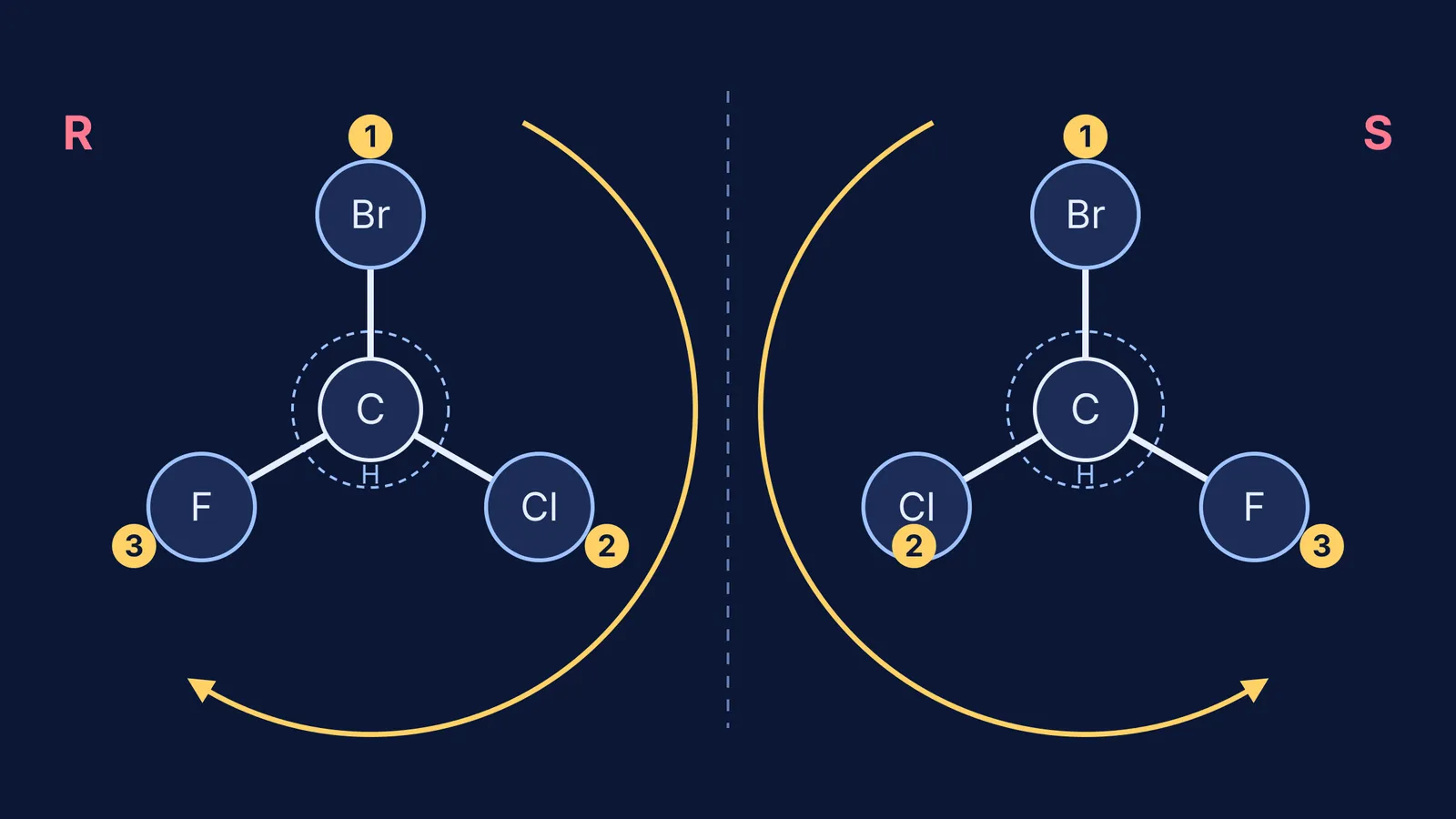
View the molecule from the side away from the lowest-ranked group and trace 1, 2, 3.
The same IUPAC section quotes Prelog and Helmchen's chirality rule: the path is followed from "the side remote from the group of lowest precedence", and the centre is R or S "depending on whether the path turns to right or left".
Our explainer on the difference between D/L, R/S and (+)/(-) sets the three labels side by side.
How do you assign R or S to a chiral centre?
Take butan-2-ol. Suppose a drawing shows OH at the top, the ethyl group at the lower right, the methyl group at the lower left, and H on a dashed bond pointing away from you.
Priority 1: OH, because oxygen (atomic number 8) beats carbon (6).
Priority 2: ethyl. Its first carbon carries (C, H, H); methyl's carries (H, H, H). Carbon beats hydrogen at the first point of difference.
Priority 3: methyl.
Priority 4: H, already pointing away.
Top, then lower right, then lower left is a clockwise path, so this drawing is (R)-butan-2-ol.
Now the three slips that cost marks:
H pointing towards you. Trace the path anyway, then reverse the letter. Clockwise becomes S.
Judging by group size. Compare -CH2Br with -C(CH3)3. The sets are (Br, H, H) and (C, C, C). Bromine beats carbon at the first comparison, so -CH2Br ranks higher even though tert-butyl is bigger.
Forgetting duplicate atoms. -CHO counts as (O, O, H) and -CH2OH as (O, H, H), so the aldehyde outranks the alcohol.
If a tie-break like -CH2Br against tert-butyl still feels shaky, the Fermi Concept Library has a lesson for each chemistry concept, and the Fermi Problem Library has worked problems with a step-by-step solver that explains the reasoning rather than printing an answer.
Once R and S feel automatic, use them to sort pairs of molecules with our guide to telling identical, enantiomer and diastereomer pairs apart.


