

On this page
Around 2,000 years ago, a Roman military engineer wrote down almost everything a builder of his time needed to know. Marcus Vitruvius Pollio served as a military engineer for Julius Caesar between 58 and 51 BCE, and wrote *De architectura* between 30 and 20 BCE, dedicating it to Augustus, according to World History Encyclopedia. Below: what is in it, his three-part rule, and two of his calculations you can check with school maths.
What is in Vitruvius' Ten Books on Architecture?
The "ten books" are ten parts of one long work, each split into short chapters. The 1914 English translation by Morris Hicky Morgan lays them out like this:
Book I: the education of an architect, the site of a city, walls and streets
Book II: materials such as brick, sand, lime, stone and timber
Books III and IV: temples, columns and proportion
Book V: forums, theatres, baths and harbours
Book VI: houses, and how climate should shape them
Book VII: floors, stucco and colours
Book VIII: water: finding it, testing it and carrying it to cities
Book IX: astronomy, sundials and water clocks
Book X: machines: hoists, water wheels, the water screw, pumps and siege engines
What did Vitruvius mean by strong, useful and beautiful?
In Book I, Chapter 3, Vitruvius says all buildings "must be built with due reference to durability, convenience, and beauty" (Morgan translation). The Latin words are *firmitas, utilitas, venustas* (Latin text on LacusCurtius). He then says how to meet each one:
Strong (firmitas): foundations go down to solid ground, and materials are chosen "wisely and liberally".
Useful (utilitas): rooms are arranged so nothing gets in the way of use, and each building faces the right direction for its purpose.
Beautiful (venustas): the building looks pleasing, and its parts are in proportion.
How did Romans keep water flowing in aqueducts?
Book VIII is a short course in hydraulics. Vitruvius says a masonry water channel should fall "not less than a quarter of an inch for every hundred feet", and be roofed over "so that the sun may not strike the water at all" (Book VIII, Chapter 6). To measure such tiny slopes he recommends the chorobates, a levelling table "about twenty feet long" with plumb lines and a water groove on top.
Worked example. A hundred feet is 1,200 inches, so a quarter-inch drop is a gradient of 0.25 ÷ 1,200, or 1 in 4,800. Over 1 km, that is a fall of only about 21 cm. Gravity does all the work, so everything depends on surveying a slope too gentle to see.
He also warns against lead pipes. Water from clay pipes, he writes, is "much more wholesome than that which is conducted through lead pipes" (Book VIII, Chapter 6). For how Rome ran its water network about a century later, read our piece on Frontinus and the Roman aqueducts.
Which machines does Vitruvius describe in Book X?
Besides lifting machines, Book X covers the water organ and the hodometer, a distance meter (Morgan translation). For the backstory, we have covered Ctesibius and his water clock and pump and how the Archimedes screw lifts water.
The hodometer makes a good maths problem. Vitruvius takes a carriage wheel 4 feet across and says one turn covers 12.5 feet. A drum with 400 teeth moves on one tooth per turn of the wheel, so it goes round once every 400 turns, by which time the carriage has gone "five thousand feet or one mile" (Book X). Each mile, a pebble drops into a bronze bowl, so counting pebbles gives the distance.
Now check his numbers:
Circumference = π × diameter = π × 4 ≈ 12.57 feet, not 12.5.
Using 12.5 is the same as taking π = 12.5 ÷ 4 = 3.125.
After 400 turns the true distance is 400 × 12.57 ≈ 5,027 feet.
The error is about 27 feet in 5,000, about half a percent, which is good enough for a road.
Gear ratios are easier to understand when you watch them turn. The Fermi Simulation Lab has interactive simulations for ideas that are easier to see than to read.
Why do students still read Vitruvius?
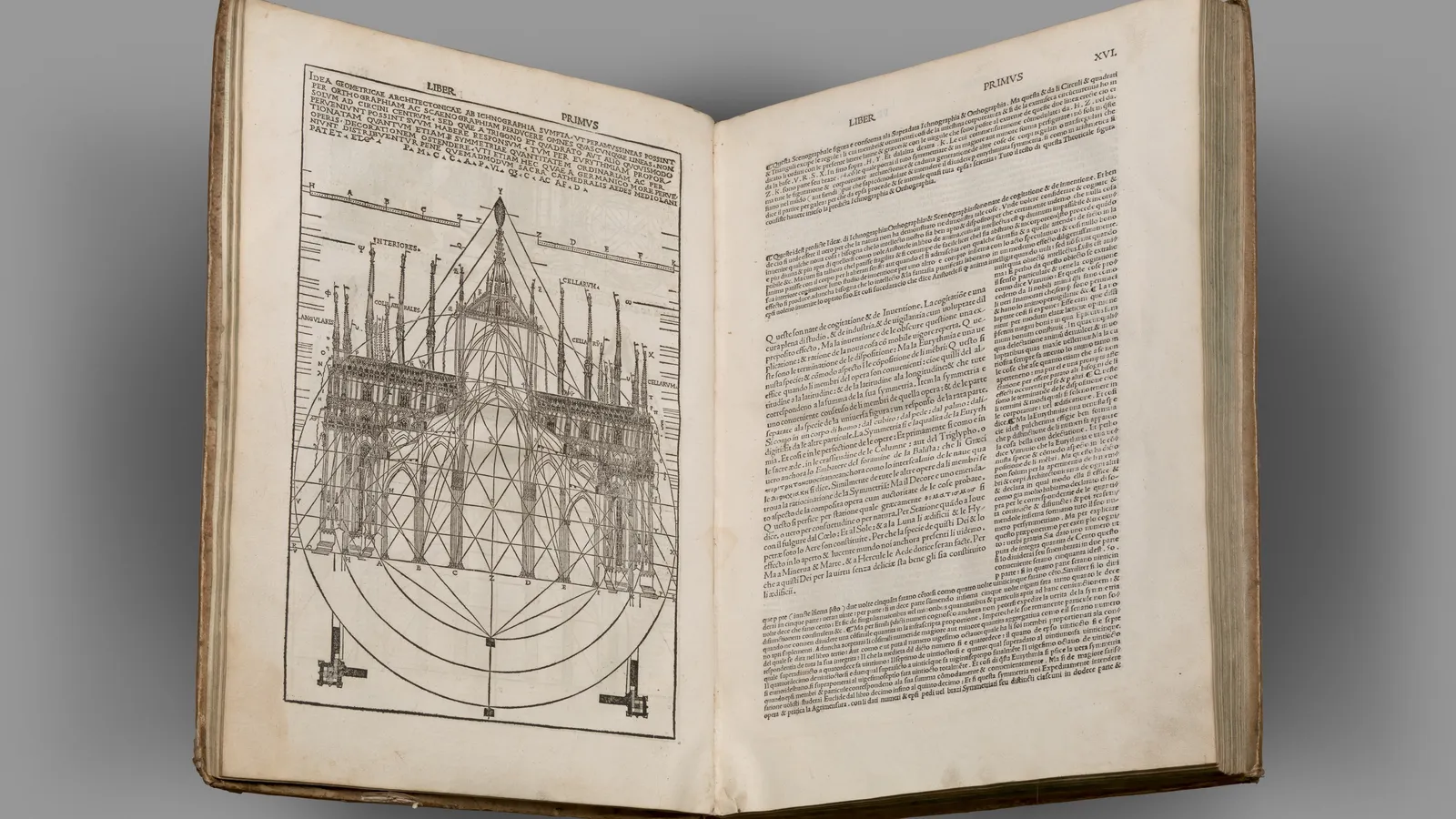
The first printed copies appeared in Rome in 1486 (World History Encyclopedia). The oldest surviving manuscript was copied around 800 to 825 CE, and the work is the only treatise on architecture to survive from antiquity (Wikipedia summary with sources), so it is our main written guide to how Romans thought about building.
The lasting lesson is his method: give numbers, say how to measure them, then check them. Entrance exams reward the same habit. If you get stuck on a step, the Fermi Problem Library has worked problems with a step-by-step solver that explains the reasoning rather than printing an answer.
The full text is free to read. Start with Book I, Chapter 3, then jump to Book X.


