

On this page
In 97 CE the emperor Nerva put a new man in charge of Rome's water. Sextus Julius Frontinus was appointed curator aquarum that year, according to a 2020 review in the journal Groundwater by geologist David Deming. He then wrote a handbook on the aqueducts that, in his words, "may be found useful by my own successor" (De Aquis, Book I, Bennett translation).
He measured carefully and proved the records wrong, yet he had no way to measure the other half of a flow rate: speed.
Who was Frontinus and what did he do for Rome's water supply?
Frontinus lists nine aqueducts serving Rome in his day, from the Appia, built in 312 BC, to the Claudia and the New Anio, completed under the emperor Claudius (Book I, sections 4, 5 and 13).
The job was part engineering, part audit. His second book describes water-men "diverting water from the public conduits for private use" and landowners who tapped the conduits to water their gardens (Book II, section 75).
How did Frontinus measure flow in the aqueducts?
His unit was the quinaria, a standard pipe nozzle whose diameter was 5/4 of a Roman digit (Book I, section 25). One quinaria corresponds to a pipe 2.3125 cm in diameter, as Deming gives it. A pipe's allowance was counted in how many quinariae of opening it had.
The records themselves did not add up: they set down 12,755 quinariae received but 14,018 quinariae delivered (Book II, section 64). So he went to the source. "I first of all undertook measurements of the intakes of the conduits," he writes, and found a supply "far greater, that is, by about 10,000 quinariae, than I found in the records" (section 64). For the Marcia alone, he gauged 4,690 quinariae at the intake against 2,162 in the records (section 67).
What did Frontinus miss about flow rate?
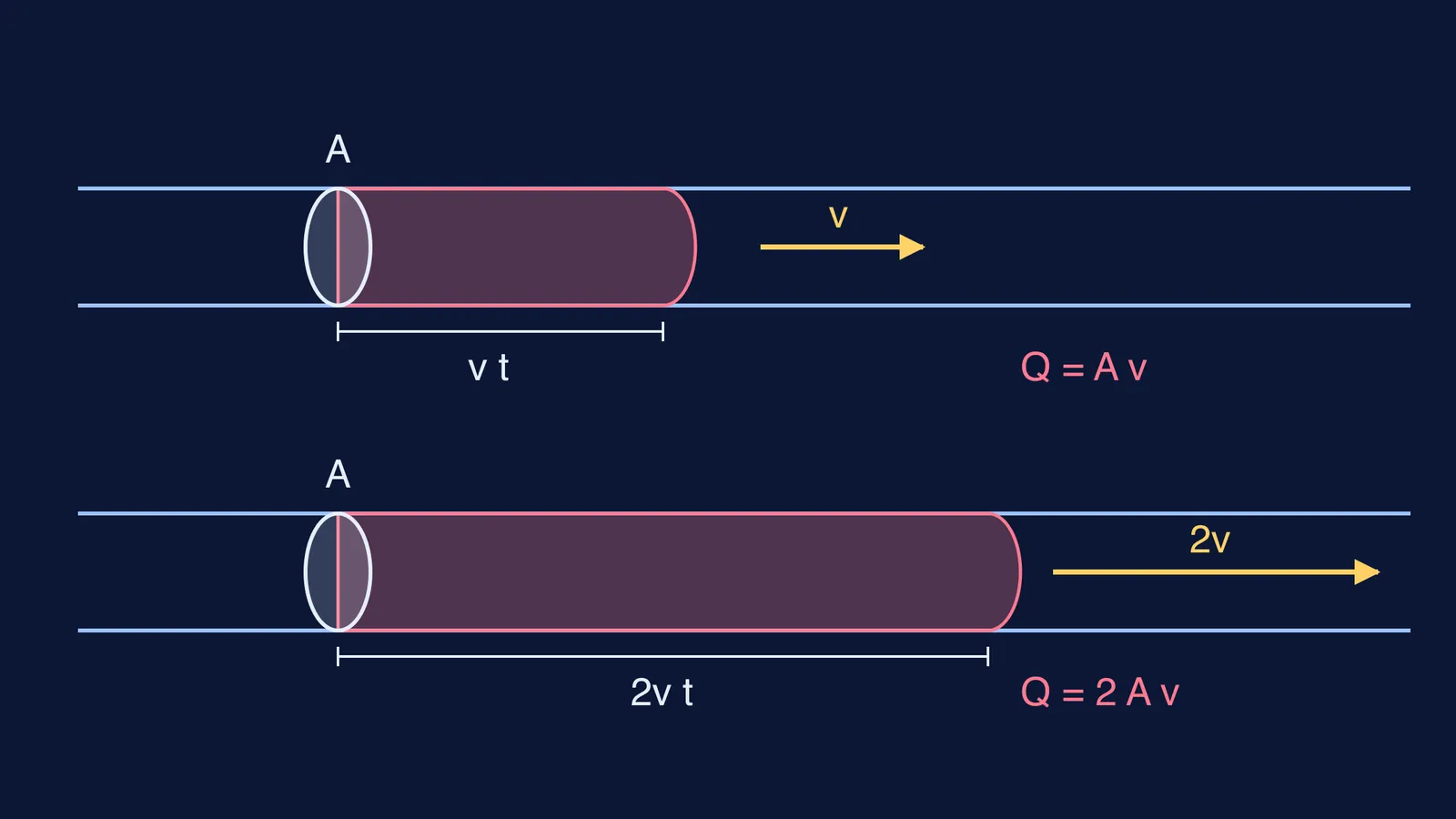
A quinaria measures area, not flow. Deming puts it plainly: "This is dimensionally incorrect, as water flow must have units of length cubed per unit time, and a quinaria has dimensions of length squared" (Groundwater, 2020). The same paper notes that the Romans had no means of measuring flow velocities.
Frontinus noticed the effect without the formula. Water that "comes from a higher point" not only fills its measure "but actually yields a surplus", while water from a lower point "shrinks in volume" (Book I, section 35). A nozzle "set against the current" will "take in more" (section 36). A higher source means faster water, which is what Torricelli later captured; our explainer on Torricelli's law and the range of a water jet works through it.
Worked example: how much water is one quinaria?
Modern scholars (Hodge 1992 and Bruun 1991) estimate that a one-quinaria pipe discharged about 40 m³ in 24 hours, as cited by Deming. Use it to find the hidden speed.
Area: the radius is 0.0115625 m, so A = πr² ≈ 4.20 × 10⁻⁴ m².
Flow rate: Q = 40 m³ ÷ 86,400 s ≈ 4.63 × 10⁻⁴ m³/s, about 0.46 litres a second.
Speed: v = Q ÷ A ≈ 1.1 m/s, the speed hidden in every quinaria.
Whole city: 14,018 × 40 m³ ≈ 560,720 m³ a day, the figure Deming gives. Other estimates he cites run from 520,000 to 635,000 m³ a day (Bruun 2013) and up to 1,000,000 m³.
Per person: Deming cites an estimate of about 1 million people in Rome under Augustus, a century earlier. If the population was similar, that gives roughly 560 litres per person per day. Much of it fed baths and fountains, so treat this as supply, not household use.
For scale, India's Jal Jeevan Mission aims for household tap connections at 55 litres per capita per day in rural areas.
Now the trap. If water in the same nozzle sped up to 2.2 m/s, the real flow would double, and Frontinus's ledger would still say one quinaria.
How can you avoid Frontinus's mistake in physics numericals?
Use this checklist on any fluids question:
Check units first. An answer in m² is an area; a flow rate is in m³/s or litres per second.
Write Q = Av before you put in numbers, and use A₁v₁ = A₂v₂ when a pipe narrows. Our guide to the continuity equation in fluid flow has practice cases.
Ask what sets the speed: the height of the source, pressure, or the slope of the channel.
Convert carefully: 1 m³ = 1,000 litres and one day = 86,400 seconds.
Compare like with like, as Frontinus did when he checked intake against delivery.
If continuity questions go wrong at the step where the speed changes, the Fermi Problem Library has worked problems with a step-by-step solver that explains the reasoning rather than printing an answer. Flow is also easier to see than to read, so the Fermi Simulation Lab has interactive simulations for ideas like this one.
Centuries later, the link between pressure, height and speed was put into equations; read how Daniel Bernoulli tied pressure to fluid speed next.


