

On this page
Every cassette tape and every spinning hard disk descends from a Danish telephone engineer's experiment with piano wire. In 1898 Valdemar Poulsen showed that sound could be stored as a pattern of magnetism and read back later, using the physics of your Class 12 chapters on magnetism and induction.
What did Valdemar Poulsen invent in 1898?
Valdemar Poulsen (1869–1942) was a Danish engineer at the Copenhagen Telephone Company when he demonstrated magnetic recording in 1898, according to the National Inventors Hall of Fame. His telegraphone was the first device to record sound magnetically.
The Computer History Museum describes the first success simply: Poulsen recorded his voice by feeding a telephone microphone signal to an electromagnet that he moved along a steel piano wire. His US patent, "Method of Recording and Reproducing Sounds or Signals", was filed on 8 July 1899 and granted on 13 November 1900.
How did the telegraphone record sound on steel wire?
Think of it as a chain of four links, each a piece of school physics.
Sound to current. Your voice makes a telephone microphone send a current that rises and falls with the sound.
Current to field. That current flows through the coil of an electromagnet, the recording head, so its field rises and falls too.
Field to stored pattern. Each short stretch of the moving wire is left magnetised by whatever the field was as it passed. Steel keeps that magnetism, which is why the pattern survives; our post on how Pierre Weiss explained ferromagnetism with magnetic domains shows why.
Pattern back to current. On playback the wire runs past the head again, and its changing magnetism induces a current that an earpiece turns back into sound.
Poulsen's patent describes the same chain: the undulations of current vary the magnetism of the electromagnet, and those variations are passed on, one after another, to the wire. It also describes erasing: a second electromagnet, magnetised uniformly by a battery, wipes the wire clean.
Why did the telegraphone fail to catch on?
It made a splash. At the 1900 Paris World Exhibition it recorded Emperor Franz Josef of Austria and won a Grand Prix, the Computer History Museum records. A simple version stored 2 minutes of audio on 130 mm steel disks, while steel wire wound around a cylinder held up to 30 minutes, the same page says. The emperor's recording is believed to be the oldest surviving magnetic audio, according to the National Inventors Hall of Fame.
The weak point was the signal. At first the telegraphone could not compete with the gramophone, the Open University explains; the thermionic valve later made it possible to amplify the weak magnetic signal. Wire recorders found limited acceptance until vacuum tube amplifiers arrived, the Computer History Museum adds.
How did steel wire lead to tapes and hard disks?
The method stayed; the material changed. In 1927 J. A. O'Neill swapped the wire for magnetically coated tape while keeping Poulsen's approach, the National Inventors Hall of Fame notes. In the 1920s Curt Stille added electronic amplification and marketed the patent to AEG, and German engineers moved from steel and powder-coated paper tape to plastic tape coated with magnetic oxide, leading to the Magnetophon, according to Trinity College Dublin's magnetism group.
In June 1956 IBM shipped the Model 350 RAMAC, the first commercial hard disk drive: 50 disks, each 24 inches across, spinning at 1,200 rpm and storing 3.75 megabytes, says the Computer History Museum. It read and wrote with inductive magnetic heads, the same head-and-coil idea Poulsen put on his wire.
Worked example: why is playback silent where the wire is most magnetised?
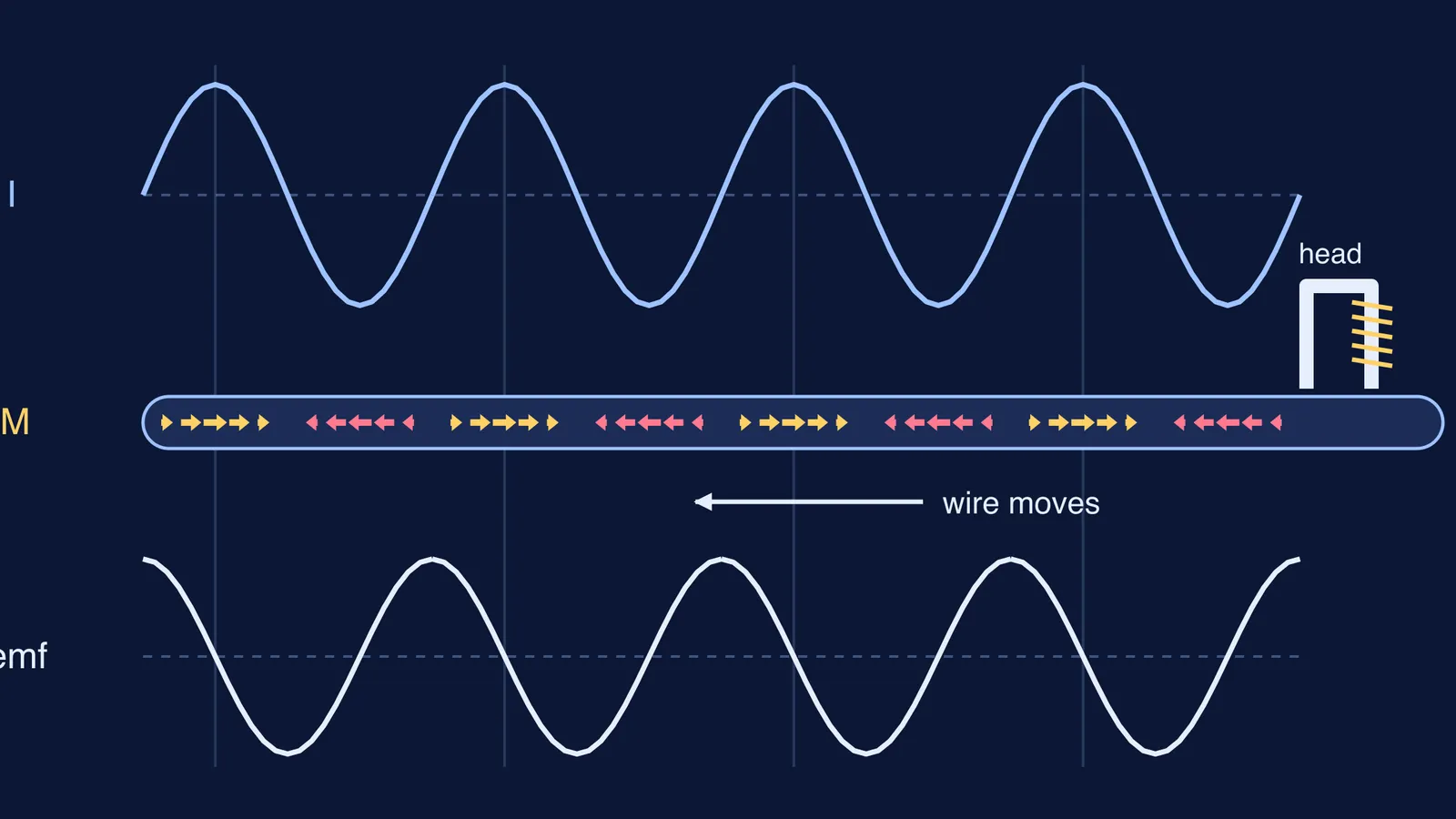
Look at the diagram at the top. Record a steady whistle, so the current is a sine wave. The magnetisation M along the wire follows that sine wave.
On playback, the emf in the head's coil is e = −dΦ/dt, where Φ is the flux from the wire through the coil.
The wire moves at speed v, so dΦ/dt = v × dΦ/dx. The emf follows how fast M changes along the wire, not how big M is.
Where M peaks, it is momentarily not changing, so the emf is zero. Where M crosses zero, it changes fastest, so the emf peaks.
You hear the same pitch, shifted a quarter cycle. Play the wire back twice as fast and the emf doubles, because v doubles (the pitch doubles too).
If step 1 feels shaky, revise how Michael Faraday discovered electromagnetic induction in 1831. To see how a recording can fade, read how magnets lose their magnetism.
Induction is easier to see moving than on a page. The Fermi Simulation Lab has interactive simulations for ideas like this, and the Fermi Concept Library gives each physics concept its own lesson, so you can close a gap in flux or emf before your next test.


