

On this page
A magnet's strength comes from order you cannot see. Heat, knocks and careless storage scramble it.
Why do magnets lose their magnetism?
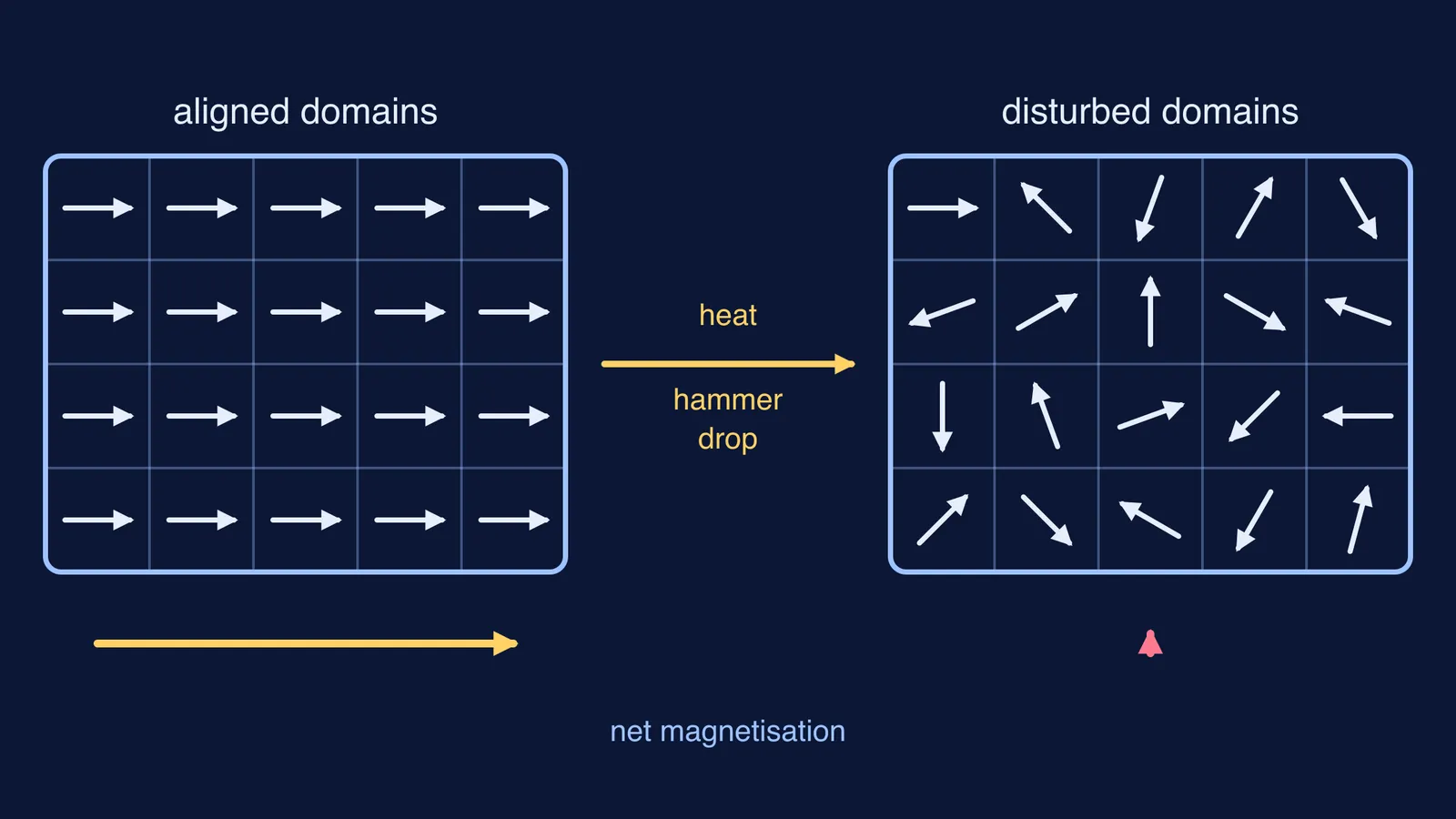
In iron, nickel and cobalt, each atom behaves like a tiny magnet. In these ferromagnetic materials, neighbouring atomic magnets line up in regions called domains, as HyperPhysics at Georgia State University explains. In an unmagnetised iron bar the domains point in different directions and cancel out. Magnetising the bar turns most of them the same way, so their fields add up.
A magnet loses its magnetism when something gives the domains enough energy to drift out of line. The three everyday causes are heat, mechanical shock and opposing magnetic fields.
How hot is too hot for a magnet?
The Curie temperature is the temperature above which the long-range order between atomic magnets disappears and the material stops being ferromagnetic (HyperPhysics). The Curie temperature of iron is 770 °C, nickel 354 °C, cobalt 1115 °C and neodymium-iron-boron 320 °C, according to a Curie temperature table from the magnet supplier supermagnete.
The maximum working temperature is far lower. Standard N-grade neodymium magnets lose part of their magnetisation permanently at 80 °C, and ferrite magnets at 250 °C (supermagnete). Very thin or flat magnets can lose strength even below the stated limit.
K&J Magnetics explains what happens in each range. Up to the maximum operating temperature, a warm neodymium magnet is a little weaker, typically within 5 to 10 percent, but recovers when it cools. Above it, some loss is permanent. In a worked example, K&J estimates from BH curves that an N42 disc magnet with an 80 °C limit would keep about 60 percent of its strength after being heated to 100 °C and cooled. Remagnetising can in theory fix that, but above roughly 900 to 1000 °C the structure changes and no applied field restores it.
Does dropping or hammering a magnet really weaken it?
It can for some types. In a simple picture, the walls between domains are held in place at tiny defects in the material, and a sharp blow can jolt them free. The magnet's own field then nudges domains out of line.
Alnico magnets (an alloy of aluminium, nickel and cobalt) are especially at risk. Magnet Source warns that alnico can lose strength if it is tapped on a hard surface or dropped on the floor, and also when it is exposed to a repelling magnetic field. The Class 6 NCERT textbook Curiosity, Chapter 4: Exploring Magnets has the magnet say: "Do not heat me or drop me or hammer me."
How should you store magnets so they stay strong?
The same NCERT chapter gives the storage rule. Keep bar magnets in pairs with unlike poles on the same side, put a piece of wood between them, and place two pieces of soft iron across the ends. It also says not to keep magnets near mobile phones or remote controls.
The soft-iron pieces are called keepers. On its own, a bar magnet works against itself: inside the bar, its own field (the demagnetising field) points back against the magnetisation and can slowly push domains out of line. With keepers, the magnetic flux runs from one magnet's N pole through the iron into the other magnet's S pole and back round. With the loop closed in iron, the field working against the domains is much weaker.Monroe Engineering advises storing alnico magnets with keepers to reduce the possibility of partial demagnetisation.
A storage checklist for home or a school lab:
Lay two bar magnets side by side, N next to S, with a wooden strip between them.
Put a soft-iron keeper across each end to close the loop.
Store the box away from heaters, stoves, phones and remote controls.
Keep alnico magnets away from strong magnets that could repel them.
Put magnets down gently and never toss them into a drawer.
Already weak? Both alnico suppliers above note that alnico can be remagnetised, so ask your teacher.
How do you explain the Curie temperature in an exam answer?
Compare thermal energy with the coupling that keeps atomic magnets lined up. Use the average thermal kinetic energy per particle, (3/2)kT, where k = 8.617 × 10⁻⁵ eV/K.
At room temperature (300 K): (3/2) × 8.617 × 10⁻⁵ × 300 ≈ 0.039 eV.
At iron's Curie temperature (770 °C ≈ 1043 K): (3/2) × 8.617 × 10⁻⁵ × 1043 ≈ 0.135 eV, the figure HyperPhysics gives.
At 1043 K the thermal energy is about three and a half times its room-temperature value, enough to overcome the coupling that holds the atomic magnets in line. A good exam answer names this competition instead of just saying "heat destroys magnetism".
If domains still feel abstract, the Fermi Concept Library has a lesson for every concept in physics, so you can trace magnetism back to the ideas it builds on. The Fermi Simulation Lab has interactive simulations for ideas that are easier to see than to read.
Next time you put the lab magnets away, pair them, add the keepers and keep them cool.


