

On this page
On 2 July 1698, the English inventor Thomas Savery was granted a patent for "a new invention for raiseing of water and occasioning motion to all sorts of mill work by the impellent force of fire" (Thomas Savery, Wikipedia). His target was flooded mines. Grace's Guide, a British engineering history archive, describes the problem as "keeping the British mines, and particularly the deep pits of Cornwall, free from water" (Grace's Guide: Thomas Savery). His pump had no piston. It used steam twice: once to make a partial vacuum, and once to push.
What did Thomas Savery invent in 1698?
Savery built a "fire engine": a pump that used heat, not horses or water wheels, to raise water. On 14 June 1699 he set a small working model going in front of the Royal Society, and the experiment "succeeded according to Expectation" (Philosophical Transactions record). That year the Society's journal printed "An account of Mr. Tho Savery's engine for raising water by the help of fire" in volume 21 of the Philosophical Transactions.
In 1702 he described the machine in a book, The Miner's Friend; or, An Engine to Raise Water by Fire (Wikipedia). Parliament extended his patent by 21 years, so it did not expire until 1733 (Grace's Guide: Newcomen Engine). His pumps were set up at York Buildings in London and to control the water supply at Hampton Court, and one at Campden House in Kensington ran for 18 years (Wikipedia).
How did Savery's steam pump work?
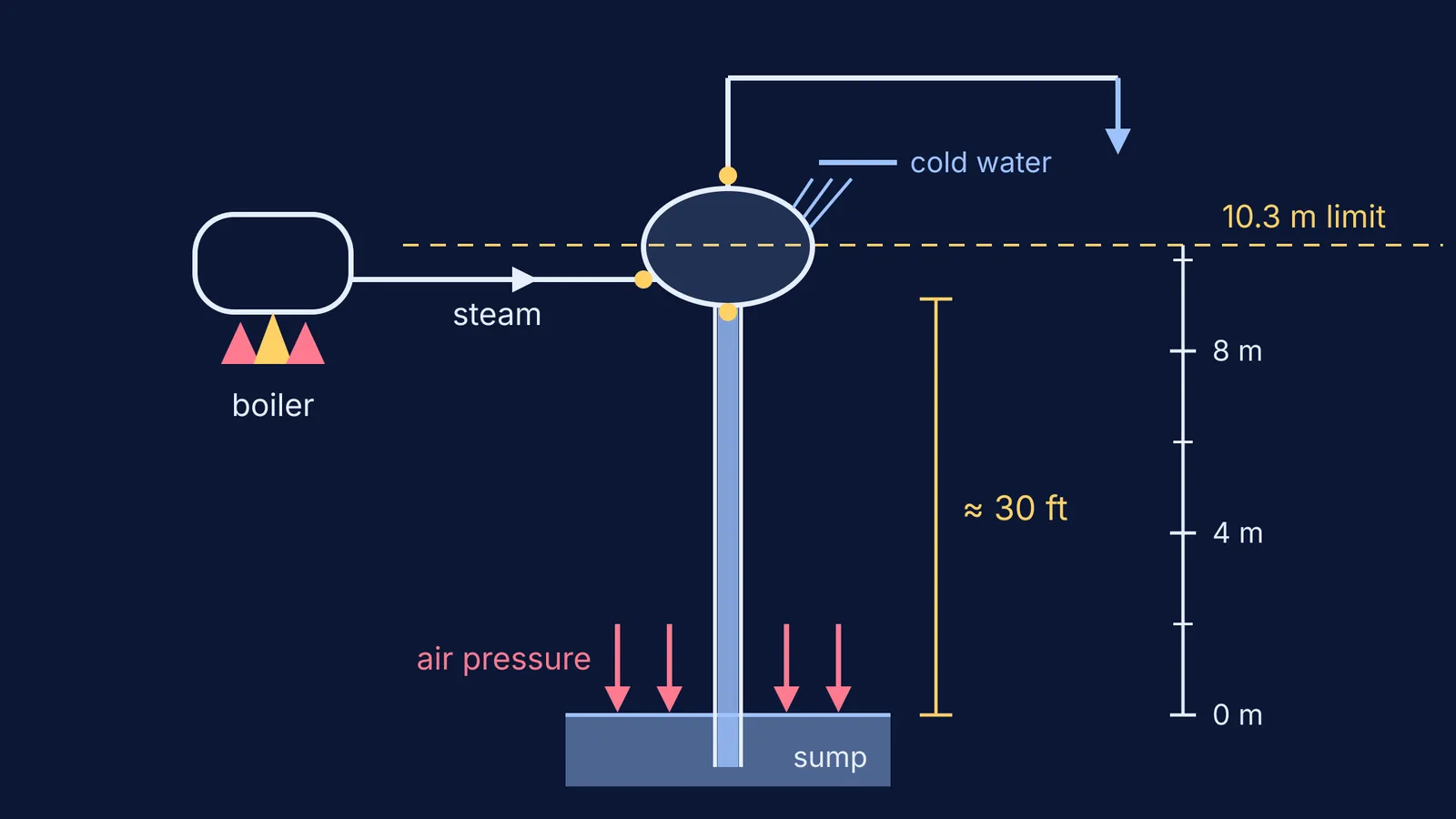
Grace's Guide gives the core of it: steam was let into a sealed container and condensed by cooling the outside with water, and "the vacuum thus created was used to draw water from the sump" (Grace's Guide: Newcomen Engine). One cycle, step by step:
Steam from the boiler fills a closed vessel and drives the air out.
The steam valve shuts and cold water is poured over the outside of the vessel.
The steam condenses into a little liquid water, which takes up far less space, so the pressure inside drops well below the air outside.
A valve to the suction pipe opens. The atmosphere, pressing on the water in the sump, pushes water up the pipe and into the vessel.
That valve shuts, steam is let in again, and it presses on the water's surface, forcing it up a delivery pipe.
It is the same physics as how a drinking straw works.
Why could Savery's pump only lift water about 30 feet?
The lift into the vessel was "limited by atmospheric pressure to about thirty feet" (Grace's Guide: Newcomen Engine).
Worked example. Even a perfect vacuum can only hold up a water column whose weight per square metre equals air pressure, so h = P ÷ (ρg).
Standard atmospheric pressure is exactly 101,325 Pa (NIST).
Standard gravity is 9.80665 m/s² (NIST).
Water's density is about 1 g/cm³, or 1,000 kg/m³ (USGS).
So h = 101,325 ÷ (1,000 × 9.80665) ≈ 10.3 m, about 34 feet.
Savery's vacuum was never perfect, so his practical figure of about 30 feet sat below that ceiling. It is the same number behind why a water barometer would be 10 metres tall.
Now the push. To force water a further 20 m up the delivery pipe, steam must exceed air pressure by ρgh = 1,000 × 9.80665 × 20 ≈ 196,000 Pa, almost two extra atmospheres. That is why deep lifts meant high-pressure steam, and why Savery's soldered joints needed frequent repair (Wikipedia).
Why did Newcomen's engine replace Savery's pump?
Thomas Newcomen's first successful engine, at Conygree near Dudley in 1712, kept the condensing trick but put it under a piston in an open-topped cylinder (Grace's Guide: Newcomen Engine). It worked purely by atmospheric pressure, so it avoided the dangers of high-pressure steam (Wikipedia). Savery's broad patent covered all pumps that raised water by fire, so Newcomen operated under it, "since its term was much longer than any Newcomen could have easily obtained" (Grace's Guide: Newcomen Engine). Read how that machine moved in Thomas Newcomen's 1712 atmospheric engine.
How can you use Savery's pump to revise pressure?
Try this short check:
Draw the five steps above as five boxes. In each, mark which side of every open valve has the higher pressure.
Redo the worked example for a pump on a hill where air pressure is 70,000 Pa. (You should get about 7.1 m.)
Explain in two sentences, without the word "suck", why the water rises.
Work out the steam pressure needed to push water 30 m above the vessel.
If step 1 is where you get stuck, it can help to watch pressure change rather than read about it; the Fermi Simulation Lab has interactive simulations for ideas that are easier to see than to read. For steps 2 and 4, the Fermi Problem Library has worked problems with a step-by-step solver that explains the reasoning rather than printing an answer.
Next time you see a straw, a syringe or a crushed can, you are looking at the same push Savery used to drain a mine.


