

On this page
When you sip through a straw, it feels as if you are pulling the drink up. Physics says otherwise. Your cheeks and tongue make the space inside your mouth bigger, so the air in there spreads out and its pressure drops a little. Outside, air still presses on the drink's surface. That outside push, not your sucking, is what drives the liquid up the straw.
How does drinking with a straw work?
Follow the pressure from the open surface of the drink to the top of the liquid in your mouth.
The open surface of the drink touches the air, so it is at atmospheric pressure. Standard atmospheric pressure is defined as exactly 101,325 Pa, according to NIST's reference table of physical constants.
In a still liquid, points at the same level have the same pressure. So the liquid inside the straw, level with the surface in the glass, is also at atmospheric pressure.
Going up the column by a height h, the pressure falls by ρgh, where ρ is the liquid's density and g is the acceleration due to gravity.
The column stops rising when the pressure at its top equals the pressure in your mouth: P(mouth) = P(atm) − ρgh. In words, you have to lower the pressure in your mouth by ρgh to raise the liquid by h.
This also explains a straw with a split above the drink. Air leaks in through the gap, the pressure in your mouth can't fall, and nothing rises.
How much do you actually lower the pressure?
Less than you would guess. Take water, with a density of about 1,000 kg per cubic metre (the USGS Water Science School gives 0.9998395 g/ml at 4 °C), and Earth's surface gravity of 9.80 m/s², the value on NASA's planetary fact sheet.
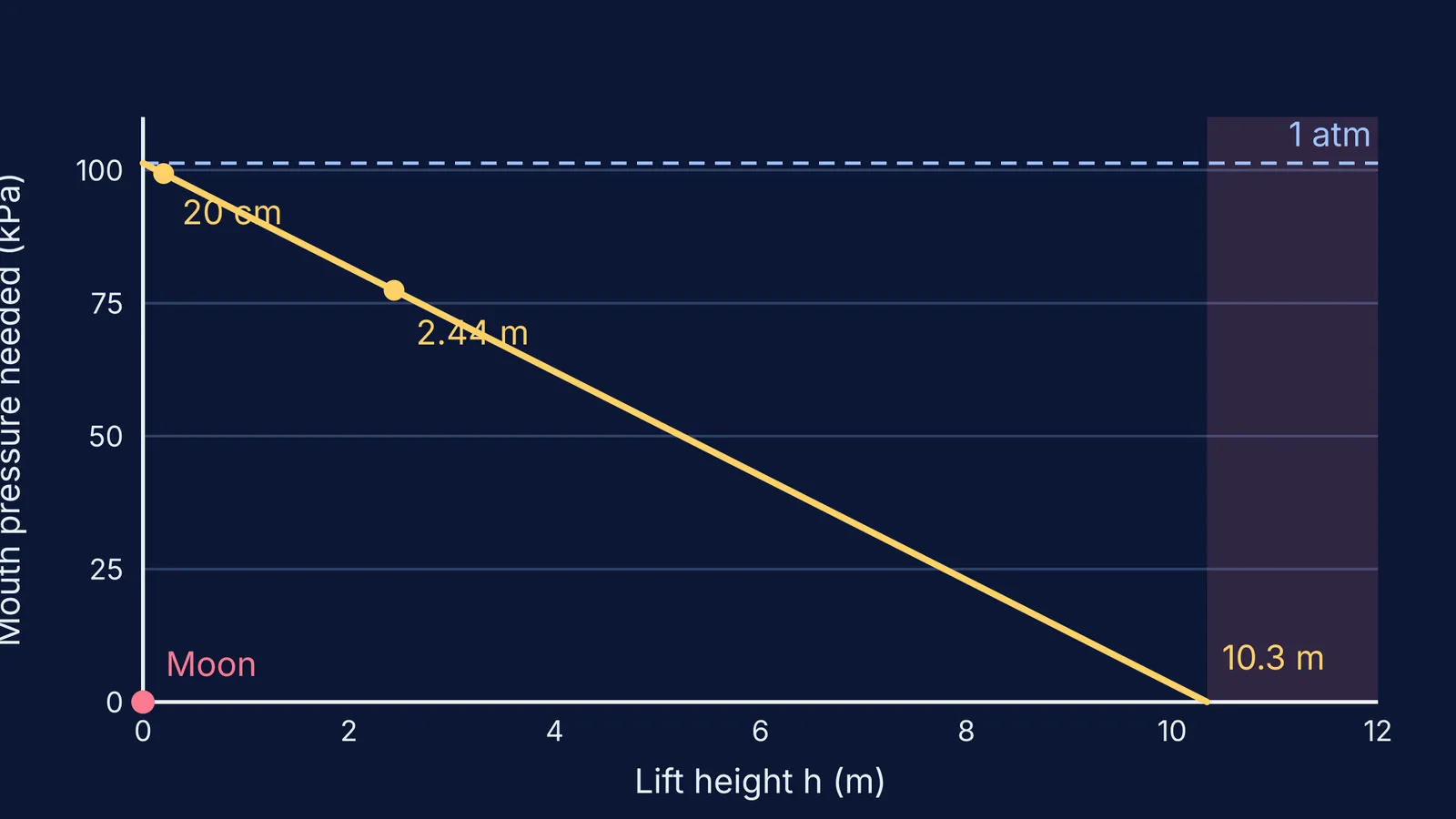
Worked example 1: an ordinary glass. The top of the column sits 20 cm above the drink's surface.
Pressure drop needed: ρgh = 1,000 × 9.80 × 0.20 = 1,960 Pa.
Pressure in your mouth: 101,325 − 1,960 = 99,365 Pa.
That is only about 1.9% below the air outside.
Worked example 2: a very long straw. A Science Buddies activity published by Scientific American says some people will have difficulty with a three-foot straw while others can drink standing eight feet above their drink. Eight feet is 2.44 m.
Pressure drop needed: 1,000 × 9.80 × 2.44 ≈ 23,900 Pa.
That is roughly a quarter of atmospheric pressure, which is why it is hard work.
Why can't a straw lift water higher than about 10 m?
Suppose you could remove every bit of air from your mouth, so P(mouth) = 0. The column can then rise only until ρgh equals atmospheric pressure.
Using the NIST value of 101,325 Pa and g = 9.80 m/s² from NASA's fact sheet, the maximum height is h = 101,325 ÷ (1,000 × 9.80) ≈ 10.3 m. The Scientific American activity gives a rounder figure of about 30 feet, and notes that a complete vacuum in the human mouth is not possible, so real people stop far lower.
This is the same ceiling that limited suction pumps, and it is why Evangelista Torricelli used much denser mercury for the first barometer. If you want more practice with ρgh, try these hydrostatic pressure and gauge pressure problems.
Why doesn't a straw work on the Moon?
NASA's Moon fact sheet lists a surface gravity of 1.62 m/s² and a night-time surface pressure of about 3 × 10⁻¹⁵ bar, which is 3 × 10⁻¹⁰ Pa.
Put that into the same formula: h = 3 × 10⁻¹⁰ ÷ (1,000 × 1.62) ≈ 2 × 10⁻¹³ m. With almost no air outside, there is nothing to push the drink up.
Now flip it. In a sealed base kept at one standard atmosphere, a straw would work better than on Earth: h = 101,325 ÷ (1,000 × 1.62) ≈ 62.5 m. The air pushes just as hard, but the column is lighter.
A five-step check for any straw or suction question
Find the free surface that touches the air. Its pressure is the outside pressure, not always 1 atm.
Measure h from that surface to the top of the liquid column, not along the straw's length.
Write P(top) = P(surface) − ρgh, with every pressure in pascals.
Check that h is less than P(surface) ÷ ρg. If it is not, the liquid cannot get there.
Watch for sealed containers. In a bottle sealed around the straw, the trapped air expands as you drink, its pressure falls, and sipping soon stops.
If you keep measuring h from the wrong place or flipping the sign, the Fermi Problem Library has worked problems with a step-by-step solver that explains the reasoning rather than printing an answer. To revise the ideas behind it, the Fermi Concept Library gives each physics concept its own lesson and its place in the map.
For the story of the air pump that first made a vacuum, read about Otto von Guericke and the Magdeburg hemispheres.


