

On this page
Thomas Risley Odhiambo (1931–2003) was a Kenyan entomologist who changed how science was done in Africa. In 1970, he founded the International Centre of Insect Physiology and Ecology (ICIPE) in Nairobi.
Rather than relying on foreign experts to solve local problems, Odhiambo built a research centre where African scientists could study the insects that ruined crops and spread diseases. Today, ICIPE is a world-renowned institution that develops safe, biological ways to manage pests.
Who was Thomas Odhiambo?
Thomas Odhiambo was born in Mombasa, Kenya, in 1931. He studied at Makerere University in Uganda before moving to Cambridge University for his PhD.
At Cambridge, Odhiambo worked under Vincent Wigglesworth, a pioneer in insect physiology. Odhiambo studied the reproductive physiology of the desert locust (*Schistocerca gregaria*). His research was so productive that he published 14 papers from his thesis work alone, detailing how hormones control locust reproduction 1.
Despite his success in the UK, Odhiambo wanted to return home. He believed that African scientists needed to lead the research on African problems. In a 1967 article in the journal *Science*, he argued that post-colonial Africa should concentrate its limited resources into specialised "centres of excellence" 2.
What does ICIPE stand for?
ICIPE stands for the International Centre of Insect Physiology and Ecology.
Odhiambo founded the centre in 1970 with support from the American chemist Carl Djerassi and over 20 national academies of science 1. It began in a rented garage at the University of Nairobi that often flooded. Today, it has a sprawling campus and hundreds of staff 1.
The centre focuses on finding biological and environmentally safe ways to control insects, rather than relying heavily on synthetic chemical pesticides.
Why was ICIPE founded in Africa?
Odhiambo founded ICIPE to study the specific insect pests and disease vectors that affect Africa. Insects have a massive impact on the continent: mosquitoes spread malaria, tsetse flies carry sleeping sickness, and locusts destroy crops. Vector-borne diseases are a global challenge, much like the insect carrier of Chagas disease in the Americas.
Odhiambo's vision of holistic science became the foundation for ICIPE's "4Hs" paradigm 1:
Human Health: Controlling vectors that spread human diseases, such as mosquitoes.
Animal Health: Managing pests like the tsetse fly, which affects livestock and limits milk and meat production.
Plant Health: Developing sustainable pest management for crops.
Environmental Health: Protecting beneficial insects like bees and promoting biodiversity.
If you are studying biology or agriculture, understanding the life cycles of insects is a core part of the syllabus. The Fermi Concept Library contains every concept in biology, each with its own lesson and its place in the map, so you can see how these systems connect.
How does biological pest control work?
Instead of spraying synthetic chemicals, ICIPE researchers look for biological relationships to manage pests. Here is how they approach the problem:
Identify the pest and its life cycle: Understand when the insect is most vulnerable (as an egg, larva, or adult).
Find a natural enemy: Look for predators, parasites, or pathogens that naturally kill the pest. Understanding these survival interactions is as crucial as studying how butterflies copy others to evade predators.
Use chemical ecology: Study the pheromones and plant chemicals that attract or repel the insect, building on the basic principles of how flowers recruit insects.
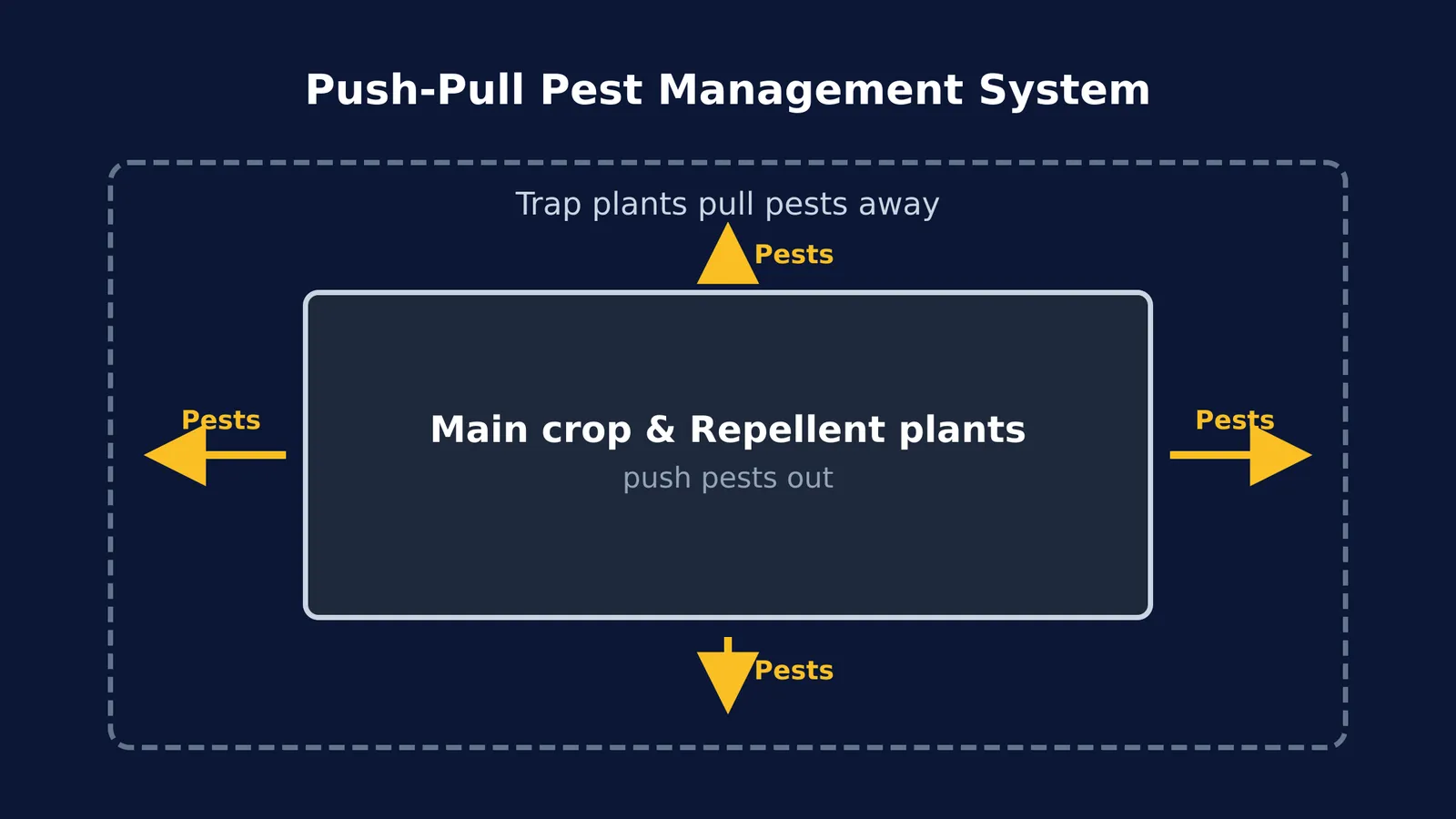
Design a sustainable system: Combine these factors into a farming method, like the "push-pull" system, where trap plants pull pests away from crops and repellent plants push them out.
For students aiming for a career in science, Odhiambo's life is a reminder that the best research often comes from understanding your own environment. If you are preparing for exams and need to map out your study sessions, Fermi's AI tutor can work out what you already know and builds a plan for the session, so you sit down to a clear next step.
When Odhiambo started ICIPE, he had a simple philosophy: "The idea was actually very simple, get the very best people and then if you have more money, put buildings and equipment around them" 1. That focus on people changed the landscape of African science.


