On this page
Thanu Padmanabhan, known to colleagues as Paddy, spent four decades asking what gravity really is. His answer: gravity may not be a fundamental force at all, but what you see when you zoom out from vast numbers of unknown "atoms of spacetime", the way pressure appears when you zoom out from molecules.
Who was Thanu Padmanabhan?
According to a biography by his colleagues and former students, he was born on 10 March 1957 in Trivandrum, Kerala, won gold medals for his BSc and MSc there, and joined the Tata Institute of Fundamental Research (TIFR) in Mumbai as a PhD student in 1979, finishing a PhD in quantum cosmology in 1983. The same biography says he published more than 300 research articles, wrote ten technical and popular books, and mentored nearly thirty PhD students and postdoctoral fellows.
The International Astronomical Union's obituary records that he moved from TIFR to IUCAA in Pune in 1992 and died there on 17 September 2021. His awards included the Shanti Swarup Bhatnagar Award (1996), the Padma Shri (2007) and the Infosys Prize in Physical Sciences (2009). For IUCAA's story, see our post on Jayant Narlikar and cosmology in India.
What does it mean to say gravity is thermodynamic?
You can describe a gas with pressure, volume and temperature without ever seeing a molecule. But the fact that a gas has a temperature at all is a clue that it is made of many moving parts. That was the insight of statistical mechanics, which we cover in our post on Ludwig Boltzmann, probability and entropy.
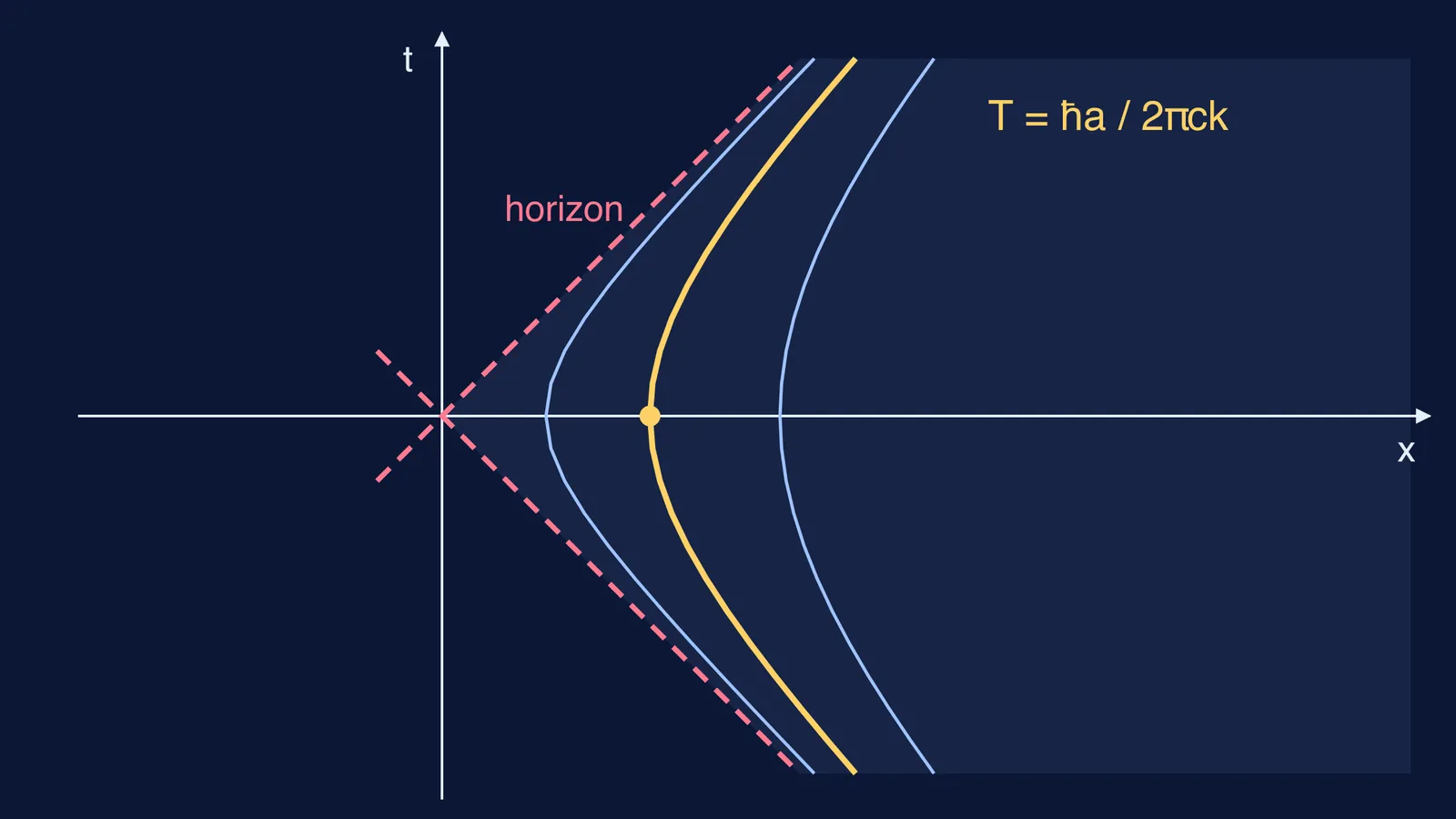
Now the twist. Horizons, the surfaces beyond which you cannot see, also have a temperature. Black holes glow faintly, as explained in our post on Stephen Hawking and why black holes are not completely black. And in 1976 William Unruh showed in Physical Review D that an observer accelerating through empty space also has a horizon and detects a temperature.
Padmanabhan took this seriously. If spacetime can be hot, perhaps it too has microscopic parts. Three of his results show the idea:
In a 2002 paper in Classical and Quantum Gravity, he showed that Einstein's equations near a horizon in spherically symmetric spacetimes take the form TdS - dE = PdV, the first law of thermodynamics.
In a 2010 paper in Modern Physics Letters A, he reinterpreted gravity as an equipartition law, E = (1/2) N kT, where N counts microscopic degrees of freedom on a horizon. He noted that the idea extends to non-relativistic gravity.
In a 2012 paper, he proposed that the expansion of the universe is driven by the difference between degrees of freedom on a surface and inside it, through dV/dt = N(sur) - N(bulk).
Ted Jacobson had earlier derived Einstein's equation from dQ = TdS and horizon entropy proportional to area, in 1995. Padmanabhan gathered his approach in a review, Thermodynamical aspects of gravity: new insights, in Reports on Progress in Physics (2010).
Read it as a research programme, not settled physics.
How hot does empty space look to an accelerating observer?
The one quantum ingredient Padmanabhan's approach needs, as his 2011 paper notes, is the Davies-Unruh temperature of a horizon. The formula is T = ħa / (2πck), where k is Boltzmann's constant (Unruh effect summary). Try it for an acceleration equal to Earth's gravity:
Write the values: ħ = 1.055 × 10^-34 J s, a = 9.81 m/s², c = 3.00 × 10^8 m/s, k = 1.381 × 10^-23 J/K.
Check units first: J s × m/s² ÷ (m/s) gives joules, and joules ÷ (J/K) gives kelvin. Good.
Numerator: 1.055 × 10^-34 × 9.81 = 1.035 × 10^-33.
Denominator: 2π × 3.00 × 10^8 × 1.381 × 10^-23 = 2.603 × 10^-14.
Divide: T ≈ 4.0 × 10^-20 K.
That matches the published figure of about 4 × 10^-20 K. Reaching 1 K would take about 2.47 × 10^20 m/s². Far too small to notice, yet in Padmanabhan's picture it is the thread tying gravity to heat.
If entropy or temperature feels shaky, the Fermi Concept Library gives every physics concept its own lesson, so you can fill the gap before going further.
Which Padmanabhan books should a student read?
He also wrote for students and the general public. The biography describes work for different stages:
Story of Physics, a comic-strip serial in Science Age, later published as a book and translated into several Indian regional languages for school children.
Dawn of Science, a 24-part serial in the science journal Resonance.
After the First Three Minutes (Cambridge University Press, 2000), a popular book on cosmology.
Sleeping Beauties in Theoretical Physics (Springer, 2015), 26 insights from Newtonian mechanics to quantum field theory, including puzzles absent from standard textbooks, for readers with undergraduate physics. Its preface opens: "Theoretical physics is fun."
Gravitation (Cambridge University Press, 2010), his technical textbook on general relativity.
A simple plan: read Story of Physics or After the First Three Minutes now, note the questions it raises, and save Sleeping Beauties for after some college physics.